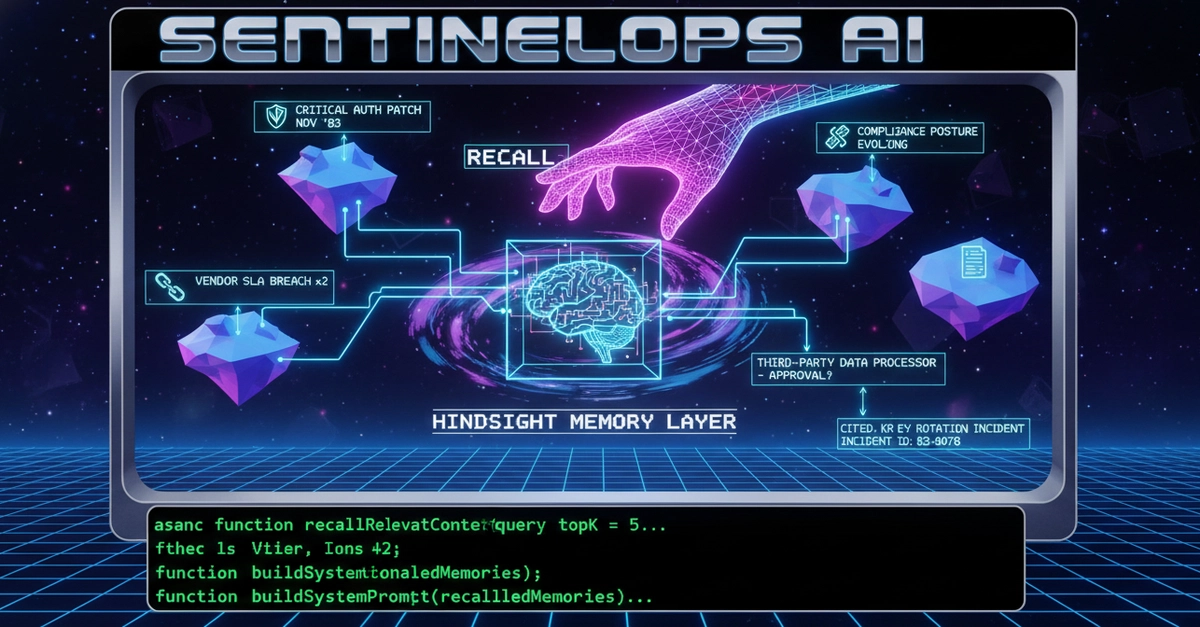
The first time the system surfaced a past incident on its own—without being asked—I had to double-check that I hadn't hard-coded it. I hadn't. The Hindsight memory layer had retrieved it from a similarity search against our vector store, and the AI had cited it as supporting context in its recommendation. That's the moment I understood why stateless LLMs are the wrong default for operational systems.
Here's how we built persistent organizational memory into SentinelOps AI, and what it actually changes about how the system behaves.
Why LLM Statelessness Is an Operational Problem
Every LLM interaction, by default, starts from zero. The model doesn't remember that your team patched a critical auth vulnerability last November. It doesn't know that a particular vendor's SLA has been breached twice. It has no concept of your organization's evolving compliance posture.
For a consumer chatbot, this is fine. For an enterprise decision intelligence platform—one where operators are asking questions like "should we approve this third-party data processor?"—statelessness is a real failure mode. You end up relitigating the same decisions. You miss pattern recognition across incidents. Institutional knowledge lives in chat logs nobody reads.