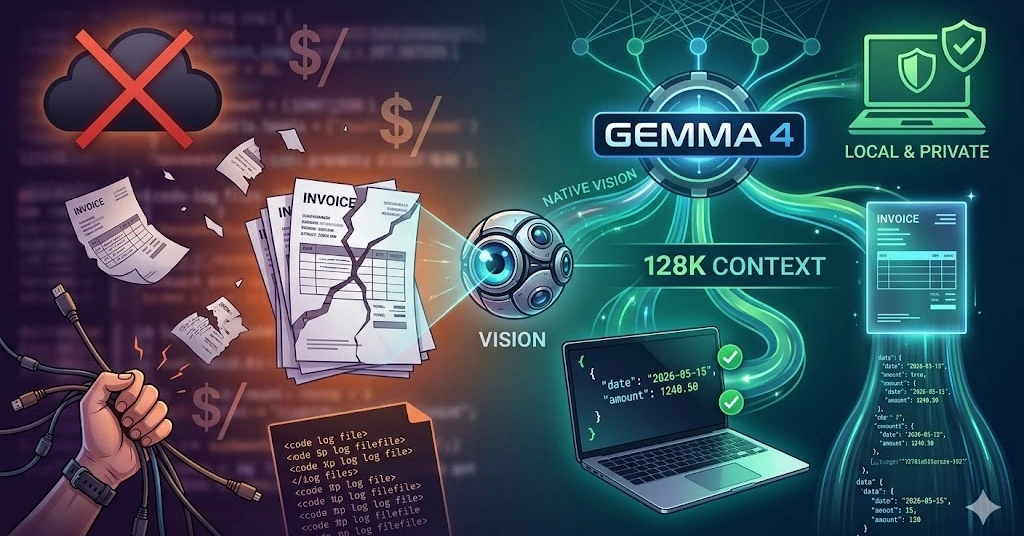
Two months ago, I was stuck in the same fragmented workflow most developers still accept: paying $50/month for OCR APIs, aggressively chunking logs for RAG, and stitching together multiple AI services just to get basic work done. Gemma 4 didn’t just replace parts of that stack — it made the entire fragmented approach feel obsolete.
This is my submission for the "Write about Gemma 4" track.
Two months ago, I was doing what most developers still do: maintaining complex RAG pipelines, managing brittle document transformations, and chopping files into tiny pieces because local models couldn't handle real-world scale.
Today, I default to Gemma 4 running locally for most of my diagnostic and automation workflows. Not because it beats every closed cloud model on massive hyper-specific leaderboards, but because it finally makes coherent, private, and simple intelligence practical on consumer hardware.
The Two Problems That Defined My Old Workflow