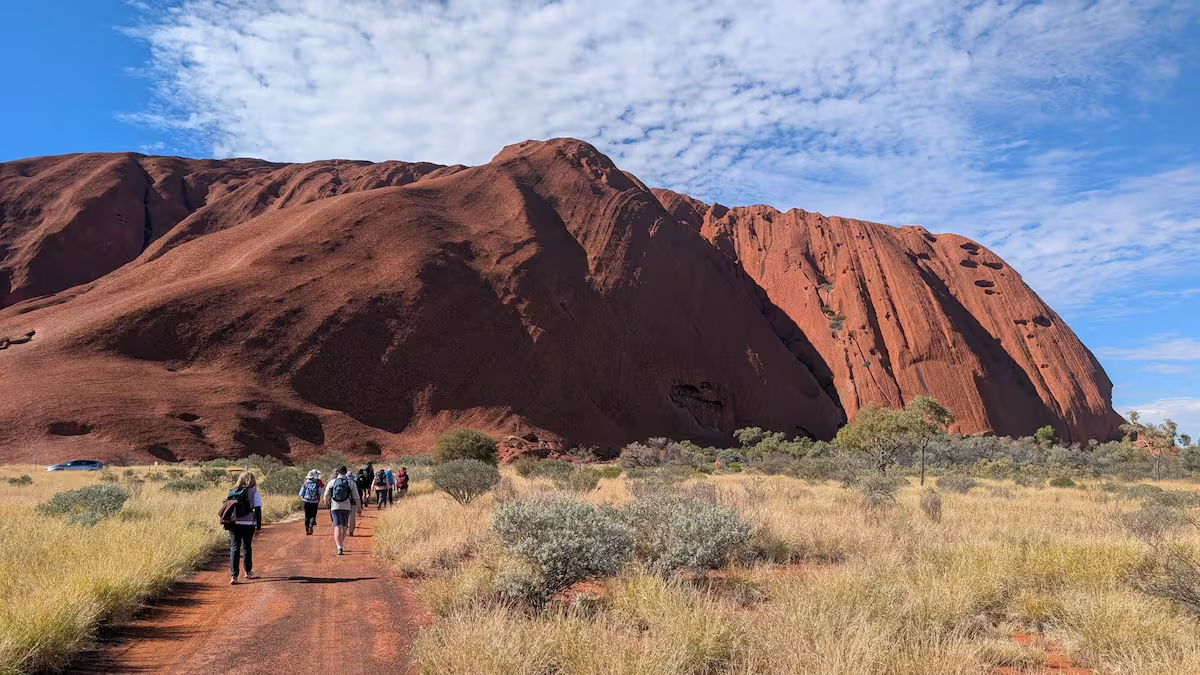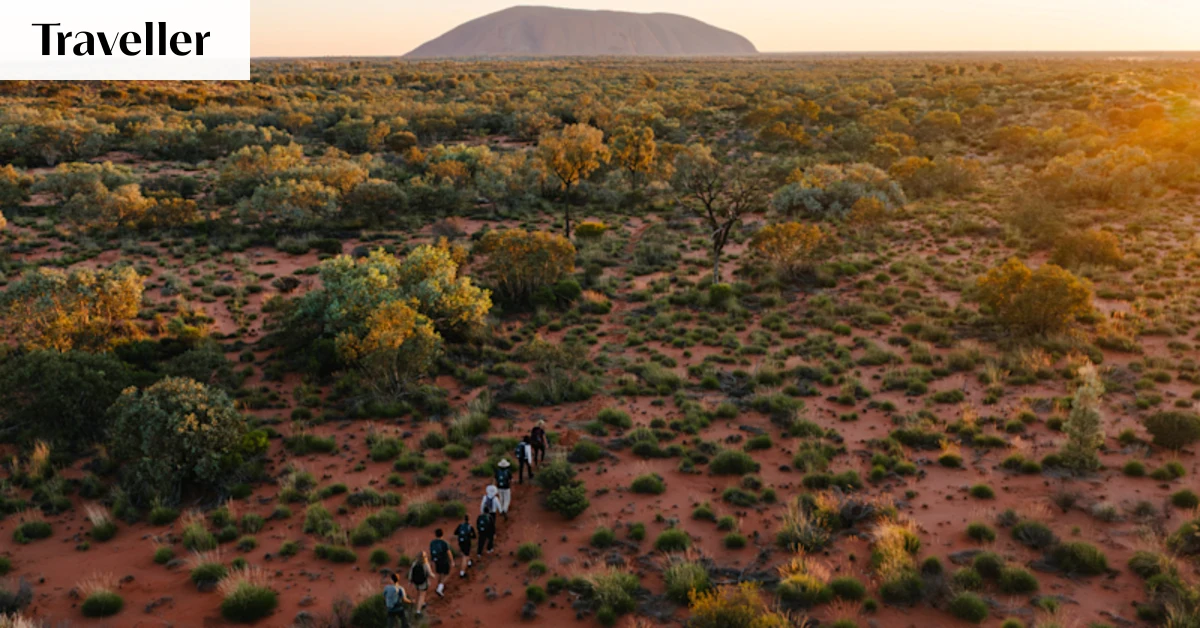
At dawn, alongside the Thermos coffee from my daypack, our group is alone on a desert dune, the unmistakable outline of Uluru in the distance.The chatter falls away as an inky sky brightens to blue before golden light spreads, eventually hitting our faces, as guide Rory Oates wonders out loud if we might take a moment to watch the sunrise in silence.In between scalding sips, the blanket of cloud turns an intense pinkish-red almost matching the colour of the sand underneath our boots.The simple wonder of watching the world wake up raises my heart rate, and it’s not just the caffeine kicking in.I was not hallucinating; a meteorologist confirms later that the altocumulus cloud is known for giving spectacular sunrises and sunsets when other conditions are right.Days earlier on our descent into Ayers Rock Airport, the pilot’s gentle turns to align with the runway also afforded impressive views of both Uluru and Kata Tjuta. The first-time visitor seated next to me gasped.Sign up for the Traveller Deals newsletterGet exclusive travel deals delivered straight to your inbox. Sign up now.Now I’m walking between the two on Tasmania Walking Company’s new five-day, 54-kilometre Uluru Kakararra Trail, or “going east” in Pitjantjatjara, on a path that most will only see from the air.The walk, 10 years in the making, is on land of the Anangu traditional owners, jointly managed with Parks Australia, and includes 38 kilometres of fresh track.Each night we will arrive at a camp of creature comforts that defy the degrees of difficulty involved to establish such havens in the remote Central Desert.More than the bamboo and cotton bedding, common threads at each camp provide a sense of the familiar; rechargeable lanterns that throw soft light; wool rugs for cold nights; and the aforementioned coffee from an Alice Springs roaster.At the end of every day showers are hot and aperitifs are served as dinner is prepared for you in the open kitchen, structures built off site and helicoptered into position.And in five short days I quickly learn that far from the barren trope, the desert pulsates with life on land that Anangu have been walking for at least 30,000 years. DAY 1: IN THE VALLEYKata Tjuta to Tjakura Camp, 7kmAs far as global icons go, the Northern Territory’s Uluru must be among the most recognisable landmarksIt attracts about 250,000 visitors annually, all keen to stand in the imposing shadows of the sandstone monolith.My first visit as a child on a 70s-style adventure sticks in my memory. Our family of five caught the original Ghan from Adelaide and our aquamarine Holden Kingswood was craned off the train in Alice Springs. Driving unsealed roads to Uluru, we slept in the back and marvelled at its dramatic sunrise and sunset hues.The 54-kilometre hike between Kata Tjuta and Uluru includes 38 kilometres of new trail.Michael PetersToday, we’re staring up at the steep domes of the no-less-dramatic Kata Tjuta, meaning “many heads”.Before we go across the country, we must go up. And down. In the Valley of the Winds trail we’re dwarfed by the conglomerate rust-red domes, its highest 500-plus metres (Uluru stands at 348 metres).What sounds like rushing water is, in fact, the low roar of the wind between the gaps, the water table in fact lies 25 metres below ground.From the Karu lookout to the valley beyond, I pause for water and a moment of futile regret for failing to do the pistol squats (Google it) that were recommended as part of this walk’s preparation.Red-sand hiking. We fuelled up earlier with custard tarts and time with traditional owner Tjiangu (TJ) Thomas, scratching the surface of the world’s longest continuous living culture.It’s based on Tjukurpa, pronounced “chook-orr-pa” when the world was created by ancestral beings. Tjukuritja “chook-a-richa” is the physical evidence, in places such as Uluru and Kata Tjuta.It forms the pillars of Anangnu belief and laws, its people and its land, says the Alatji Tours owner, who has recently returned to his Mutijulu community from South Australia to raise his young family.“In my mind it’s everything,” he says.“If you look after these three things you’re going to have a healthy people, healthy country and strong law,” he says.The sharing of Indigenous knowledge is a feature of the walk.Michael PetersStories and lessons from this period are passed down through oral culture; we will be told some.Others come with cultural obligations and are permitted to be told and heard by certain Anangu.Today TJ starts us off with “palya” which works as a hello, goodbye, thank you or welcome.“It’s a good word to know because it’s pretty versatile,” he says. ″We want you to come here and experience our culture and then experience it with others.”At Tjakura Camp, neat rows of tents on platforms are spaced apart and Kata Tjuta stares back from the distance.At a long table sitting in red sand we dine under the stars serenaded by crickets.Weary, I stumble, not into tent pegs or camp chairs, but a bed more at home in a hotel rather than my canvas digs. The cool desert breeze that flows through the open sides that night is the ultimate luxury.Among mulga and desert oak the tented camps come with creature comforts.Michael PetersThe realisation of the Uluru Kakararra Trail started a decade ago for the Tasmanian Walking Company and more specifically co-owner Brett Godfrey after he walked more than 150 kilometres with traditional owners from the South Australian border, ending in Uluru.“It was a bit of a slog because we did 25 kilometres a day, but it was amazing, and I left here changed,” Godfrey says.In response to the end of the Uluru climb in 2019, there were calls for experiences that focused on connecting rather conquering Country, according to Godfrey. He proposed the walk across land handed back to the Anangu Traditional Owners in 1985 that is jointly managed with Parks Australia and is also World-Heritage listed.The trail and its low-impact structures, both developed in close partnership with Anangu, closely resemble Godfrey’s initial idea about bringing walkers to this unique part of the country in a project that cost $25 million.“Aspects of it may have been moved a kilometre here or there but on the whole this would be what we wanted.”Walkers sleep under the stars in a bed that’s more at home in a hotel.DAY 2: WALKING UNDER STARSSouthern Kata Tjuta Dune traverse to Tali Camp, 16.5kmWitnessing that unforgettable dune sunrise required a 5.15am departure and a purposeful pace, book-ended by guides Joe Hammond and Marie-Charlotte Redot, who kept in regular radio contact with each other, to keep the group tight and on the fresh trail.In lockstep and under a roof of stars, headtorches illuminate the distinct desert sand of the Red Centre and my fellow hikers’ steps in front.Saturn, Mars and Mercury hang in the sky.Sunrise on the sand dune.Jane ReddyNow as we finish our coffee and breakfast burritos also packed in our daypacks (alongside three litres of water, electrolytes, a grain-based salad, muesli bar and an apple) full daylight reveals the path ahead.Marie-Charlotte points out the stands of desert oaks, the mother surrounded by a ring of juveniles which are growing close – but not too close – to ensure they receive necessary nutrients.The landscape is as varied as the colours of the desert, verdant after a recent March deluge when two days of rain made up three times Uluru’s monthly average for that time of year.We’re surrounded by low puffs of spinifex grass and rows of the fragrant desert heath myrtle or pukara, a small woody shrub with white flowers.Lunch is at a wiltja (shelter), a purpose-built platform under shade (with a flushing toilet nearby). We also have multiple water stops along the way to take in desert life.There are the long flowers of the honey grevillea with a honey-like nectar that can be sucked directly (a treat for Anangu children), and the naked woollybutt that’s ground down to a peanut butter-style paste to make nyuma or seed cakes. There’s also emu bush to make an antiseptic balm.Marie-Charlotte and I are the last to arrive at our second tented camp, so taken by a creeping parakeelya we’ve spotted, its pink stems resembling a healthy finger coral that could be at home on the ocean floor.On the trail.Two things surprise me most on this hike; the amount of energy required to walk across sand that slips away with every step; and the thrill of arrival into a camp knowing there is nothing to be done but to soak in the desert.Kata Tjuta is a powerful presence, visible deckside during a footbath, through the shower window and from the wiltja that houses long lounges and soft rugs to stretch out, snooze or read on.Local ingredients, much of it fresh, is a focus. Tonight it’s a Humpty Doo barramundi curry which goes well with an Alice Springs Brewing Co ale.From the stargazing lookout night sky, guide Altair Alim helps us spot the Indigenous dark emu constellation created by the dark clouds of the Milky Way and spaces between stars.DAY 3: TRACK TALKDesert trails to Mala Lodge (16.5 km) Mala Lodge sits lightly on the sand dunes that look to Uluru.Michael PetersThrough the veil of a sanity-saving fly net, I start to see the desert differently. This morning as we walk towards the early morning, Joe points to tracks of the nocturnal animals who have been here before us.“Anangu would read this land, know where water is, know how to navigate and reading the tracks is another important way that they would hunt and find food,” he says.We spot squiggles, either a small snake or lizard, and the diminutive prints of the spinifex hopping mouse in the ultimate survival story. So efficient are this desert mammal’s kidneys, its urine is excreted as a solid.Passing sweeps of purple flowers and plains of tall spinifex that’s soft to touch, the duckboard signals we’ve made it.A cool plunge at Mala Lodge.Michael PetersDAY 4: BACK TO BASEMala Lodge to Mutitjulu Waterhole (12.3 km)Uluru is close enough now to gaze upon from the two separate wilchas, the plunge tank or through one of the 16 ensuite rooms with floor-to-ceiling windows at Mala Lodge that is the final, stylish stop on this walk.Designed by NT-based Troppo Architects to withstand the desert’s environmental extremes, these structures, like those of its sister camps, are made of Corten steel and are low impact, “floating” on the landscape using a steel plate sure-foot system, no excavation required.Dinner with a view at Mala Lodge. Michael PetersAt the wellness pavilion, Olivia Moneymoon’s “bush medicine” canvas is as soothing as the therapist massaging weary calves, and an imposing sculpture by the noted Tjanmpi Desert Weavers hangs over the main dining table.We meet traditional owner Tjiangu (TJ) Thomas once more at the base of the rock and walk to Mutitjulu Waterhole to hear of the deadly battle that occurred here between ancestral beings Kuniya and Liru.It’s a story about responsibility to family and respecting and following the lore, TJ says.As Rory had said at the start of our journey, “This is more than just a hike.”Five more things to do at Ayers Rock Resort (that don’t require a walk)The modern telling of the devil dog Kurpany story at Wintjiri Wiru.Getty ImagesLight fantasticWintjiri Wiru, meaning “beautiful view out to the horizon” in the local Pitjantjatjara language, is a stunning telling of the ancestral Mala story through choreographed drones, lasers and projections. From $210 (adult) $105 (child).High tea, but make it localBarramundi, lemon aspen saffron tart and wattle seed dark chocolate truffles and finger lime almond tart are on the Native High Tea menu. It’s served with specialty brews from Blak Teas. At Sails in the Desert. From $90.Cultural centreWith views to Uluru the buildings representing two ancestral snakes house Maruku Arts and Walkatjara Art, rich in Anangu art and crafts for sale. There’s an excellent cafe onsite.Get on the busThe Uluru Hop On Hop Off shuttle has a set timetable with pick-up and drop-off points located throughout Yulara Resort and viewing areas within the national park from sunrise to sunset. From $54 (adult), $27 (child, 5-15, infants free).Look to the skyWith the help of telescopes hear Indigenous stories that connect to the night sky. Family friendly. $70 (adult).THE DETAILSFLYJetstar flies daily from Sydney to Ayers Rock Airport between late March and late October; from Melbourne up to five flights a week year-round. See jetstar.comTasmanian Walking Company’s five-day 54 kilometre Uluru-Kata Tjuta Signature Walk on the Uluru Kakararra Trail costs from $5395 a person; the easier four-day 30 kilometre Uluru -Kata Tjuṯa Lodge Walk from $3995. See taswalkingco.com.auMORE ayersrockresort.com.aunorthernterritory.comThe writer travelled as a guest of the Tasmanian Walking Company and Tourism and Events Northern Territory. See taswalkingco.com.au
Australia’s epic new multi-day hike is like no other
With 38 kilometres of new track through previously inaccessible outback, along with hotel-quality overnight stays, this Australian trek is like no other.
2,113 words~10 min read