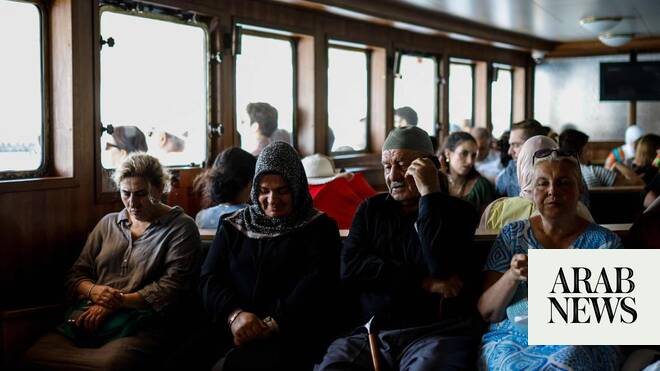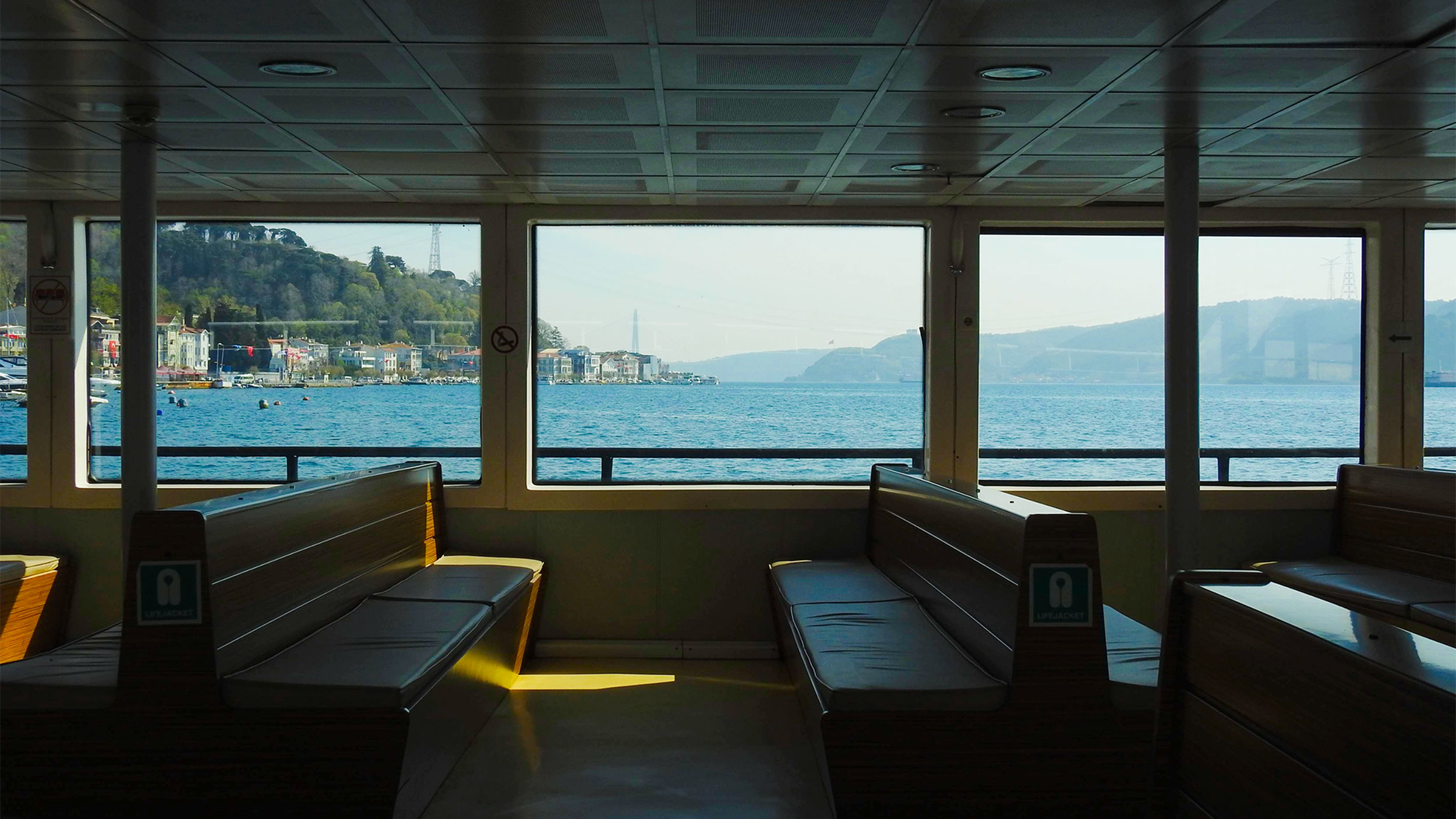
The indoor sitting area that makes up most of the ground floor of the ferry Affet was outfitted with rows of tables and cushioned benches taken up by families, couples and solo travelers chatting, sipping tea or gazing out the expansive windows. The ship holds nearly 300 people; by midday, it was already close to capacity.Elvan, a Turkish resident in her mid-40s visiting Istanbul from another part of the country, sat with a friend near the front of the boat. Though she had been to the city plenty of times before, she said she still feels lucky to be on the water.“It feels like a novel to me,” Elvan said, pointing to a sprawling campus of yellow buildings that stood proudly among cypress and Judas trees, the main building feet from the Bosphorus Strait. The boat was cruising past Galatasaray University, a school with a legacy dating back to the late 1400s.Captain Güngör Mutlu steers the Affet with a cup of tea at his side. Buttons on his navigation panel are customized, including an evil eye amulet in the shape of a heart.Eda Uzunlar/The World“For instance, in that building — the experiences within it, in high schools or palaces, in the mansions,” she added. “Everyone there has a story, even the buildings.”Across from Elvan, a group of older women’s knitting needles flew as they watched the scenery. A few rows back, a younger woman sat with her husband. Originally from Florida, Sahar, who only shared her first name, moved to Istanbul a few years ago. The Bosphorus is part of what sold her on the city.“It is one of the most different places I’ve ever been to,” she said. “It’s a very important part of the entire world. There are always cargo ships, there are military vehicles or ships. It’s a vital part of, not only Turkey, but the whole globe.”Winding through the most active parts of the city, the Bosphorus Strait divides Istanbul across continents. At its widest, the strait is more than two miles across, but this unique geographic separation does little to keep its some 16 million residents and visitors from moving between the European and Asian sides. Instead, the journey across the water is a highlight for many.Celebrating 175 years of service this year, the city-run ferry services report more than 900 trips up, down and across the water every day across 53 piers. Annually, more than 40 million passengers board the ferries. Güngör Mutlu is the captain of the Affet, meaning “forgiveness” in Turkish; according to him, there are days when thousands of people board his boat alone.A temporary installment at the Kadıköy ferry station in Istanbul reads, “şehir hatlar 175 yaşında,” or “city lines are 175 years old,” celebrating the city-run ferry system’s 175th anniversary, April 2026.Eda Uzunlar/The WorldMutlu has been working on boats for 40 years, and though he’s eligible to retire, he said he can’t imagine life without the job. The passengers are a major part of that. “I would really lose my mind. I mean it,” he laughed. “What would I be doing? I’d be stuck at home. Maybe I’d go for a walk, but then I’d come back home. Here, you have a different adventure every day. You see all kinds of people, you meet all kinds of people.”The captain explained that he’s happiest when people on his boat are happy. After decades of working on ferries, he’s taken notice that the boat doesn’t function quite the same as other forms of public transportation.“Let’s say you’re about to get on the subway, and you’re stepping onto the escalator going down. Do you know how awful it looks?” Mutlu said. “Everyone has their cell phones in front of their faces. It’s on the subway, it’s on the bus.”Güngör Mutlu stands aboard a neighboring ferry before departing for his daily route as the captain of the Affet, a ferry serving Istanbul’s city-run ferry lines on the Bosporus Strait.Eda Uzunlar/The WorldWhen passengers board the ferry, the captain explained, their habits change. Passing historic palaces, ornate mansions and swaths of forest, Mutlu said he thinks people are more likely to look up and around at their surroundings. When they do, they’re more likely to strike up conversations, engage with the world around them, or, at the very least, take a breather. “The sea relaxes people,” he said. “There’s peace on the water.”Acting as the main trade artery for Black Sea countries like Ukraine and Russia, data released by Turkey’s Ministry of Transport and Infrastructure and compiled by Anadolu Agency shows that an average of about one hundred ships passed through the Bosphorus every day from January to March of this year. In March alone, about 3,500 ships carrying nearly 60 million tons of cargo passed through the strait. One of the kitchen staff aboard the Affet, a ferry serving Istanbul’s city-run ferry lines, makes a cup of tea for a passenger.Eda Uzunlar/The WorldSimilar activity was bustling inside the ferry. A small but mighty kitchen that acted as the beating heart of the Affet’s entire operation was situated at the front of the boat; behind the counter, kitchen staff Dursun and Arif, who also only shared their first names, were constantly on their feet. As Dursun heated tulip-shaped glasses with near-boiling water before pouring in red-hot tea, Arif prepped a large circular tray with juice, fruit and snacks. The moment the tea hit the tray, he was off to serve, not a drop spilled despite the rocking boat. Later, Arif took a break to cut more fruit behind the kitchen counter. “The people on my regular route know me,” he shared. “They like me, and they know I’m ‘good people.’”Arif started his job on the city’s ferries after years of work on land that were both hard on his body and left him wanting more from his life. Though he’s past the age of retirement, he said he can’t afford to stop working yet, so he may as well work a job that makes his days exciting.“I do this because it’s more fun. I meet new people, and some are great,” he said. “I give directions, I practice different languages. I’m still young.”One of the kitchen staff aboard the Affet, a ferry serving Istanbul’s city-run ferry lines, prepares a hot sandwich made from cheese and Turkish sausage for a passenger.Eda Uzunlar/The WorldOver the course of the day, the Affet made its way down the Bosphorus and back up four times, covering nearly 160 miles in total. At its final stop at the top of the strait, the boat rested in a small neighborhood dock nestled on the Asian side of the city. On the right of the ferry sat a cluster of wooden homes and markets. On the left was a wide expanse of water where the strait gives way to the Black Sea and the cargo routes that run through it.As the boat emptied, passengers, workers and passerby were all on the move, mimicking the water that carried them there.
Tale of a Turkish ferry: A day working on Istanbul’s 175-year-old transport system - The World from PRX
Istanbul’s city-run ferry service reports more than 900 trips up, down and across the Bosphorus Strait every day across 53 piers. Annually, more than 40 million passengers board the ferries. As the city marks 175 years of service, passengers and workers reflect on their experiences.
1,166 words~5 min read