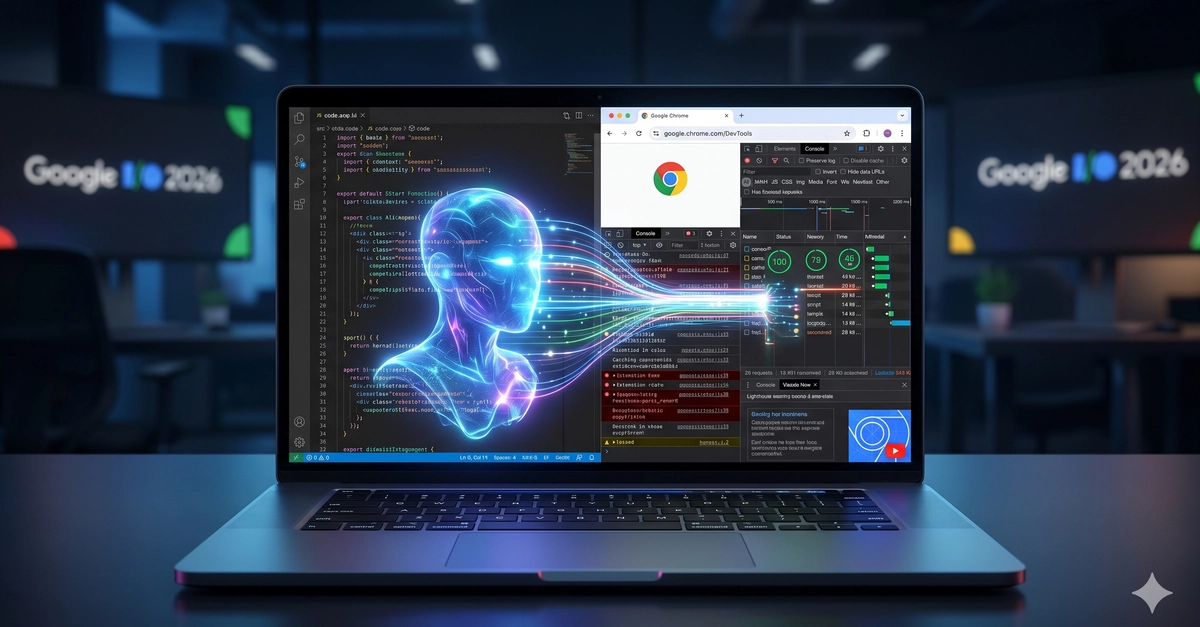
We have spent the last two years acting as high-priced data messengers between our browsers and our LLMs. At Google I/O 2026, Chrome quietly closed that loop, fundamentally changing how software gets built and verified locally.
Every developer who uses an AI coding agent knows this exact feeling.
The agent writes a beautiful new UI component. You pull it into Chrome. It immediately breaks. The console lights up with a wall of angry red text. You copy the stack trace, paste it back into your LLM chat client, explain what went wrong, and ask it to try again. The agent refines the code. It breaks again, just differently this time. You copy that error and paste it back.
You are the messenger. You are carrying runtime execution realities back to a model that is completely isolated from the environment it’s targeting. The model can write code faster than any human in history, but the part that slows everything down is its complete lack of operational visibility.
At Google I/O 2026, Google announced the structural fix for this disconnect. And almost all the mainstream coverage completely missed it.