AFP, KYIV
Four years of brutal Russian attacks have forced millions of Ukrainians to seek safety abroad, but with the war showing no signs of stopping, significant numbers of refugees have started trickling back home, if only temporarily, for one reason: to see their dentist.Those displaced by an onslaught of Russian tanks, drones and missiles have been navigating long journeys home by car, bus or rail for orthodontic work they prefer — or can only get — in Ukraine.“Here in Ukraine, we really appreciate the quality of the medical services, as well as the personalized approach to our daughter,” said Yana Sidko, who left for France in 2022.
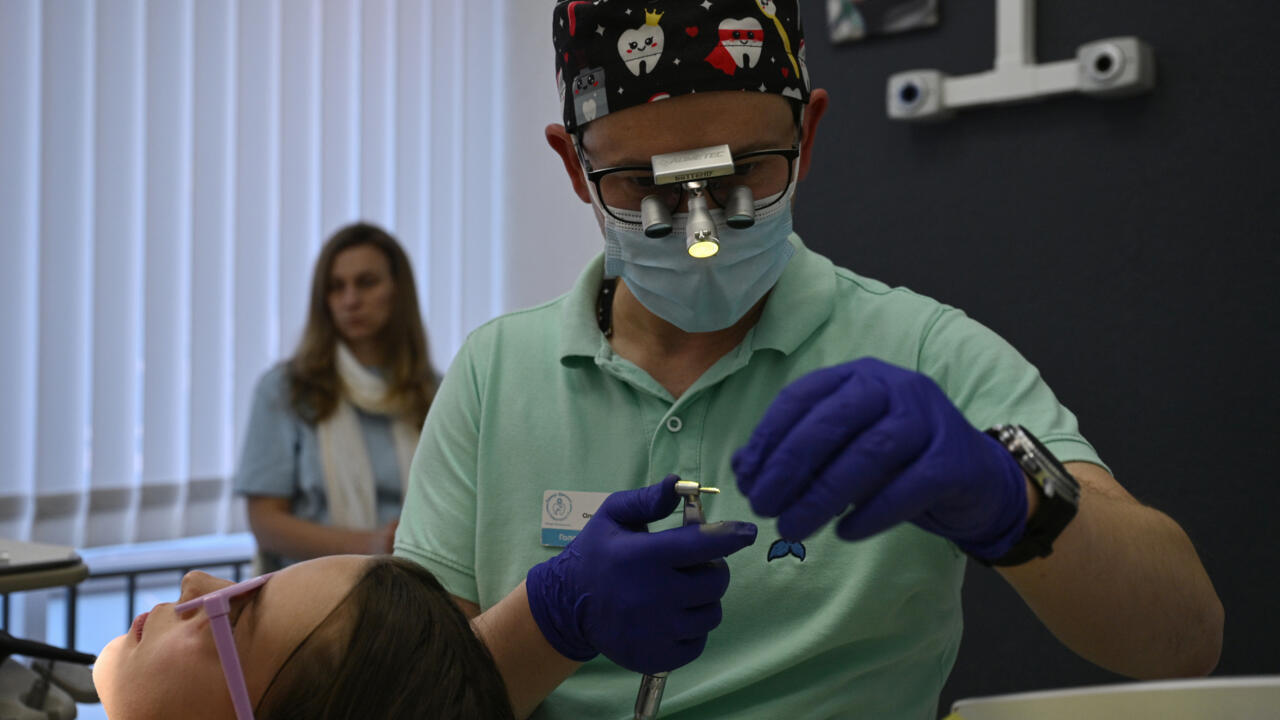
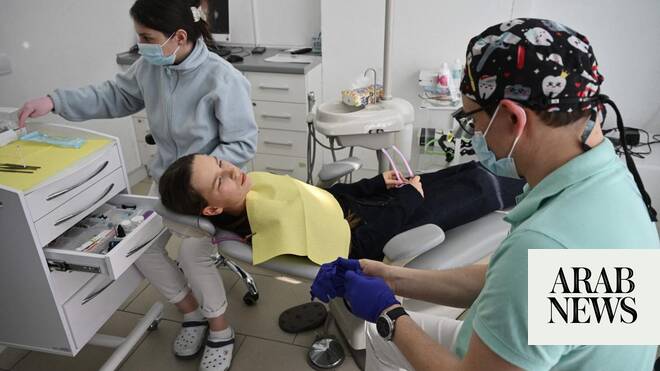
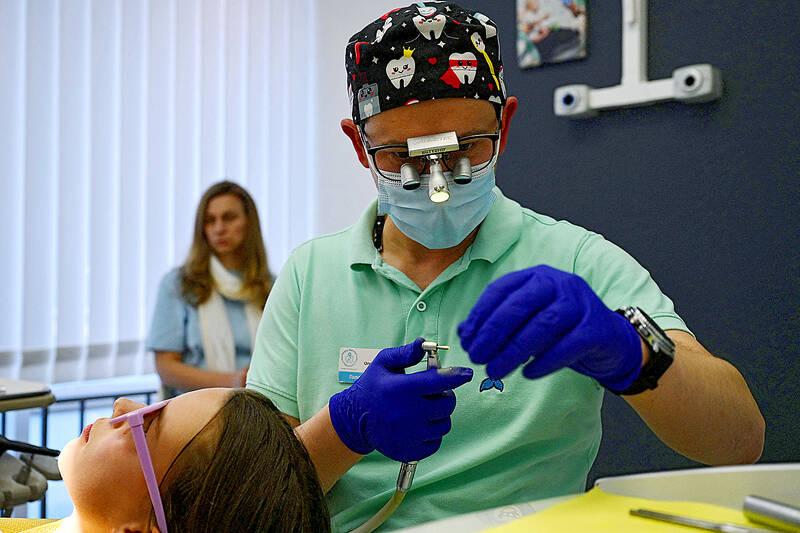
Daryna Sidko, left, receives dental care by dentist Oleg Kovnatskyi, right, at a clinic in Kyiv on April 30.
She made the arduous pilgrimage back to the Ukrainian capital with her 13-year-old daughter for treatment.The country was a dental tourism destination before Russia invaded, with Europeans seeking lower-cost procedures and a broader range of treatment.
Now the vast majority of those coming from abroad are Ukrainians who fled the war, professionals in the industry said.In a pediatric clinic in Kyiv, dentist Oleg Kovnatskyi said that about 20 percent of his patients — 10 to 20 people a month — come from abroad.About 90 percent are Ukrainians, the 39-year-old said.“Whereas previously there were more foreigners ... today it’s our own citizens that left the country following the full-scale invasion, but are now returning,” he said.About 5.7 million Ukrainian refugees are living outside the country — compared with a prewar population of about 40 million.So common is the trend that there is a running joke that dentists could be one of the main catalysts for many to move back permanently — something that would help alleviate a long-running demographic crisis and a deepening labor shortage.Refugees return because dentists are cheaper at home and offer some treatment unavailable everywhere — like the use of sedatives for children — Kovnatskyi said.The lack of a language barrier and that children prefer to see the same dentist on repeat visits are also important factors.“The emotional dimension is essential, as are body language and empathy, and every language has its own nuances,” Kovnatskyi said.“This complexity, made up of linguistic and cultural differences, can be an obstacle that is difficult to overcome,” he added.People often come from abroad for procedures that can take several days, such as X-rays, and magnetic resonance imaging and ultrasound scans.Sidko and her 13-year-old daughter, Daryna Sidko, traveled from France to see Kovnatskyi — their dentist for the past decade.He has a personal touch and takes Daryna Sidko’s sensitivity into consideration, Yana Sidko said.Yana Sidko also schedules her own check-ups during the trips back home.“It reduces my stress and anxiety, and it’s easier to sort things out here, even though the journey is very long and difficult,” the 40-year-old said.She is thinking about returning for good, but only when Russia’s daily drone and missile attacks ebb and the situation in Ukraine is better for her daughter.Kovnatskyi began the visit by replacing one of Daryna Sidko’s old fillings.“It won’t take very long, we just need to remove the old one and put in a new one,” he said.Kovnatskyi played upbeat music and reassured Daryna Sidko as he got to work. When the procedure was over, she chose a toy to take home from the clinic.“People often feel afraid when they don’t know what’s going on,” the teenager said. “When he explains what’s happening, it reduces the fear and you feel in control.”For his part, Kovnatskyi said he would be happy if refugees trickling back home for dental work meant that he and his colleagues had a hand in “bringing Ukraine back to life.”