AFP, SAN FRANCISCO
Chip giant Nvidia Corp on Wednesday posted record quarterly revenue of US$81.6 billion, blowing past Wall Street forecasts as insatiable demand for its artificial intelligence (AI) hardware powered another blockbuster quarter.The results for the first quarter of next fiscal year, ending on April 26, marked an 85 percent jump from the same period a year ago, and a 20 percent rise from the prior quarter, underscoring Nvidia’s status as the primary beneficiary of a global AI infrastructure buildout.Net profit surged to US$58.3 billion, more than tripling from US$18.8 billion in the period a year earlier.
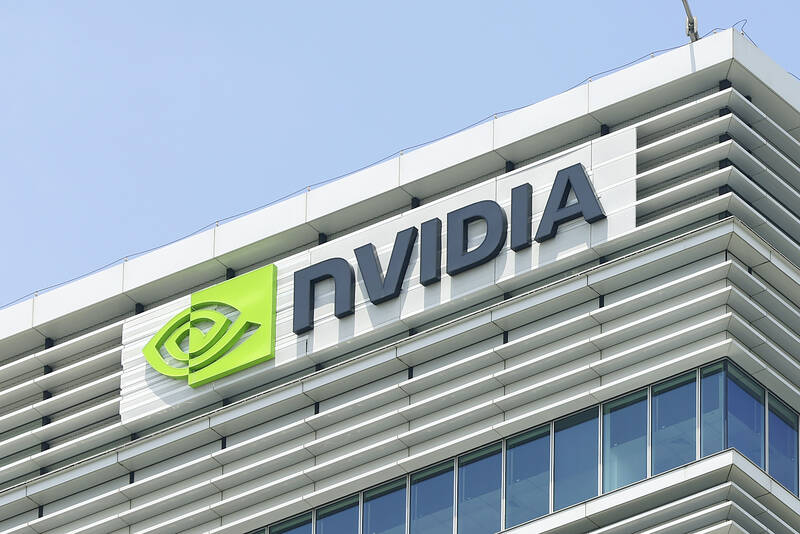
The Nvidia logo is displayed outside the corporation’s headquarters in Taipei on Wednesday.
Nvidia’s data center business, which sells the processors powering AI systems at tech giants and technology companies worldwide, was the engine behind the quarter’s performance.Data center revenue, which includes Nvidia’s key graphics processing units (GPUs), hit a record US$75.2 billion, up 92 percent from a year ago.
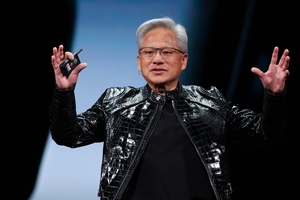
A GPU is a specialized computer chip originally designed to render video game graphics at high speed, but Nvidia has since made it the engine powering AI.That pivot has made Nvidia the world’s most valuable company, on the back of huge demand for its AI hardware.For the current quarter, Nvidia projected revenue of US$91 billion, representing a further acceleration in growth.Crucially, Nvidia said it was not assuming any data center revenue from China in its outlook, where its core product has been caught up in a geopolitical dispute between Beijing and Washington.Nvidia chief executive officer Jensen Huang (黃仁勳) this week said he expected China to eventually open its market to high-end US chips that can train and run AI systems.However, there is no sign that Chinese tech companies are buying US chips, including Nvidia’s H200 chip, as Beijing ramps up domestic chip development in a bid to challenge US dominance in the sector.During a conference call with analysts on Wednesday, Huang reinforced the outlook for AI, pointing to additional sources of demand and new applications. He touted prospects for “physical AI” as humanoids and automated vehicles become more widespread, and also talked up growing need for lower-end chips as overall computing levels skyrocket.Long-term, the economics of AI would shift and the second category — his new term for use of the technology outside of hyperscalers — would be bigger, Huang said. “And then I’m hoping that within the next five years, physical AI and robotics segment is going to grow incredibly fast,” he said.The comments have “given investors a more concrete next chapter for the trade — moving the story beyond data centers and chips into robotics, automation and a hardware supply chain where Asia holds the keys,” Vantage Global Prime Pyt Ltd analyst Hebe Chen (陳碧菲) said.Additional reporting by Bloomberg