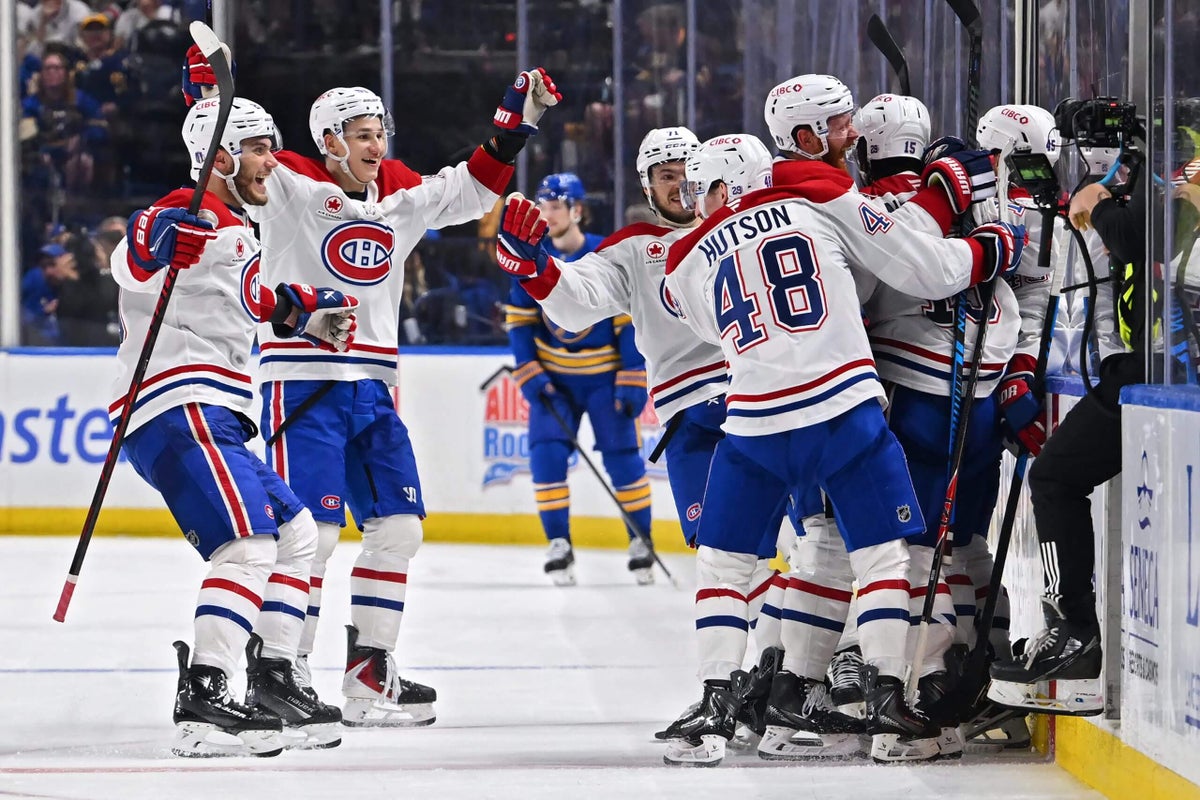
RALEIGH, N.C. — The last time an NHL team pulled off what these plucky young Montreal Canadiens have was 15 long years ago. And in the decade that followed, that club went on to become a powerhouse — one of the top franchises of the salary-cap era.Going from dead last in the standings to making the postseason’s final four within four years is a rare feat — so rare that the Canadiens are the first to do so since an upstart Tampa Bay Lightning team back in 2010-11.Tampa Bay lost to the eventual champion Boston Bruins in Game 7 of the Eastern Conference final that spring, but the young core of that franchise — built around Steven Stamkos and Victor Hedman, the No. 1 and No. 2 picks in 2008 and 2009 — went on to be truly special. The Lightning made the Cup Final four times in an eight-season span between 2015 and 2022, including winning back-to-back Stanley Cup titles in 2020 and 2021.Including those Lightning and this year’s Canadiens, just five teams have made a similarly quick leap from the basement to the conference finals over the NHL’s past 38 seasons. Three of those teams went on to win a Stanley Cup in short order, including the Lightning, the 2007-08 Pittsburgh Penguins (winning in 2009, 2016, 2017) and the 2005-06 Carolina Hurricanes (winning that season).If we expand the field to include the Colorado Avalanche — who finished last in 2016-17 and then won a championship five years later — there’s a clear, defined history of teams pivoting out of the NHL’s basement to start a climb up the standings.The Canadiens — as the second-youngest team in the league, with a strong prospect pool and impressively clean cap sheet for 2026-27 and beyond — are well-positioned to do the same, as they begin the Eastern Conference final against the Hurricanes as the underdogs Thursday night.But how Montreal has shifted from a full-scale rebuild, focusing on building through the draft, to a contender almost overnight is unique in the league right now. And its success could be a template that other organizations attempt to follow in the years to come.The notion that a full, scorched-earth rebuild is the appropriate route to a championship really took off following the NHL’s full-season lockout in 2004-05. That lost season brought the institution of a new collective bargaining agreement and what was then a $39 million salary cap, two shifts that changed how the league’s general managers looked at roster construction.The combination of the NHL shifting to a more wide-open, youth-oriented playing style and the age of unrestricted free agency shifting from 31 down to as young as 25 also put a greater focus on the draft. Rather than buying up veterans to fill out super teams, as some franchises had in the late 1990s and early ’00s, GMs had to learn to build.The cap era’s first draft-driven success story initially started with a financially troubled Penguins team needing to tear down out of sheer necessity. With the franchise in transition — and existential peril — Pittsburgh bottomed out and selected Marc-Andre Fleury, Evgeni Malkin, Sidney Crosby and Jordan Staal at Nos. 1 or 2 in four consecutive drafts between 2003 and 2006. From that pain, they built a champion in short order, with a trip to the Final in 2008 and a Stanley Cup title a year later.At the same time, two big-market U.S. clubs that had each been through a teardown began winning in the Western Conference, with the Chicago Blackhawks’ mini-dynasty taking three Cups in six years (2010, 2013, 2015) thanks to top picks in Jonathan Toews and Patrick Kane, and the Los Angeles Kings following suit in 2012 and 2014 behind Anze Kopitar and Drew Doughty.
Have the Canadiens pulled off the best quick-turn rebuild of the NHL’s cap era?
That Montreal rapidly shifted from a full-scale rebuild to a contender almost overnight is uniquely impressive in today's league.
1,670 words~8 min read