(Image credit: Nvidia)
Nvidia announced its financial results for the first quarter of its fiscal 2027 on Wednesday, posting a whopping $81.615 billion in revenue, marking its best quarter ever. Sales of the company’s AI platforms to various customers were record, prompting the company to reconsider how it reports its earnings going forward. From now on, the company will no longer report sales of its client graphics cards — whether consumer or professional — as separate product categories. Instead, sales of graphics solutions will be reported under different categories.
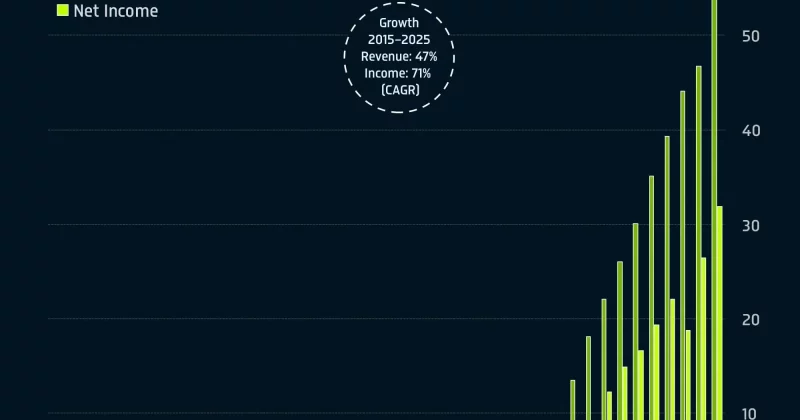
(Image credit: Nvidia)For the quarter that ended on April 28, 2027, Nvidia's GAAP revenue totaled $81.615 billion, up 20% sequentially and up 85% compared to the same quarter a year ago. Nvidia’s net income topped $58.321 billion, up 211% year-over-year (YoY) as its gross margin reached 74.9%. Sales of Nvidia’s Compute & Networking hardware hit $74.55 billion (an all-time record), whereas sales of its graphics hardware totaled $7.065 billion, up 20% sequentially and 85% year-over-year.
(Image credit: Nvidia)New reporting frameworkSelling $81.615 billion worth of hardware in a single quarter is, without any doubt, an incredible achievement. However, a more startling revelation is that Nvidia will cease to report sales of gaming and professional graphics cards as separate categories, which emphasizes once again that Nvidia's primary business now is artificial intelligence and data center hardware, not graphics.Instead of its traditional product categories, Nvidia will now split its revenue based on deployment markets. Going forward, the company will report two main platforms: Data Center and Edge Computing. Within Data Center, Nvidia is splitting revenue into two major sub-segments: Hyperscale, which includes hyperscale cloud providers and large internet companies (AWS, Google, Meta, Microsoft, etc.), and ACIE (AI Clouds, Industrial, and Enterprise), which covers enterprise AI factories, industrial deployments, sovereign AI deployments, supercomputing, and other deployments not controlled by hyperscalers. Edge Computing will include PCs, workstations, robotics, automotive, gaming consoles, and telecom infrastructure.Splitting its data center segment into two major sub-segments — hyperscalers and ACIE —makes a lot of sense for Nvidia. Hyperscalers tend to deploy custom silicon, own AI accelerators, or hardware from competitors, which limits Nvidia's growth in this segment. By contrast, there are thousands of participants in the broad ACIE category, virtually all of whom can take advantage of Nvidia's rack-scale platform-based approach, and almost none of them can afford development of custom silicon, which means limitless growth for Nvidia. As a result, Jensen Huang repeatedly emphasized that the ACIE category eventually becomes larger than hyperscale simply because AI is going to become ubiquitous and there are thousands of companies to address.The 'new' resultsAs Nvidia will from now on report its revenue split differently, the company had to re-report results across the new market platforms for previous physical years. One interesting observation is that the ACIE segment was outperforming the hyperscale segment till Q2 FY2026, when large CSPs began to deploy Nvidia's GB300 platform for inference, spending tens of billions of dollars per quarter. Now, the ACIE platform has almost caught up.