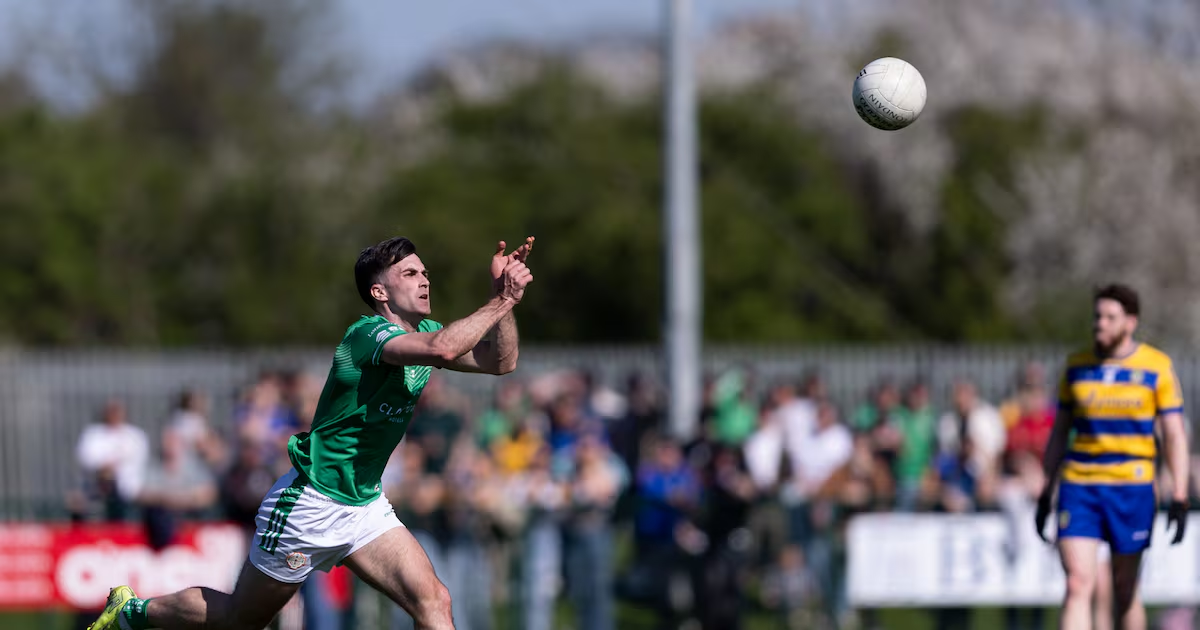
It says much about London’s progress that their recent 17-point victory over Waterford in the opening round of the Tailteann Cup was not portrayed as any manner of a shock. For this is who they are now, fresh from a training camp in Portugal and eyeing up possible Croke Park appearances later in the summer. It has been a season of genuine development for the London footballers. They went to the last round of games in Division 4 of the league with a shot at promotion, ultimately finishing just two points away from making the leap to Division 3. They won three league games, lost three and drew one, ending up with seven points and a scoring difference of -3.Measure that against the past. In 2006, they finished bottom of their league table having lost all seven fixtures and coming in with a scoring difference of -96. They were intercounty football’s soft touch.Ten years ago, they were still bottom of the pile, rooted to the basement of the 2016 Division 4 table with one win from seven games and a scoring difference of -41. “We had a record league campaign this year, in terms of seven points. It was the highest we’ve ever achieved but we definitely walked out of the campaign feeling like we’d perhaps underachieved a bit,” says London captain Liam Gallagher.“We were right in the mix on the final day, which was the first time we had ever really been in contention for promotion. “So, in the grand scheme of things, plenty of positives to take from that but we were also frustrated, which I think reflects where we’ve come to as a county, that we think we can compete at this level.”Gallagher is a Londoner born and bred, but the son of Irish parents – his dad from Donegal and his mam from Monaghan. There are over half a dozen home-grown players in the London squad right now.“There are seven (London-born) squad players in total, about five starters at the minute,” says Gallagher, who plays his club football with Tír Chonaill Gaels.“In terms of player retention, it’s really important to have a core group of London-born players that actually may play for London for eight, nine, 10 years. “Whereas previously you’d have people coming in from Ireland and they’d play for two to three years and have a great impact and then they would go again.”Gallagher speaks with a distinctive London brogue, but that only hints at part of his story. Growing up, he and his family were immersed in London’s Irish community.“There is a real strong Irish diaspora in London, obviously. A lot of my friends growing up were like me, London-born Irish people,” says the 29-year-old.“Everyone gets together, they socialise in similar bars and pubs when they get to their teenage years or early 20s. There’s definitely a community within a wider community there. “It’s a very unique community because we call ourselves Irish to people in London, but we come over to Ireland and people in Ireland call us English. You’re kind of stuck in between both.”Gallagher works in finance in London and over the years has found a useful analogy when it comes to explaining the GAA’s competition structure to friends and colleagues. London's Liam Gallagher during a Division 4 league fixture against Tipperary at Semple Stadoum last year. Photograph: Ken Sutton/Inpho London are currently preparing for a Tailteann Cup Round 2A fixture against Laois in Ruislip on Saturday – having chalked up the aforementioned 5-12 to 0-10 victory over Waterford.Their Connacht Championship campaign ended with a 0-31 to 1-15 quarter-final loss to Mayo in April. “When I’m explaining to people in London or people at work what I’m playing, for example the Mayo game, I’m saying they’re a Champions League team when we’re normally playing Europa League teams. “And, you know, the Europa League is our level, and we think we can compete with everyone at this level. So, definitely the Tailteann Cup is a big thing we want to go after.”And going after it they are. Michael Maher’s side even managed to get away to Portugal for a training camp this season.“That’s not something we’ve done before. So, that was a great experience and gave us time to really focus on a lot of the tactical elements of our game and reflect on Mayo, as well as the league campaign, to see where the weaknesses were and actually target those with some good long training sessions.“Definitely it’s been a process and it’s been evolving year on year.“Player retention year on year has improved because people want to play. We have our first ever floodlit Gaelic football pitch that we can train on – that happened two years ago. “It’s all now being reflected in the league campaign and the results we’re getting and how competitive we are in each game.”
‘We call ourselves Irish, people in Ireland call us English’: Home-grown talent adding longevity to London’s rise
Captain Liam Gallagher one of a growing crop of London born and bred players lining out for Michael Maher’s side
810 words~4 min read