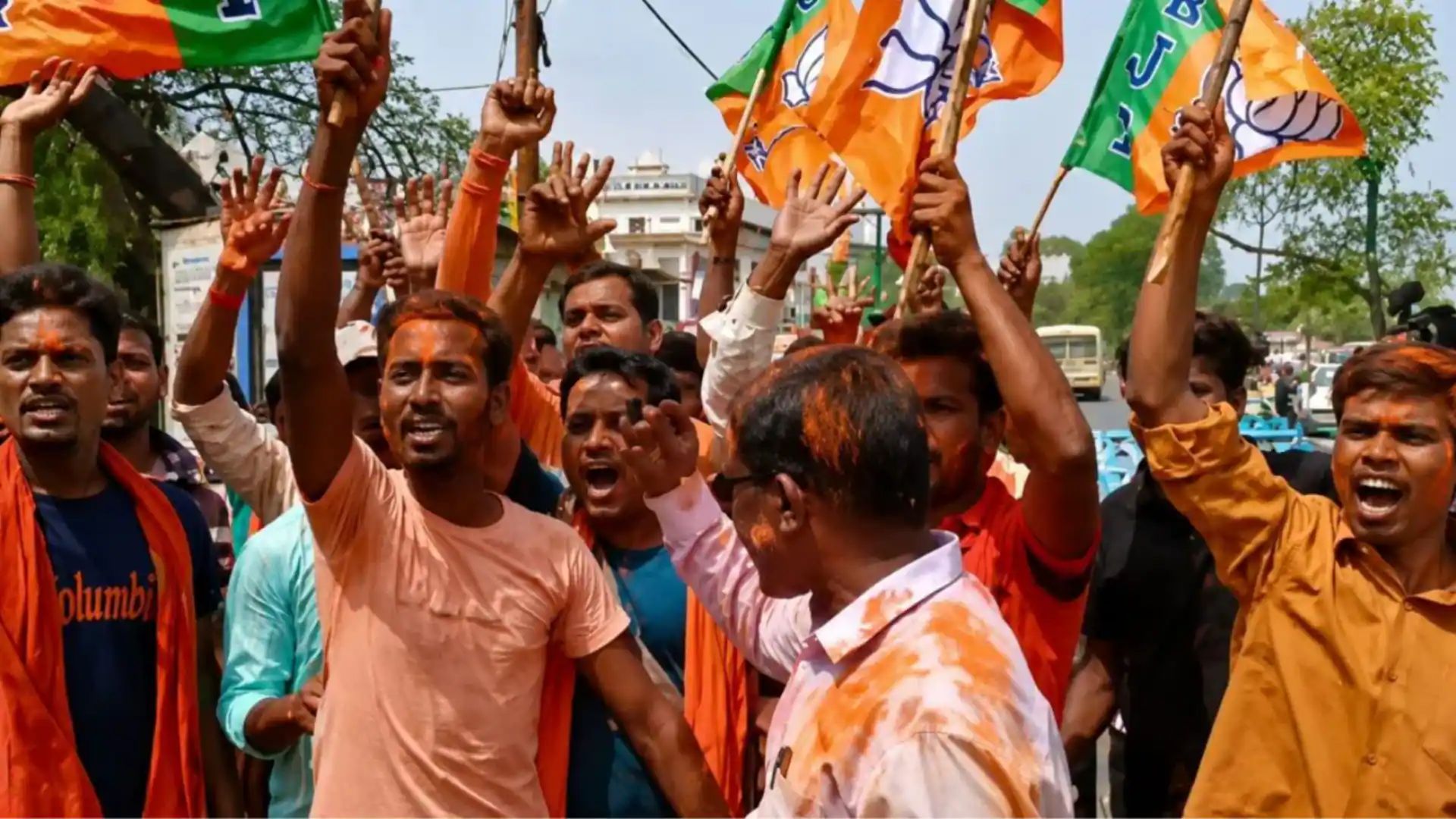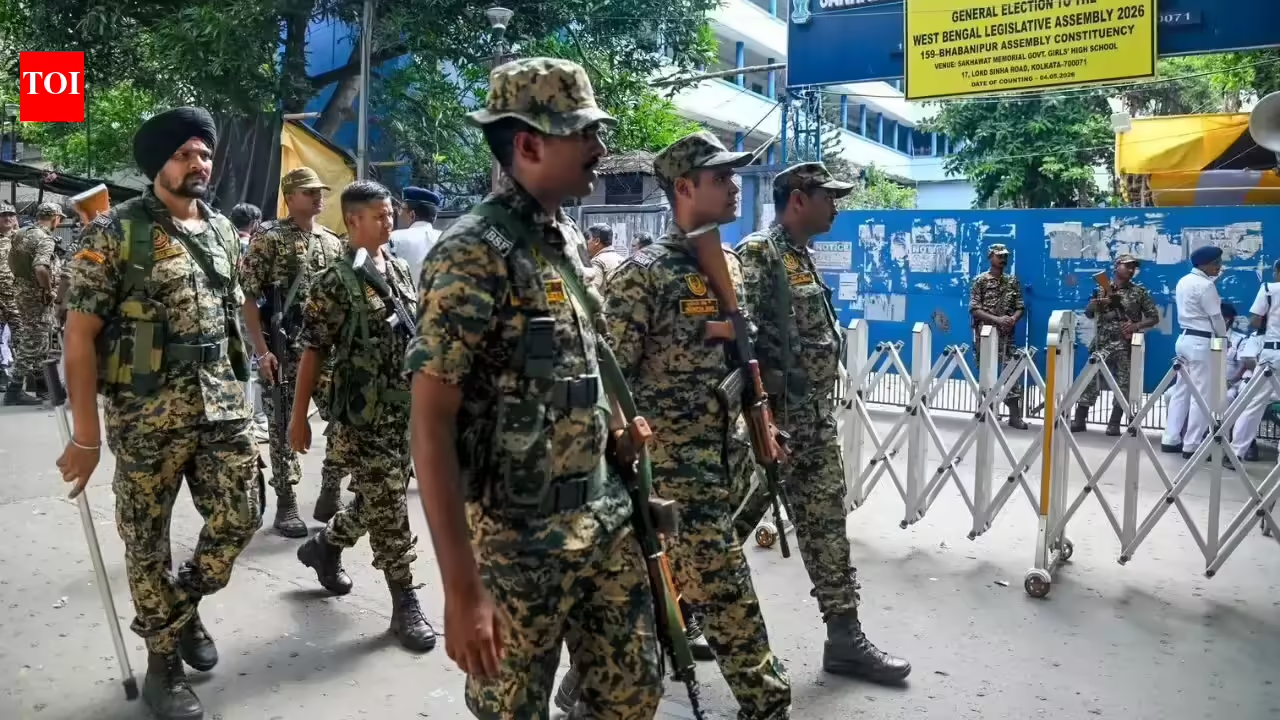
A close contest led by the Trinamool Congress in West Bengal’s Rajarhat New Town constituency flipped to the Bharatiya Janata Party as a Muslim-majority booth returned an overwhelming vote for the Hindutva party, shows a Scroll analysis of the Election Commission’s official booth-wise data.The state voted in two phases for a new assembly, on April 23 and April 29. When the results were announced on May 5, they showed that the BJP had pulled off its first victory in West Bengal, winning 207 seats in the 294-member house.In Rajarhat New Town, a ground report by Scroll had described how the Trinamool Congress had a lead of 316 votes on May 4. But after an additional round of counting the next day, the BJP won the seat with the same margin. The Election Commission did not respond to Scroll’s queries about the need for an extra round.Candidates of both parties accused each other of manipulating the counting process.At the heart of the controversial poll lies Musalman Para, a locality in North Kolkata with two booths – 164 and 165. Most of the registered voters in these booths are Muslim and they vote at the same polling centre, their electoral roll shows.On May 4 and 5, when the votes were counted, booth 164 was not counted in its scheduled round, but in a separate round at the end of the counting process. The tally in Musalman Para showed a strange divergence: while the BJP could only manage a few dozen votes in booth 165, it got an overwhelming majority in booth 164.This runs against the communal polarisation seen in West Bengal’s voting pattern in this election and is difficult to explain, given the near-identical demography of the two booths.Questions sent to the Election Commission did not elicit a response.The booth not countedThe Election Commission has guidelines on how votes are to be counted on results day. Most of it is done in counting halls with at least seven tables. In every round, counting officials at each table tabulate votes from one booth.Table one gets the electronic voting machine of booth one, table two gets the electronic voting machine of booth two, and so on, explains the poll body’s handbook for counting agents. If there are seven tables in the counting hall, every round will likely include the votes of seven booths.Rajarhat New Town constituency has 330 booths – 320 main booths and 10 auxiliary booths. Auxiliary booths are extra polling stations set up to accommodate booths with more than 1,200 electors.We compared the Election Commission’s round-wise results published on its website with its booth-wise data from the constituency.We found that the sum of votes of all candidates in round one matched with the sum of votes that the candidates got from booth one to booth 20. For example, BJP candidate Piyush Kanodia got 5,461 votes in the first round of counting. This is also the number of votes he got in the first 20 booths of the constituency.Similarly, round two of counting is a sum of votes cast in booths 21 to 40, round three has votes from the next 20 booths, and so on.This means that counting officials were counting votes from 20 electronic voting machines in every round. For a constituency with 330 booths, the counting needed only 17 rounds – 20 electronic voting machines would have been counted in the first 16 rounds and the remaining 10 in the 17th round.But on May 4 and May 5, the counting took place in 18 rounds.The Election Commission’s published voting figures for round nine show that it only counted 19 electronic voting machine in that round. If it had counted all 20 electronic voting machines scheduled in this round – booth 159 to booth 177 – the sum of counted votes would have been 16,870. But the official figure is 16,214, falling short by 656 votes.In booth 164, according to the Election Comission’s booth-level data, 656 votes were cast. This meant that the counting officials did not count this booth in round nine.The EC’s round nine count (above) does not match the votes from the booths scheduled for that round, as per booth-level data (below).Up to the 17th round on May 4, the Trinamool Congress’s Chatterjee maintained a lead over BJP’s Kanodia. But it was a thin lead of 316 votes – he was ahead by 440 electronic voting machine votes but behind by 124 postal ballot votes, which had been counted earlier that day.The only booth to be counted on May 5 in the 18th round had 656 votes, Election Commission data shows – the exact number of votes polled in booth 164, which was skipped in the ninth round.Here, the BJP got 637 votes and the Trinamool Congress only five, turning the result in the BJP’s favour with a margin of 316 votes.Musalman ParaRecent elections in Bengal have seen significant communal polarisation. In the previous Lok Sabha and assembly elections in West Bengal, only 4%-7% of the state’s Muslims have voted for the BJP. Nearly 70%-75% of the community voted for the Trinamool Congress, according to post-poll data collected by the Centre for the Study of Developing Societies.Even Suvendu Adhikari, the BJP’s most prominent leader in West Bengal said that his victory in Nandigram constituency was because of Hindu voters. “There, the entire Muslim vote went to Trinamool Congress,” he had said. “I will work for the Hindus of Nandigram.”But Muslim voters at booth 164 in Rajarhat New Town turned this voting pattern on its head.Voters allotted booth 164 and 165 in this constituency both vote at the Jagadishpur FP school polling centre.The polling centre of Musalman Para locality in Rajarhat New Town constituency. Photo from Facebook.Booth 164 has 670 electors, shows its electoral roll, of which more than 88% or 591 are Muslim. The Hindutva party won 97% of the 656 votes cast at this booth. Even if every Hindu voter here voted for the BJP, the party still received 558 votes from Muslim voters. This means that more than 94% of the Muslims in booth 164 voted for the BJP – an unprecedented figure given all past data on Bengal.Similarly, booth 165 has 654 electors, of which more than 91% or 597 are Muslim. Oddly, despite being from the same locality, voters here had voted very differently: the BJP only received 32 of the 638 votes, while the Trinamool Congress got 290 votes and Communist Party of India (Marxist) candidate and 299 votes.It is difficult to explain how two booths in the same neighbourhood, with nearly identical religious profiles, produced such sharply different results. Nearly every voter in booth 164 backed the BJP, while voters at booth 165 did not.The discrepancy is deepened by the counting process. Booth 164 was skipped in its scheduled round and counted separately at the end, erasing a narrow Trinamool lead. The Election Commission is yet to explain why the electronic voting machine of this booth was set aside.
One mostly Muslim booth flipped a controversial Bengal seat – 97% of its vote went to BJP
The Trinamool almost won Rajarhat New Town. Until, a mostly Muslim booth was counted out of turn in the final round, and voted overwhelmingly for the BJP.
1,169 words~5 min read