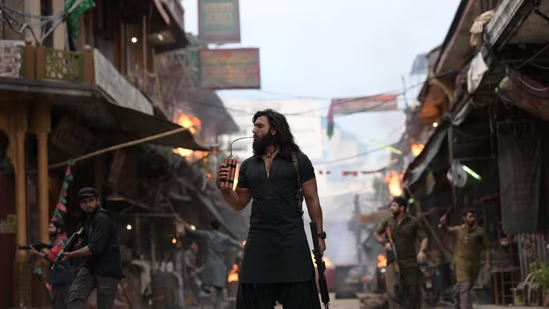
The Delhi High Court on Wednesday asked the Centre and the Central Board of Film Certification (CBFC) to take a call on a plea seeking a specific policy governing spy-thriller films, even as the petition argued that scenes in the movie “Dhurandhar: The Revenge” had the potential to reveal information related to the armed forces that could compromise national security.A still from “Dhurandhar: The Revenge”. (FILE)A bench comprising Chief Justice DK Upadhyaya and Justice Tejas Karia observed that although the movie Dhurandhar: The Revenge was stated to be fictional and made for entertainment purposes, its impact could not be ignored, adding that there ought to be some guidelines framed by the CBFC.“The movie is a work of fiction, made for entertainment purposes, but the impact of the movie cannot be denied. Suppose a movie is made where there is a character who commits suicide and someone in the same position before committing suicide searches for the process…. Can it be permitted? Even if it is fiction. He (the petitioner) says that tactics of the army or the force for meeting challenges and secrets are revealed, even if the movie may be fictional. This needs to be addressed. There should be some guidelines of the censor board,” the bench said.The court directed the Centre and the CBFC to treat the petition filed by Deepak Kumar, a personnel of the Sashastra Seema Bal, as a representation and take an appropriate decision on it.Appearing through advocate Jagjeet Singh, Kumar argued that scenes in the movie Dhurandhar: The Revenge had been portrayed in a manner that could potentially reveal information prejudicial to the security interests of the country. The plea contended that the explicit depiction of locations, operations, and characters allegedly modelled on high-ranking officials and slain officers was so detailed that, despite the film being presented as fiction, it could adversely affect national security and integrity.The petition further referred to films such as Bell Bottom, Mission Majnu, Raazi and Uri: The Surgical Strike, arguing that movies depicting defence and military techniques should not place sensitive operational details in the public domain.“Having regard to the nature of the issue and the concerns raised, we are of the opinion that the concerns raised by the petitioner need to be considered and addressed. Accordingly, we dispose of the writ with the direction that the competent authority of the Ministry of Information and Broadcasting and CBFC, consider the entire petition as a representation and take an appropriate decision on the issues raised therein. The decision and corrective measures, if any if taken on consideration of the representation dated March 23 2026, shall also be communicated to the petitioner. The writ petition stands disposed of in the aforesaid terms,” said the court.
HC asks Centre to take call on a spy film policy
Delhi High Court urges the Centre and CBFC to create guidelines for spy-thriller films, citing potential national security risks from "Dhurandhar: The Revenge." | India News
454 words~2 min read