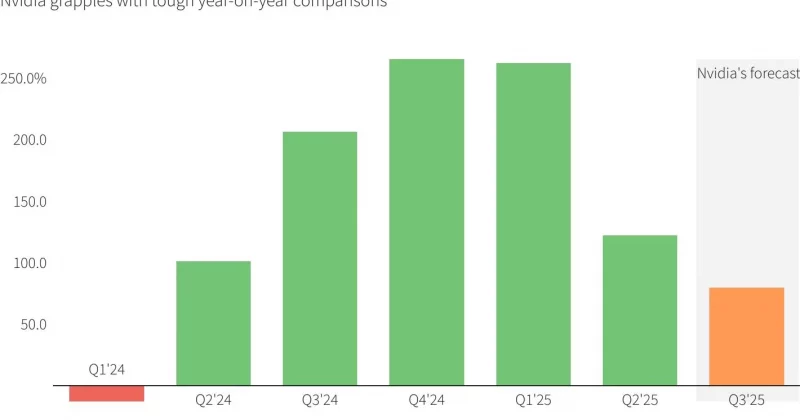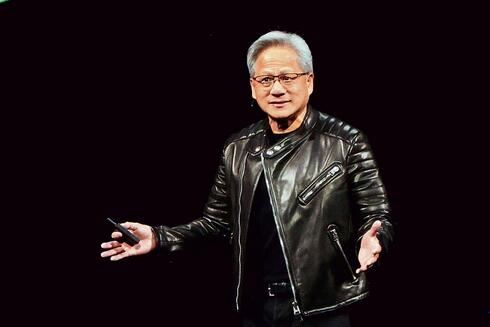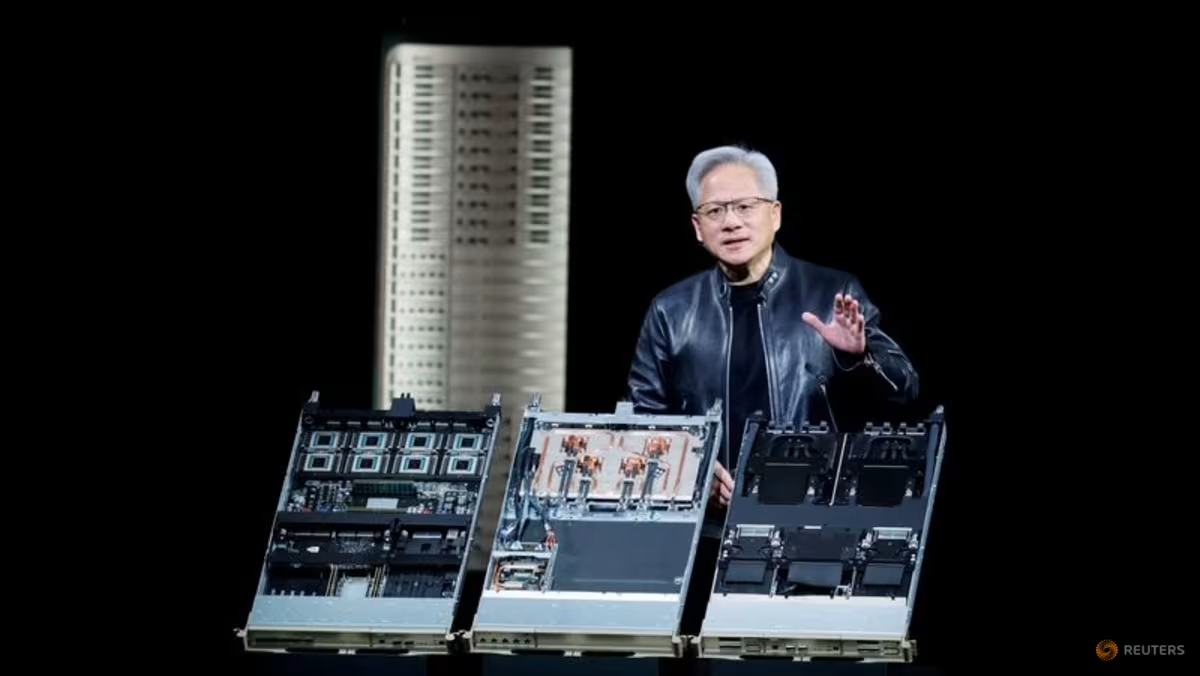
– Nvidia, the world’s most valuable company, delivered another huge quarterly profit and a sales outlook that topped analyst estimates. It even announced a US$80 billion (S$102 billion) share buyback programme, but all this drew a lukewarm reaction from investors who sent its shares down.The AI chipmaker’s first-quarter profit hit US$58.3 billion (S$74.5 billion), up 211 per cent from a year ago and topping analyst expectations. Just three years ago, its quarterly profit was US$2 billion – about a 30th of what it is today.Sales in the current second quarter will be US$91 billion, compared with analyst average estimates of US$87 billion, according to data compiled by Bloomberg.Apart from the share buyback, the company raised its quarterly dividend to 25 US cents a share from one US cent.Still, Nvidia shares fell 1.3 per cent in extended trading on May 20.The outlook let down investors who have grown accustomed to Nvidia shattering expectations. The company is also facing the first major challenges to its dominance in AI computing, with a variety of chipmakers trying to carve out a piece of the business.“Nvidia delivered another beat, but at this point that’s essentially priced in as it keeps beating quarter after quarter,” Emarketer analyst Jacob Bourne said in a note. “The lingering question is whether it can convince investors (that) the AI build-out has durability into 2027 and 2028.”Before May 20, Nvidia shares had gained 20 per cent in 2026, a performance that outpaced the S&P 500 but lagged most major chip peers.Nvidia is the top seller of so-called AI accelerators, chips used to develop artificial intelligence models. But it faces growing competition from across Silicon Valley. Advanced Micro Devices (AMD) has rival processors, and Broadcom and Alphabet’s Google are attacking the market with their own technology.For now, Nvidia has an enviable position – with Wall Street predicting that the company’s revenue will account for more than a third of the entire semiconductor sector’s sales in 2026. Chief executive Jensen Huang has stuck to his assertions that Nvidia will continue to deliver unprecedented growth as demand remains strong for the foreseeable future.“The build-out of AI factories – the largest infrastructure expansion in human history – is accelerating at extraordinary speed,” he said in a May 20 statement. Data centre spending – the main source of Nvidia’s revenue – has not shown signs of letting up. The major spenders in this area, a group known as hyperscalers, plan to shell out a combined total of roughly US$725 billion on AI in 2026.That has not just buoyed sales of accelerators. General-purpose CPUs, or central processing units, are also in greater demand. That has lifted results for Intel and AMD. Chip upstarts are getting a boost as well: Cerebras Systems, which offers a novel product based on large pieces of silicon, had the year’s biggest initial public offering last week. Nvidia does not just sell accelerators. It offers a range of chips, as well as networking, software, AI models and even complete computer systems. That helps make its reach and capabilities unassailable, Nvidia management has argued. The company has said it has more orders than it can fill and is investing to add supply to meet that flood of demand.The company is on course to record revenue of more than US$370 billion in 2026, according to estimates. By that measure, it will be roughly 22 times the size it was in fiscal 2021. Nvidia easily chalks up more sales in a quarter than its next three largest rivals combined. But Nvidia has run into roadblocks in China, the largest market for semiconductors overall.Mr Huang has just returned from a trip there with US President Donald Trump. US export rules have stymied Nvidia’s growth in that country by restricting sales of AI accelerators on national security grounds. The Trump administration has begun allowing older Nvidia products to be sold to Chinese customers. But Beijing, trying to cultivate local suppliers, has resisted that initiative. That has left Nvidia mostly locked out of a market that it has said could generate US$50 billion a year. BLOOMBERG
$74.5 billion profit, $102 billion buyback – so why did AI chip giant Nvidia shares slide?
The AI chipmaker’s shares fell 1.3 per cent in extended trading on May 20. Read more at straitstimes.com. Read more at straitstimes.com.
677 words~3 min read