Reviving the industrial ecosystem of West Bengal
| Photo Credit:
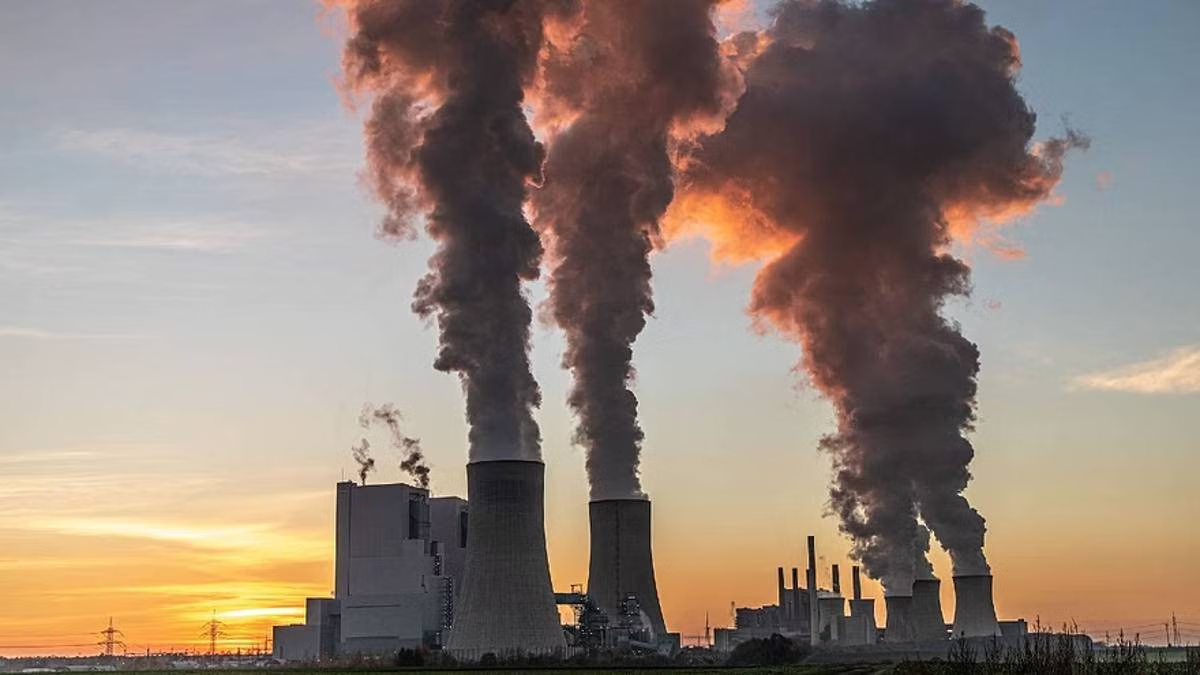
For the first half of the 20th century, the banks of the Hooghly River served as one of major industrial heartlands of Asia. Stretching nearly 100 km, this vibrant corridor was a metallurgical and engineering powerhouse that provided the inspiration for Japan’s burgeoning industries.Today, that legacy is a distant memory. A region that once defined economies of scale and sophistication in Asian manufacturing now accounts for less than 6 per cent of India’s metallurgical output. Decades of industrial decline, rooted in the anti-industry political culture of Bengal starting in the 1970s, and exacerbated by five decades of misgovernance by the Left and Trinamool governments, have led to widespread factory closures and capital flight.Despite this stagnation, the region retains an immense, untapped potential for a renaissance. To realise this, the West Bengal government must implement a dedicated package specifically tailored to the Greater Kolkata region, focusing on its comparative advantages in metallurgy and the burgeoning sector of Global Capability Centres (GCCs). Here are some ideas how.Metallurgy, a global hubThe Greater Kolkata region still hosts a specialised ecosystem of approximately 3,000 registered metallurgical units, including a core of 320-500 foundries. This MSME-driven landscape possesses a niche expertise that can return Bengal to the centre of the global supply chain for advanced industrial materials and metalworking.However, this cannot be achieved through cosmetic efforts involving minor subsidies or development of small-scale industrial parks that characterized the approach of previous state governments.We must “dream big”, with ambitious, seemingly outlandish targets. The goal should be achieving an industrial output exceeding $50 billion and exports of $25 billion within a decade, while creating one million direct and ancillary jobs. This is a realistic goal if we leverage the region’s proximity to the mineral-rich belts of Odisha, Jharkhand, and Chhattisgarh.Furthermore, the State should collaborate with the Centre to develop a customised PLI (Production Linked Incentive) scheme for metalworking, metallurgy and advanced materials industries going beyond the existing PLI for specialty steel, which specifically designed to allow small and medium-sized industries to benefit from.Brownfield DevelopmentThe cornerstone of this revival must be brownfield development. Rather than relying solely on greenfield projects that face significant land acquisition hurdles, the focus should shift to revitalising “sick units” or those under litigation through a specialised Special Purpose Vehicle (SPV) scheme. Here are the advantages of brownfield retrofitting.Reduced lead times: Setting up in a brownfield zone can help units becoming operational within 6 to 12 months, compared to the 24 to 48 months required for greenfield clearances and construction.Capex efficiency: Retrofitting typically reduces capital expenditure by 25-30 per cent.Policy alignment: The Centre’s Bharat Audyogik Vikas Yojana (BHAVYA) scheme explicitly supports infrastructure modernisation for brownfield projects, serving as a significant force multiplier complementing state government resources to support Kolkata’s revival.Port powerThe Syama Prasad Mookerjee Port can be a primary catalyst for this industrial transformation. As Kolkata’s largest landholder, the port authority controls approximately 11,000 acres — a land bank that offers significantly cheaper real estate than competitor hubs like Mumbai, Pune, or Chennai.Greenfield potential: Lands near the Haldia dock system are uniquely suited for large-scale manufacturing and attracting Foreign Direct Investment (FDI).The GCC revolution: Land parcels within 5-8 km of Kolkata’s central business district are ideal for commercial GCC facilities. While the initial IT revolution bypassed the city, Kolkata’s high-skilled manpower and lower operating costs make it the logical “next stop” for India’s services export revolution.Self-sustaining finance: By utilising SPVs, revenues from these lands can be reinvested into commercial assets that help finance port operations and industrial development of port held lands over the longer-run.Overcoming obstaclesThe primary barrier to replicating a London or Hamburg Docklands style revitalisation is a lack of political will to confront the “dockland mafia”. Illegal occupations and the influence of political strongmen have deterred legitimate investment for decades. The port has failed to reach its potential because previous State administrations refused to support federal initiatives.A comprehensive, courageous plan for urban and industrial revival would resonate with a middle class desperate for economic opportunity.By aligning the port’s development with a clear industrial roadmap, the government can replace a culture of litigation and stagnation with one of growth and entrepreneurship.Renaming the port after Dr. Syama Prasad Mookerjee was a symbolic beginning. The true tribute to his legacy lies in reclaiming the economic pride of the city he defended. Transforming the Kolkata corridor into a global economic hub for advanced metallurgy and metalworking should be treated as Bengal’s strategic industrial imperative.Bengal under the new BJP led government must move beyond “small potatoes” thinking and implement a large-scale ‘Kolkata region’ industrial plan that restores this region to its rightful place among the world’s great economic clusters.The writer is Head, Centre for WTO Studies, Indian Institute of Foreign Trade (IIFT). Views expressed are personalPublished on May 21, 2026