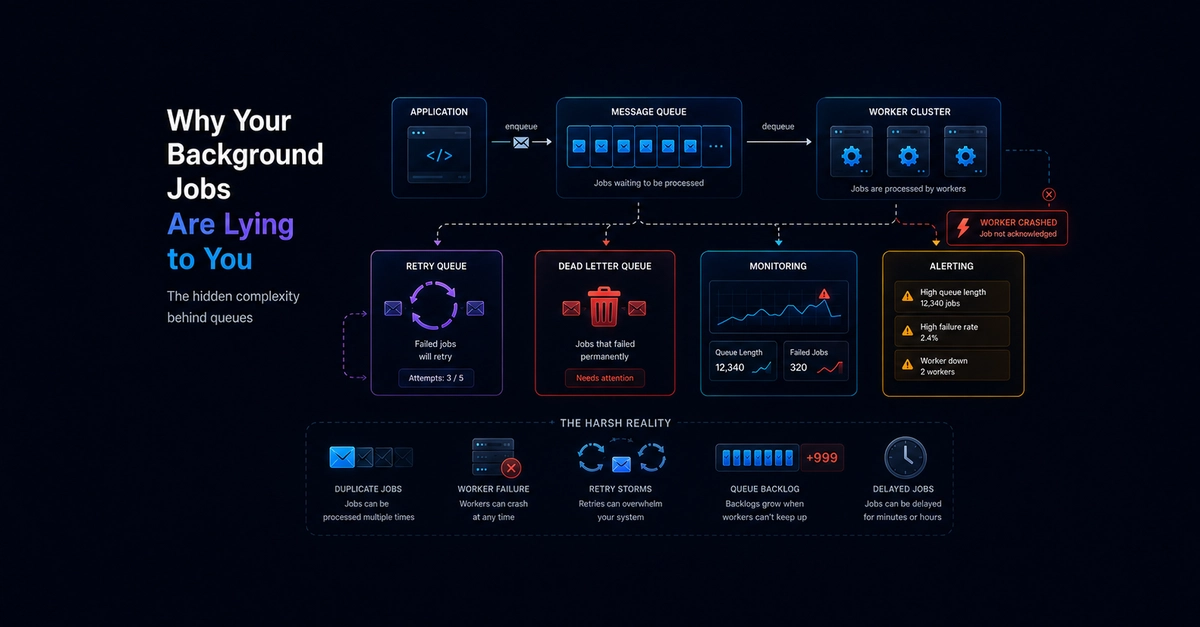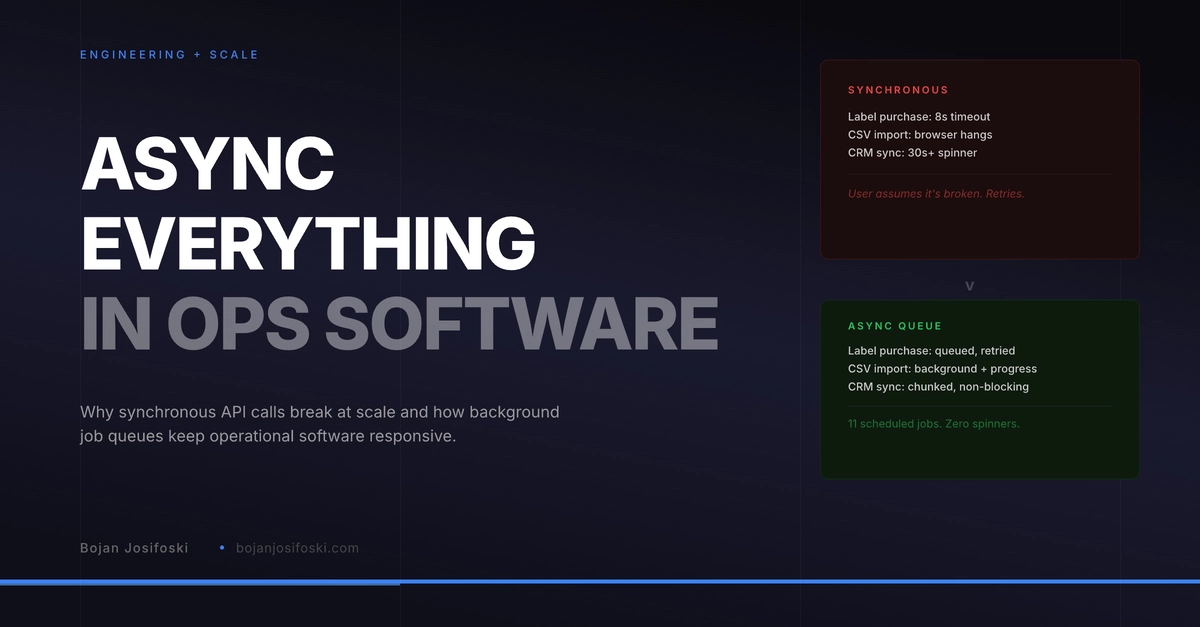
The first version of most operational software runs everything synchronously. User clicks a button, the server does the work, the response comes back. It works fine until it does not. And when it stops working, it stops working suddenly and visibly, usually when a customer is watching.
I learned this building SampleHQ. The CRM setup flow that worked in development took thirty seconds in production because Salesforce metadata deployment is slow. The CSV import that handled fifty rows instantly choked on five hundred. The shipping label purchase that completed in two seconds occasionally timed out at eight because the Shippo API was under load.
Every one of these was a synchronous operation that should have been asynchronous from the start.
What Breaks Synchronously
External API calls. Any operation that depends on a third-party API is at the mercy of that API's response time. Shippo label purchases, CRM data syncs, carrier tracking lookups, address validation. These calls typically take one to five seconds. But under load, or when the provider has an incident, they take ten, twenty, thirty seconds. The user stares at a spinner and assumes the system is broken.