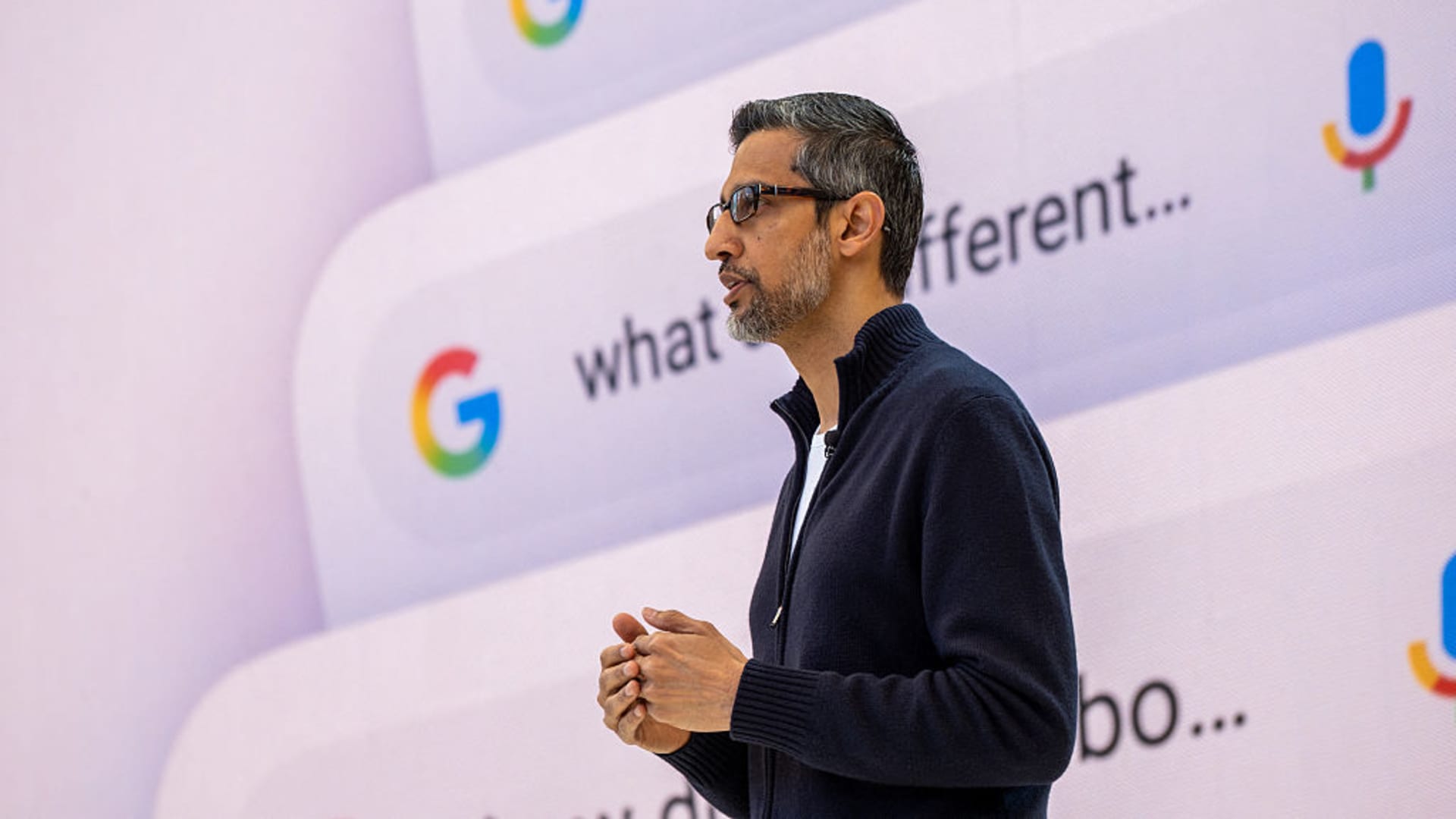
Google faced fears during the rise of chatbots like ChatGPT and Claude that they would become search-engine killers and cut into the core of parent company Alphabet’s revenue. But that hasn’t happened.Instead, last year Google brought in more than $400 billion in revenue — over $224 billion of which came from its search engine, now powered by its own AI model, Gemini.To discuss how Google has managed to avoid being left in the dust, “Marketplace Morning Report” host Sabri Ben-Achour spoke with Gil Luria, managing director and head of technology research at the financial services firm D.A. Davidson. The following is an edited transcript of their conversation.Sabri Ben-Achour: So Google's market capitalization — you know, that's where you take the number of shares, and you multiply it by the price — that measure of value increased by $1 trillion in a year. Big picture: What has been fueling Google's growth?Gil Luria: AI. So at some point last year, it all clicked that Google has the chips to do AI. They have the data centers to place those chips and host the AI compute. They have the advanced model they call Gemini. They have all the consumers. They have search. And they were able to put all those pieces together, and now they're leading the way in AI.Sabri Ben-Achour: It sounds like basically, they have a finger in every single pie all up and down the whole AI supply chain.Gil Luria: That's right, and that's very unique. Because if you think about how the other parts of the artificial intelligence market, it's Nvidia chips going to a Microsoft data center on an OpenAI model, and there may be a wrapper around that by Perplexity. So it's much more fragmented, and all those companies work well together. But in Google, that's not even an issue. Sabri Ben-Achour: Speaking of the relationships between all these companies, there is this circularity in the investment between them. You know, the one invests in the other, invests in the other, invests in the first one — it's just a big circle. To what extent is Alphabet’s increase in worth just a factor of that, you know, it invests in Anthropic, and then Anthropic value goes up, so it looks like Google's value goes up?Gil Luria: That's a piece of it, but for Google, it's probably less than some of the other participants. If you think about Nvidia, Microsoft, and Amazon, a lot more of that is them feeding their customers that are feeding them back. For Google, it is really mostly that Anthropic relationship that's been a big boom for Google, but it doesn't explain all of their success. Now, to be fair to all of them, they're doing it to get artificial intelligence off the ground to have enough compute to have powerful enough models, and it is starting to pay off. If you look at the results of Anthropic and OpenAI combined, they are at more than $60 billion of annualized run rate; that's from no dollars two years ago. And those dollars, that's not circular — that is consumers and businesses paying to use AI.Sabri Ben-Achour: Google was a little late to the AI game, and people were afraid it was going to gut their search results. But then Google was like, “You know, if someone's going to disrupt us, it should be us,” and things have worked out. Search revenue has actually increased dramatically. What is the takeaway from that?Gil Luria: When they changed their mind and said, to your point, “No, we are going to disrupt ourselves. We are going to push consumers to interact with AI instead of interacting with traditional search,” that's when they started being successful, and it's easy to understand. We rarely do Google searches these days because that's not as good as interaction as the AI mode that Google presents us as a chat, that OpenAI gives us where we're actually having an interaction, where we can form complicated thoughts, and we don't have to spell everything exactly right. And on the other side, these AI tools are looking at a website in a more comprehensive way. They're not just looking for keywords. They're trying to figure out what it is that the company does, how it does it, how it positions itself, what products are important. So it's taking that much better understanding of the website with a much better understanding in the consumer, and it's putting those together. And what happens when you do that is consumers get what they want, and when consumers get what they want from advertising, that means the advertisers are willing to pay more for that.Sabri Ben-Achour: Yeah. And meanwhile, even though we think of Google as like an ad search company, their cloud services business has been taking off at the same time.Gil Luria: Accelerating at a tremendous rate. This is a business that, just a few quarters ago, is growing maybe 20-30%, and that is because all these things are coming together for them. They have chips to offer business customers, they have models to offer consumers and business customers, and they're a big investor and supporter of Anthropic — which means they're handling a lot of that spike in demand for Anthropic. So all that's coming together through Google Cloud, which is why it's now the fastest-growing cloud, faster than Amazon Web Services, and even faster than Microsoft Azure.
Google was supposed to lose the AI race. Instead, it’s thriving.
Google’s search business survived the chatbot boom — and now its AI tools and cloud services are accelerating the company’s growth.
903 words~4 min read