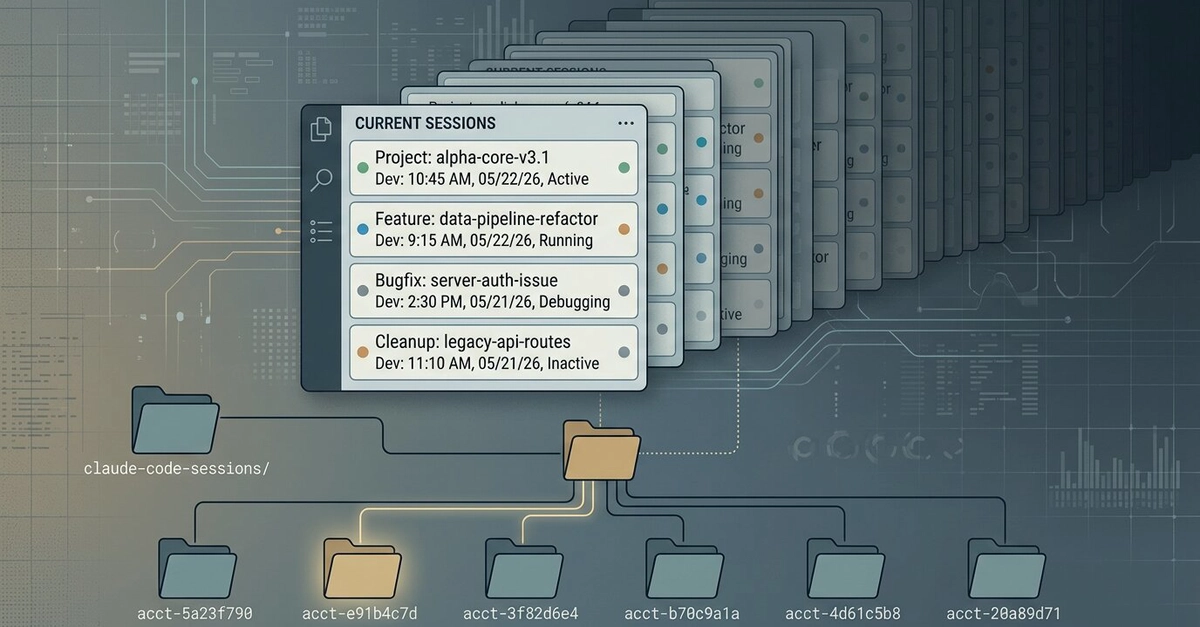
A documented user investigation posted in late April 2026 reported, for one Windows machine, the following two numbers: 715 Claude Code sessions on disk, and 69 sessions visible in the Claude Code desktop application's sidebar. Roughly ten percent. The other six hundred and forty-six sessions, totalling about 48 megabytes of local_*.json files, were on the disk, were intact, and were entirely absent from the only program that can natively open them.
I want to take that ten-percent number seriously rather than file it under "user error" or "edge case," because the structural reason it happens is the same reason it will happen to anyone with more than one Anthropic account, and there are now a fair number of people in that category. Anthropic introduced weekly rate limits on its Pro and Max plans on August 28, 2025, which means the response of any sufficiently committed Claude Code user is, eventually, to maintain more than one account and rotate when one of them hits its cap. This is not an exotic workflow. It is the normal response of a tool's power users to a quota policy. The desktop application was not built around it.
Why anyone runs more than one account
The current weekly-limit structure is documented across Anthropic's pricing pages and a year of TechCrunch / Northflank / Portkey coverage. The $200/month Max plan offers, by Anthropic's own published guidance, somewhere in the 240–480 hours of Sonnet and 24–40 hours of Opus per week. The $100 plan is roughly half that. The Pro plan is well below either. For someone using Claude Code as a daily driver on multiple substantial projects, the cap is not theoretical — power users hit it within days of each weekly reset window.