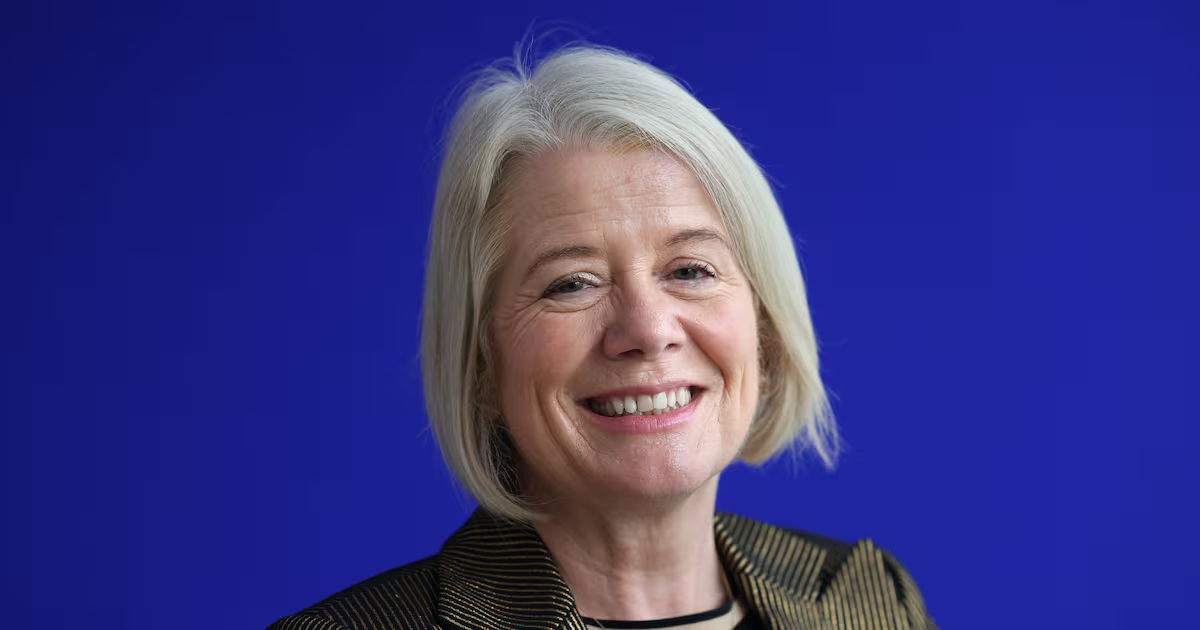
Artificial intelligence will reinforce, rather than diminish, the role accountants play in the economy, an industry group says, challenging the narrative that accountants are at risk of being replaced by AI. “There is a common belief that AI will replace accountants, but the evidence simply doesn’t support that,” said Rosemary Keogh, chief executive of Chartered Accountants Ireland (CAI) at the publication of a position paper on the future of AI and accountancy. “It reflects a misunderstanding of what modern accountants actually do.” The paper emphasises that accountants need to take a leading role in implementing AI in finance functions, ensuring that systems are deployed responsibly, controls are robust and outputs can be trusted. Speaking at Wednesday’s publication of the paper, Oireachtas Joint Committee on Artificial Intelligence chairman, Malcolm Byrne cautioned that “accountants who use AI will replace accountants who don’t”. Byrne described AI as “a tool, rather than a goal in itself” and said that “maintaining public trust is going to be critical”. However, he accepts that it will see the nature of the profession evolving, with Byrne noting: “We are going to see job displacement in certain areas and opportunities in others.” He cited a statistic from the World Economic Forum that, by 2030, there could be up to 90 million jobs displaced by AI, but up to 250 million created. Among several common myths about the impact AI is expected to have on the accountancy profession is the idea that entry-level roles in accountancy will disappear, the paper says.“Entry-level jobs have been constantly evolving for many, many years,” Keogh said. “Historically, graduates coming into accounting firms would have been doing a lot of what we would have called ticking and bashing. Accounting software has done much of that work for a really long time, so this isn’t something that is completely new. “AI will allow [entry-level auditors] to look at an entire data set for an organisation, see the trends and give them the opportunity to use their critical thinking and analytic skills. I think the role will change, but actually, I think the work at that junior level will become far more interesting in the future,” Keogh said. “I think what will be really important as they move through university, third-level, and into the workplace, is that they learn how to use AI responsibly and effectively to do a better job.” Keogh emphasised the responsibility of individual accountants regarding their use of AI. “Accountants have a role to stand over any work that they produce and any work they’re signing off on, so there is a huge personal and organisational responsibility about ensuring that anything that goes out into public domain has been sanity checked by a human being.”
AI will not replace accountants, Chartered Accountants Ireland says
Profession must take leading role in ensuring that AI is deployed responsibly, controls are robust and outputs can be trusted
452 words~2 min read