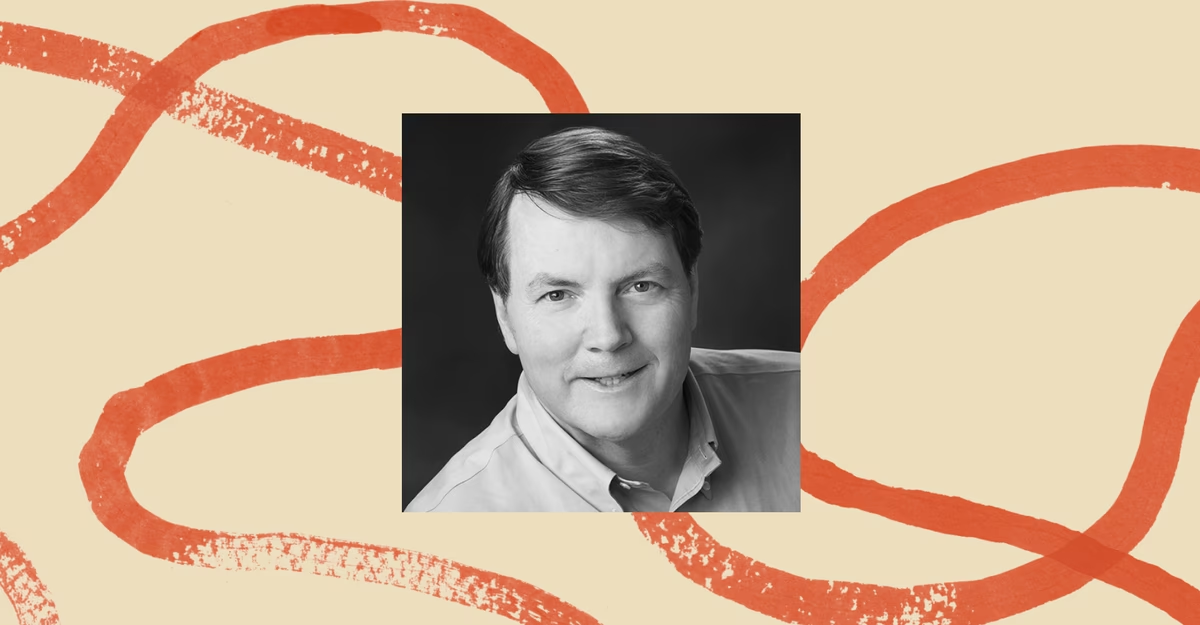
Subscribe here: Apple Podcasts | Spotify | YouTubeOn this week’s episode of The David Frum Show, The Atlantic’s David Frum opens with his reaction to President Trump’s shocking settlement with the IRS and his new $1.8 billion slush fund for victims of political “weaponization.”Then, David is joined by Phillips O’Brien, a military historian and a professor of strategic studies at the University of St. Andrews, for a discussion about the fallout from the war in Iran, Russia’s stalemate with Ukraine, and Trump’s recent meeting with President Xi Jinping in China. Frum and O’Brien discuss President Trump’s lack of commitment toward Taiwan and how he has greatly diminished America’s standing with China.Finally, David ends the episode with a discussion of What Science Says About Astrology, by Carlos Orsi.The following is a transcript of the episode:David Frum: Hello, and welcome to The David Frum Show. I’m David Frum, a staff writer at The Atlantic. My guest this week will be Phillips O’Brien, a military historian at the University of St. Andrews, and we’ll be discussing the wars in Ukraine and Russia, the wars between the United States and Iran, and the risk of war around the island of Taiwan. The book this week will be What Science Says About Astrology, by Carlos Orsi.But before either the dialogue or the book discussion, some thoughts about recent news that President Trump has succeeded in obtaining some kind of fund of, apparently or reportedly, $1.776 billion for him, at his near sole personal discretion, to dispense to allies and associates. The whole story is so incredible and so doubtfully legal that it’s hard even to find a language to describe what it is we’ve got here. Let’s step back to understand the story a little better before we understand what its implications are.In the first Trump administration, an IRS contractor leaked thousands of tax returns of wealthy people, including President Trump, to make the point that rich people in the United States pay very little tax. President Trump’s tax returns were made available by this contractor, who ultimately was indicted, pled guilty, and was sentenced to five years in prison. The contractor is now appealing that sentence. The revelations were intensely embarrassing to President Trump. They showed that in the year that he ran for president, 2016, and his first year as president, 2017, President Trump paid $750 in tax to the United States Treasury. He paid tens of thousands of dollars to other governments, but to the United States, he paid only $750. And indeed, he had paid no tax at all in 10 of the 15 years before the election of 2016.The record showed that President Trump had deducted money for his haircuts, had deducted money for property tax on one of his properties, and it showed that he had purported to run enormous losses to generate enormous tax refunds for himself. When President Trump in 2016 talked about being under audit, what was under audit was that he had used these losses that he had claimed to generate a multimillion-dollar tax refund to himself, and the IRS was questioning that tax refund, and that was the audit he was worried about revealing—not how much he had paid in tax, but how much money he was trying to get back despite not having paid very much money in tax.Now, when the lawsuit came forward, the judge in the case expressed skepticism. The Constitution gives the federal judiciary jurisdiction over “cases and controversies.” The judge in the case asked, How can there be a case and controversy here when the same person is on both sides of the litigation? President Trump is suing the Trump administration for money. The Trump administration takes orders from President Trump. Whether or not there’s a settlement of some kind or a payment of some kind, that is President Trump giving orders to the Treasury to put money in President Trump’s own pocket. Whatever you call that, how is that a case or a controversy under Article III? How can the federal courts take any cognizance of that in any way at all? And indeed, President Trump’s lawyers say, Right, the courts have nothing to say about this. We’ve dropped the matter. And now there’s a side creation of a fund that will be under President Trump’s direction.What exactly this fund is, as I speak, I don’t exactly know. The details remain murky. It is reported that the fund is to be about $1.7 billion, maybe—very ironically, $1.776 billion—to conjure up 1776. According to the reports I have seen, the structure of the fund will go something like this: There will be a board of five people appointed by the attorney general and removable by the attorney general, who, of course, answers to President Trump, and who is, of course, appointed by President Trump and removable by President Trump. And these five people will direct money where they think it should go and all of this without scrutiny by Congress, scrutiny by the court, scrutiny by anybody except the president and the attorney general, who takes orders from the president.So this is an amazing story of corruption and self-dealing. It also is an example of the way that President Trump has fundamentally attacked the Constitution. One of the basic principles of American constitutional law, maybe the most basic—and the Americans inherited it from their English constitutional forebears before them—is that the executive has no money to spend except what it gets from the legislature. The legislature votes the funds; the executive then spends them. No taxation without representation: That was the principle of the actual 1776, made mockery of by the reported amount of the payment that President Trump is seeking to put aside to dispense to, again, according to reports, his friends and allies. No taxation without representation, no flow of funds to the executive without the legislature.But the entire project, the biggest project of President Trump’s second term, has been to create sources of revenue for the executive completely independent of Congress. That’s what he tried to do with his emergency tariffs; that’s what he’s tried to do with the new tariff regime that remains in place after the Supreme Court struck down President Trump’s first attempt at a tariff regime: to create revenue sources that President Trump can impose at his sole discretion, to create money for the president without Congress saying anything about it.This new fund, if it stands up, is his most cynical attempt yet to create a source of money in his hands without Congress voting it. It’s your tax money, but your representatives will have no say. President Trump orders his own Cabinet to create this own fund out of money that has been set aside for proper settlements as a result of proper litigation and proper settlements with the federal government. If there’s anything that is a violation of the principles of 1776, that is it, and it’s just an extra insult on top of this mockery to give the fund that financial value.Now, it seems to me incredible that any of this can stand up to future litigation and that Congress can leave any of this in passing. As I said, if there’s a principle in the United States government and its English predecessor, it is that the executive can have no funds except those which are allocated to it by the representatives of the people in Congress. The whole Constitution says as much about this as it says about anything, any of the rights guaranteed in the Bill of Rights. The core mechanism of the Constitution is the way that the United States government is funded through taxes voted by Congress, through spending voted by Congress, and through financial power delegated by Congress to the president.President Trump doesn’t respect any of that, doesn’t believe in it, and has been looking for a way out. If he finds it, I don’t know what remains of the constitutional system of the United States. If he finds it, you’ve created an executive that is completely independent of Congress or its spending and its taxing, whether those are for big purposes, like the war in Iran that President Trump never got a vote in Congress from, or payoffs to his friends and buddies who got themselves in big trouble with the law, and perhaps payoffs to himself for his own troubles with the law.It’s shocking. It’s astonishing. It cannot be, and yet it is.And now my dialogue with Phillips O’Brien.[Music]Frum: Phillips O’Brien is a military historian who emphasizes the role of industry and technology in modern warfare. American-born, he teaches at the University of St. Andrews in Scotland. His books include How the War Was Won: Air-Sea Power and Allied Victory in World War II, one of the most important contributions to our new understanding of the centrality, again, of industry and technology to the outcome of the war; The Second Most Powerful Man in the World: The Life of Admiral William D. Leahy, Roosevelt’s Chief of Staff, published in 2019; The Strategists: [Churchill, Stalin, Roosevelt, Mussolini, and Hitler—How War Made Them and How They Made War] was published in 2024; and War and Power: [Who Wins War—and Why], 2025. Phillips O’Brien was born and raised in Boston, and he joins me today on The David Frum Show.Phillips, I am so excited to talk to you. Your books have had such a large impact on my way of thinking, and I think they’ll have that impact on the way of thinking of anyone who turns attention to these books, which so eminently deserve it.Phillips O’Brien: It’s very kind of you to say, David. I really appreciate it.Frum: We are speaking on Monday, May 18, after an extraordinary weekend of events over the skies of Moscow. Tell us about the recent turn in the war between Russia and Ukraine, which you have studied so closely.Phillips O’Brien: Well, I think what we’ve seen in the last few months is, in three or four different domains, Ukraine has been taking the initiative away from Russia. That if you were looking in 2025, Russia was on the attack most of the places. It was on attack on the ground. It was on attack in bombarding Ukrainian cities. So the Russians were attacking. They weren’t achieving a great deal strategically, but they were attacking. And one of the big things they were doing is they were attacking Kyiv and Ukrainian cities.What has happened in the last few months is the Ukrainians have started pushing back across the board. Now, the specific event of this last weekend that you’re referring to is, the Ukrainians launched a mass attack on Moscow, and hundreds of Ukrainian drones–slash–cruise missiles—’cause they’re sort of hybrid systems now—were used to attack the Russian capital, and a number of them actually hit their targets. Why that is, I think, remarkable is that Moscow has more air-defense systems than you can imagine ringing it, that [Russian President Vladimir] Putin has been desperate to protect Moscow, and he has ringed it with basically three rings of antiair systems to try and keep Moscow as safe as possible. But what the Ukrainians showed this weekend is that Moscow is not safe. They were able to get some of their long-range systems over Moscow and, more impressively, actually hit some strategic targets, from a refinery to a components factory, the kinds of things that the Russian war industry needs.And this destroys a lot of Putin’s narrative. What Putin has been trying to do, particularly to Moscow and St. Petersburg, is tell the people, The war’s going great. We’re not gonna draft you. Your standards of living is high, that We’re the ones who are winning the war. We’re pushing the Ukrainians back. Look, we’re bombarding Kyiv, and you’re happy in Moscow and safe. And that whole narrative, in many ways, came tumbling down this weekend. And the Russian people and the Muscovites saw that they are actually now in a frontline city. And that is just one area, as I said, where the Ukrainians have started taking the initiative.So that’s a very important development. It also means the Ukrainians have the systems to keep it up. This is not gonna be, we assume, a one-off attack. The Ukrainians have been building up and building up, and one assumes they now can keep doing this.Frum: The Russians have fought an air war of atrocity against Ukrainian cities. They have attempted to attack nuclear power plants. They destroyed a dam and flooded much of southeastern Ukraine. As Ukraine gets equal and maybe superior capabilities to wage drone warfare deep into Russia, do you think there’s any temptation to them to match atrocity for atrocity against the Russians?O’Brien: I’m sure there’s temptation; they just haven’t done it. And the Ukrainians have been incredibly restrained in the last few years. Now, they couldn’t have attacked Moscow and committed atrocities, but they could have attacked closer cities like Belgorod, which are large Russian cities not that far from the Ukrainian border.As you said, the Russians have launched a sort of a double campaign. Part of the Russian campaign is strategic, without a doubt. They’ve been trying to destroy all Ukrainian power, all Ukrainian power plants, and they’ve done quite an efficient job of that—well, efficient is probably the wrong word, but at least, they’ve dropped so much ordnance on Ukrainian power plants that Ukraine has had a real power supply [issue].But they’ve also engaged in what is clearly a terror campaign, and the terror campaign is these random attacks on Ukrainian apartment buildings, nurseries, hospitals, double-tap attacks on the people doing the sort of evacuations of the wounded, which is pure terror attacks. And they’ve been doing that, one assumes, to try and break Ukrainian will. The Ukrainians have never responded to that. They have never done the same thing to the Russians. My guess is there’s less of an incentive for the Ukrainians to do it now, because they actually can attack the strategic targets deep inside Russia. If the Ukrainians were so desperate that they had to resort to terror to fight terror, it’s probably ’cause their systems weren’t so good. But what they’re showing is their systems are pretty good.So what we can, I think, assume is that the Ukrainians will keep fighting their war, which is a long-range strategic war, to show that they can damage Russia where it matters, and that’s Russia trying to generate more military power.Frum: Your great contribution to the scholarship of the Second World War is to emphasize that total war, of the Second World War kind, is a war not against armies, but against capabilities. And one of the most arresting sentences in the whole arresting book is your statement, “There were no decisive battles in World War II.” Stalingrad, El Alamein, even the battle that cleared the U-boats from the North Atlantic, none of those were decisive. What was decisive was the slow strangulation and air destruction of the war-making power of Japan and Nazi Germany.Many of the wars that the United States has fought since 1945 have been much more limited, and they’re much more about political will than they are about industrial capability. How does Ukraine versus Russia fit into that? Is it about a battle of political will, like Vietnam? Or does it look more like the capability battle that was World War II?O’Brien: It’s entirely like the Second World War. The American point is really interesting, and I do think the United States has a real problem understanding war because the U.S. military has fought, as you said, these sort of battle-focused, limited wars where America hasn’t been a target. So America has engaged the enemy overseas, and its focus, therefore, has not been this long attritional battle; it’s been winning the battle against the enemy overseas—though they actually haven’t done a good job on that, because they’ve not translated it to strategic victory.But what Russia and Ukraine have done is the Second World War redux, and it is almost an identical kind of process, that they went into the war—and this is the full-scale war of 2022, with completely different armies than they have now. There’s probably very few soldiers in either army left who are still fighting from 2022. But the equipment is entirely different. So they both went in with their versions of a Soviet-slash-NATO combined-arms army. They had tanks. They had mobile artillery. They had fixed-wing aircraft flown by pilots whose job it was was to go over the battlefield. It really was what you would’ve thought World War II– or Desert Storm–type of combined-arms warfare.That’s all gone. They’ve reconstructed their military two or three times since that time. Now there’s hardly any vehicles because vehicles can’t survive. On the other hand, there’s millions of drones, which neither of them had much of in 2022. And they’ve transferred the way—there’s very few infantry for the Ukrainians on the front line. The Russians are fighting an infantry-heavy war with no vehicles. It’s a bit like stepping back into time. But what we have seen is them constantly having to recreate military force as their older military force is destroyed.Why Ukraine now has a growing, you might say, seizing of the initiative is they have generated more effective military force in the last few months than the Russians. And what the Ukrainians have done is generated what they’re calling a killing-field military force. So what they throw up now are hundreds of thousands of drones over a battlefield area. The Russians can’t move, ’cause as soon as they move, they’re seen, and as soon as you’re seen, you’re killed or you’re incapacitated. So the Ukrainians are using these huge forces of drones, backed up by artillery, to find Russians and kill them.Frum: I don’t think we’ve absorbed the idea that there’s so many drones, because we’re knowing the war through photographs or film, and how many drones can you capture in a shot? And we’ve all seen those dramatic videos of a single drone engaged in some kind of combat against a tank or some kind of installation. The idea that the air is thick with them, that’s not something that the camera has shown—at least, I haven’t seen that—and that’s a hard thing to wrap your mind around. I’m still remembering the battles in the [President] Biden days about whether to send the Ukrainians tanks or not.O’Brien: Yeah. You can’t imagine it. I’ve not seen the battlefield live with all those drones, but from what I’ve heard is you cannot imagine it, because you have to operate on the assumption you are going to be seen. There’s so many drones flying around. By the way, even if you can’t see the drone, you assume there are drones up there looking at you. So it’s a constant idea of surveillance if you’re on the battlefield.Outside of the Ukrainian and Russian militaries, Western militaries are not ready for this. That when Ukraine now does war games—they did some war games, I think it was the Swedish military the other day; they’ve done a number of war games with NATO militaries in the last few months—the Ukrainians always win because NATO militaries are simply incapable of fighting, at this point, in the kind of combat environment that Ukraine is used to.So the Ukrainians know how to fight in this battle. They’ve adjusted really well. We don’t. So I would say our soldiers are not yet capable of fighting in this kind of battlefield, because it is so different, so alien than they’ve been expected to fight in, and it is so deadly. But you just have to assume you’re gonna be seen.Frum: I wanna ask you about the United States versus Iran, but let me just insert as a transitional point the question, in your opinion, how obsolete is the United States military right now? The Trump battleships, those vast, beautiful, expensive machines, are they all out of date?O’Brien: No, they’re not. American long-range fire is still very effective. And they’re moving on certain things. What the American military went into Iran not prepared for was intercepting a lot of cheap drones with other cheap systems. Clearly, they weren’t ready for that. They went in assuming that they would intercept a smaller number of more expensive and advanced weapons with expensive interceptions. What they weren’t ready for were these large numbers of cheap things, which they weren’t capable of taking down, except with very expensive advance. So they would spend $1 million to take down a $30,000 Iranian drone. That’s the problem with the U.S. military, is it has too advanced systems, too complex, too expensive systems, and fighting en masse is a real difficulty.Now, there had been some adjustments by this. There had been some discussions about it. I think the problem we have is, the military under the present leadership has this almost boneheaded ideology of Let’s stress lethality like we’re Spartans. And it isn’t actually thinking about fighting the war intelligently or, indeed, by saving casualties, which is a key way of fighting the war. So the military ethos under Trump is aggressively anti-intellectual. It’s anticerebral. And it means that sort of you hoo-ha your way through a problem, and then you end up with something like the Iran war, where you can’t hoo-ha your way through it. And that’s why they are now stuck, is that they don’t actually have a coherent way through it.Frum: In the first Trump administration, a lot of people in the Trump world got very excited about a Russian army recruiting ad that showed a bunch of male models—very ripped, tall, ripped male models—sleeping in bunks, roaring out of the bunks, and doing push-ups. And many people in the United States who should have known better said, See, our woke military can’t compete [with] this army of male underwear models that the Russians have recruited. Now, as you will know better than I, the Russian army is not, in fact, recruiting male underwear models. (Laughs.)O’Brien: Male models are not surviving very long on the battlefield, as they survive—Frum: But even if they were, there are a lot of boring, mechanical, technological—not boring, but highly technical—that can be done by people even if they’re not good at push-ups.O’Brien: Yep. Right now, if you’re talking about who is the most valuable soldier in the Ukrainian army, it’s a first-person-view drone pilot. They are basically video-game players. That’s what they are. They play the world’s most deadly video game. They stay sort of undercover, not seen, flying a drone, and they have to stay close enough to the line that they can still control the drone. Sometimes they even control it with a direct cable, a fiber-optic cable. And they are, by far, more valuable than anybody. A good drone pilot is worth their weight in gold in this military. The Russians rush forward as soldiers and fight, and they die. The Ukrainians are trying to save their soldiers. The stress on this anti-woke, it’s just done so much harm.And to talk about the U.S. military and Iran, there’s gonna be a reckoning. The amount of losses they’ve suffered are much higher than people realize. Almost every American military base in the region’s been hit. They didn’t have the defense plans worked out. I think we’ve seen quite a shoddy military effort by the United States, which Americans often don’t like to face, ’cause they tend to have a reverence towards the military. But we’re seeing a military, I would say, with real signs of rot, from the head down.Frum: There’s a lot of controversy—and this takes us to the Iran question—a lot of controversy about how much damage the United States has taken. The Trump administration plays it down and says there’s some lucky shots to the question “How extensive is the damage?” And then there’s a lot of debate about how much damage has been inflicted on the Iranians in turn. What is your assessment of how much harm each has done to the other?O’Brien: Well, I’m just going on the reports based on the pictures. And the reports based on the pictures of U.S. military facilities in the region say most were hit. And they’ve been hit regularly. These are satellite shots that are readily available—both The Washington Post and The New York Times have done these investigations of them, and they’ve gone through and said, Actually, these hits look more extensive than we realize, or than the administration has been saying. So it certainly seems to me that these bases were not as well protected as we think.We won’t know the exact bill. It’s also, what the problem is, the Trump administration lies and doesn’t tell the amount, so they’re refusing to say what the costs are going to be. They just wanna say, Oh, they’re not as bad as you think. So the Trump administration is setting this up.When it comes to what has happened in Iran, in some ways, we are dealing with deep speculation. They clearly were able to hit the Iranian government at the start of the war and kill the supreme leader and kill a number of other senior political figures. Since then, we don’t really know what has been going on. There does seem to be a new Iranian leadership, which is being very hard-line. So they’re not acting like they’ve been devastated. Now, this might be bluff, might be the Iranians are trying to bluff Trump down. But they’re not acting like they have been devastated or they feel that their control over the country is being threatened.And there’s entirely different narratives about the state of the Iranian military. There were the leaked intelligence reports that said 70 to 75 percent of Iranian missile technology is still there, that they can dig it out and fire again. I know U.S. senior commanders are saying, No, no, it’s much worse than that. And in some ways, we won’t know ’til long after this thing. However, what we see from the U.S. is an inability to get the Iranian regime to give Trump the kind of peace deal terms that he needs. And because he can’t get that, he is stuck. And people are saying he might go back to bombing now ’cause he doesn’t know what else to do. And if he’s forced to go back into bombing, then we have to assume that, by the way, the Iranians haven’t been as damaged as he says they’ve been.Frum: Well, as best I can tell, the Trump theory of the war seems to have been based on what happened in Venezuela, which was, you had a leader at the top who believed some ideology, who’s a direct heir of the regimes founded by Hugo Chávez. He hands it off to Nicolás Maduro. Maduro has some degree of belief in whatever he thought Chávez was doing. But below Maduro, it’s all gangsters and crooks. So if you can get rid of the top guy who believes in the old ideology, then you bring to the fore gangsters and crooks, and the Trump people look at that and say, We love gangsters and crooks. We recognize gangsters. Those are our people. We can do business with the gangsters and crooks, and they’ll do what we say in exchange for some kind of financial consideration. And it does look like that’s sort of what happened in Venezuela. And they seem to have made a similar assumption about Iran, that the next level down to the level below that, those are also gangsters and crooks. So kill the top, what, 40, however many people they killed, and bring to the surface the gangsters and crooks, and you can do business with them.O’Brien: Yeah. The other thing is, Maduro wasn’t an ideologist either, and Maduro was a gangster and crook extraordinaire. And from what we see in Venezuela, it’s simply the Maduro regime without Maduro. Still, his vice president’s now president, and his very, very nasty minister of justice is, some say, the power behind the throne. So the Maduro regime endures; it’s even perhaps more hard-line than before.When it comes to Iran, I don’t know what they thought. I think you are exactly right—he thought, I can get rid of the leadership, and a new leadership will come up. They won’t be nice, but they’ll do what I care—he doesn’t care if they’re democratic. He doesn’t care if they believe in freedom. He doesn’t care what they are as long as they do what he wants. He wants leaders that will defer to him and kowtow to him, and the Venezuelans have done that, to a certain degree. The Iranian regime is utterly different, and it’s a far more extreme regime, I would argue. And he simply didn’t understand what he was dealing with, and they didn’t have any real plan in place to get rid of them. They assumed it would be much easier than it is. And now they’re left with what most people are saying is a more hard-line regime than the one they killed at the beginning of the bombing. So they probably made the Iranian regime more extreme. They certainly don’t seem to have candidates to take over on the ground in Iran. You don’t hear that there is a new leadership waiting in the wings for the U.S. to activate. It’s just been a colossal miscalculation. They assumed it would be easy.They acted very much like Putin did in 2022. That’s the most close analogy I can think of. Really, they thought a few days of military action, they’ll show their power, the Iranians will fold, and they’ll get a new leadership. And that’s what Putin thought in 2022: We’ll march into Ukraine. The Ukrainians will fold. They really won’t wanna fight. They love us. We’ll have a new pro-Russian government, and we’ll all move on from there. And it just doesn’t work out like that.Frum: Well, U.S.-Iran is now turning into a true O’Brien-style war of mutual economic punishment. The intensity of violence has stepped down greatly. But Iran is blockading the flow of oil from the Persian Gulf to the rest of the world. The United States is counterblockading. President Trump seemed at first to dismiss the significance of the blockade because not very much of the oil comes to the United States. I don’t think he really absorbed the idea that even if 80 percent of the oil flows from the Persian Gulf to Asia, there’s still only one price in the world, so if the price goes up, it goes up everywhere. He doesn’t seem to have grasped that, at least at the beginning. He surely grasps it now.So the Iranians are inflicting significant economic damage on the rest of the world, but the United States is inflicting economic damage on Iran: They can’t sell their oil, which they need to do.O’Brien: There’s actually two deadlines here, and we don’t know which one will be reached first. I think the American deadline is quite clear, as in what the Iranians are thinking is Trump has to settle this in time to run the midterm elections. He can’t go into the midterm elections in the fall with this war ongoing and fighting going on, bombing of Iran, a very unpopular war, which will not help him with anybody. So the Iranians are calculating, He’s gotta settle it in time to run the midterm elections.I think what Trump is calculating about the Iranians is, At some point, the enormous economic pressure I’m putting on them by not letting them trade will force them to cut a deal that I want. And really, he has, at this point, almost minimal demands. I think, really, Trump would take almost anything if it makes it look, particularly when it comes to nuclear weapons, that he’s got a concession. This is the one thing he sort of has to have. So he’s gambling that his economic pressure will force the Iranians down before the Iranians’ political pressure forces him down.I think the problem that he faces is that he’s dealing with a pretty tough and nasty group, and they are willing to suffer pain, and they’re willing to put their own people under pain to hold out for longer. The Iranians have calculated they have a much higher pain-tolerance threshold than Trump has, which is why more and more you hear—I can’t believe there’d be strategic rationale behind it—that the U.S. is thinking [of] going back to bombing, that is, that they’re seriously contemplating it now.Frum: One of the things that the people around Trump say so often is, he never bluffs. And I think if you’ve been president now for two terms and you never bluff, you don’t need a lot of people to say you never bluff. (Laughs.) You only need people to say it when, in fact, everyone would say, You bluff all the time. And the Iranians have figured that out, that the idea that Trump would escalate, given his poll numbers, given the price of gas, if he escalates, then the Iranians can hit the opposite shore and all of its energy resources too, and the price of oil goes up, and the price of gas goes up, and Americans who didn’t support the war in the first place, didn’t understand the war, weren’t invited to give an opinion about the war, Congress never voted on the war—gas goes higher, and Trump’s in even more trouble.O’Brien: The issue he faces is I think he can’t wait as long as the Iranians do. If you had to look at who’s gonna crack first time-wise, the problem he faces is his deadline is there: The election is November. This has gotta be over by the summer.Frum: If the war ends with some kind of armistice, where Trump gets some piece of paper with the word nuclear on it, Iran has effective control over the Strait of Hormuz—which I suppose it had before, but now it’s really proven that it can do it—and a lot of damage to Iran’s nuclear program and Iran’s missile program, some damage in turn to the American forces, who’s the winner of that war?O’Brien: China. The winner of that war is China.Frum: Explain.O’Brien: Well, because, basically, the Chinese will come out of this as a far more influential force in the region. The United States will come out looking much weakened, with a degraded military, an inability to get what it wants through military force, and looking capricious and, in some ways, unable to assert itself over Iran. The Iranian regime will not come out of it in great shape. It’s been damaged. It has been damaged militarily. Certainly, the Iranian people will be the losers ’cause they will suffer a great deal of oppression, one assumes, coming out of that. But the Iranians would have survived, and the other regimes in the area are gonna have to cut some kind of deals with them. But the Chinese are just sitting there. They are gonna be seen [as] a bastion of stability. They’ll get a huge amount of reconstruction contracts. Their ally in Iran will still be there. And one assumes that a lot of the other powers in the region will want good relations with China going forward.So the big winner in the long term is probably China. The big winner in the short term right now is Putin because the price of oil is up and it’s gonna stay up. So the Russian economy has at least been thrown a lifeline by Trump in this war by having—Russian oil revenues are up spectacularly from before this all started.So short-term victory, Putin; long-term victory, Chinese. The Americans are probably the biggest loser of it. I think their regional position would be undermined. And the Iranians won’t be big winners, but they will have survived, and that will have given them some kind of leverage going forward.Frum: The figure for Russia that I heard from a politician in the area was that the war has added $1 billion a day to Russian revenues.O’Brien: It’s crazy. Even though they can’t export as much, because the Ukrainians have done a good job of degrading some of their systems, the fact that, one, everyone’s buying Russian oil now. Because of the sanctions before, that people were buying Russian oil at a discount, that discount’s gone, and everyone’s buying oil wherever they can. So the Russians are just—whatever they’re selling, they’re selling at more than twice the price of what they were selling before this, and they’re selling whatever they can ship out. So the Russians are doing very well out of it. Yeah, from the point of view of immediate benefit, what Trump has done could not have been better for Putin.Frum: Okay, since you’ve mentioned China, let’s pivot to our last big area of topic, which is, we had last week, the week before you and I speak, President Trump and President Xi [Jinping] in China had a summit meeting. There’s not a lot of visible output of the meeting—that doesn’t mean that nothing happened—but one of the things that was visible was a remarkable weakening of the American line on Taiwan. President Trump has always been pretty half-hearted in his support for Taiwan independence. During the campaign, he said things that questioned whether it was worthwhile. Now he’s again said that he’s not sure he will fight for the independence of a country 9,500 miles from the United States and he might put on pause the next American arms sale to Taiwan. It’s not clear that he got anything in return for those concessions, if they are concessions. Bearing in mind that authoritarian regimes always look stronger than they really are, how would you evaluate the balance between the United States and China?O’Brien: By the way, I agree completely with your last point. Chinese foreign policy has been a disaster until about American foreign policy got worse. (Laughs.) The Chinese foreign policy, for much of the period up from, say, 2000 to 2015, ’16, was really bad ’cause it was basically alienating everybody. The Chinese were like, you might say, the United States is now. They were aggressive, threatening. They seemed very dangerous to people around them, and the Chinese were doing a good job of alienating everybody. So Chinese foreign policy has not been brilliant, and I think we have to be understanding of that.The only problem is, now, is the United States seems to be—and completely by choice. The United States doesn’t have to be weakening itself. The United States is choosing to weaken itself by destroying its alliances, destroying certain other sort of strategic advantages that it had. That was all on display in China.It was actually sort of pathetic, what we saw. We saw Trump sucking up to Xi Jinping like Xi was Miss Universe: Oh, my dear friend, and Oh, you’re [wonderful]. What we saw from Trump was pathetic, and the Chinese were almost laughing at him. When Xi Jinping talks about the “Thucydides Trap” to Trump’s face, basically saying, You’re a declining power; we’re a rising power, and Trump turns around and said, We have a lot of Chinese food restaurants in America. (Laughs.) The Chinese are just wondering, What is this? And then the Chinese say to him, You better be good on Taiwan, and the next thing they hear is Trump saying, We might not fight for Taiwan. They can see that the Americans are reacting to Chinese demands. And by the way, the Chinese have given the United States nothing. The Trump administration went in saying, We’re gonna convince the Chinese it’s in their interest to help us on Iran. Well, they’re not getting any help on Iran.I think this summit is really important in terms of a historical marker on the road of U.S. decline, that, I would say, at this point in time, at that summit meeting, the Chinese had a stronger hand to play than the Americans, and they played it, sadly, I would say, better. And that’s where we are. Now, the American position can recover, but from what that meeting saw, the United States is in an inferior position to the Chinese right now.Frum: Well, there’s a threshold question: Why does the United States do summit meetings with China? In the olden days, when the United States did summit meetings with the Soviet Union, there was a fundamental reason for that, which is, one of the things that the United States wanted from the Soviet Union was arms control. The two major nuclear powers had to deal with each other and only with each other on arms-control discussions, so there was a necessity to deal one-on-one with the leader of the Soviet Union, or the leaders collectively, to get toward the arms-control agreement that Republican and Democrats alike sought to pursue.But with China, you would say, the agenda should always be, I would think, to say, We will never meet you as a G2. We will always meet you with our friends. Because the United States and China are near-peers, but the U.S.-led alliance and China’s nonalliance, those aren’t peers. If the United States shows up flanked by Japan and India and Australia and Canada and South Korea and Great Britain and the European Union, then suddenly, this is not a contest of equals anymore, if you can preserve the unity of the U.S.-led alliance system. If you smash it up first and have to meet the Chinese one-on-one, then it’s a discussion of near-equals and with no reason to talk that way because the arms-control agenda of the past is not present anymore.O’Brien: The United States took a great global-alliance system and decided to blow it up in the last few years. I live in Europe, and Greenland, I think, was one of those moments—the Greenland crisis in January—the trust in the U.S. is gone. The Europeans do not look at the U.S. as a reliable ally anymore. My guess is, right now, the Taiwanese do not look at them; the Japanese do not look at them. The Indians, who are growing closer and closer to the U.S., have now had a terrible relationship with Trump in the last few months, since he gave them special tariffs, which, again, was almost like a gift to the Chinese.So the United States, when it shows up, as you say, with the Chinese, they have no one with them. They have no reliable states that believe the United States is their ally. They have destroyed this position. And that’s why Trump is left begging for the Chinese to buy soybeans and Boeing jets, and the Chinese sort of string him along.But the United States will rue this. They will rue this development for the future because even if the United States has sane leadership in the future, the trust in the United States will take a long time to recover, and it might never recover to the way that it was, because the United States’ trust was based on the fact that the United States did protect its allies, and it has now not shown itself to be willing to protect its allies, and you don’t get over that easily.Frum: Do you think the United States has the capability to protect Taiwan? That’s Trump’s big idea, I think, on this, is, Well, Taiwan is a goner anyway, so let’s not pretend we can do it, and let’s see what else we can get in return. And anyway, I’m mad at them for selling us too many computer chips at too low a price.O’Brien: The problem that the Chinese would face is that they would have, if Taiwan is properly armed—and you’d have to really prepare Taiwan well—the Chinese will have great difficulty getting off their own coastline. The threat that the Taiwanese present to China is not that they can fight China one-on-one, but they control the seas, the sea lanes coming out of China in its most important sea routes, that they have to go within range of Taiwan.Oh, by the way, I think actually invading Taiwan would be almost so difficult to imagine, the Chinese wouldn’t do it. When people talk about a D-Day of Taiwan, that’s a really scary prospect for the Chinese ’cause the Taiwanese could have a lot of anti-ship missiles, and the Chinese military has not fought a war since 1979 and they lost that. So you would expect an entirely inexperienced military to try a really complex military maneuver. So the way you protect Taiwan is you turn it into a really nasty hedgehog.Frum: [The] 1979 war was their war against Vietnam.O’Brien: Against Vietnam, and they lost it. And that was the last time the Chinese military has fought a war.So the United States could prepare Taiwan to be an incredibly difficult strategic task for the Chinese, and by making the Chinese think they are gonna stand with the Taiwanese, that would be a real deterrent factor. But right now, what the Chinese are gonna, I think, say very much to the Taiwanese—and they probably are—is, Look, the United States isn’t gonna fight for you. Come back to us. And what the Chinese don’t wanna do is invade; this is what I hear. What they want is a political connection à la Hong Kong, to get the Taiwanese to accept the fact that the Americans are not their friends and say, Okay, we’re gonna let you be “two systems, one country.” Just sign up with us. But as soon as the Communist Party gets their hooks into Taiwan, they’ll do what they did to Hong Kong: slowly take it over.Frum: You said something a moment ago that I wanna put a spotlight on because, again, it draws on so much of your work, which is, one of the things that American strategists have worried a lot about in recent years is the Chinese could not invade Taiwan, but blockade it. And Taiwan, of course, depends on trade, and it could be isolated. But you just made the point, drawing on the Ukraine example, it’s not so obvious that it’s just China that could blockade Taiwan. Using drones, Taiwan could also counterblockade China. The smaller and seemingly weaker country, if it has enough drones, can cut off the trade links of the bigger and seemingly stronger country.O’Brien: Absolutely. China lives on shipping, and that shipping all goes along the Chinese coast. The shipping ports from the north of China, most of the shipping goes through the Strait of Malacca. It comes down and around, and they have to go by Taiwan. So Taiwan is perfectly situated.The strategic position of Taiwan cannot be undervalued, for both the United States and for China, that with Taiwan pro-American, the Chinese have to protect shipping in a way that would be almost impossible if Taiwan were properly armed. On the other hand, if Taiwan becomes Chinese, it is over for the U.S. Navy in the Western Pacific. It’s done. All right? If Taiwan becomes Chinese, the American naval base in the Marianas—Guam, Tinian, where there are U.S. forces—they become undefendable because Chinese missiles can rain down on the Marianas from Taiwan. Indeed, shipping in most of the Western Pacific then becomes controlled by the Chinese. If the United States loses Taiwan, it’s back to Hawaii. You’re back to Pearl Harbor. And that’s the only place you can deploy them safely. And you’re basically saying to the Chinese, Yep, Western Pacific’s yours.Frum: So these are all the lessons of the Ukraine war that you’ve tried to impart to American audiences. In your work—and you travel all over the world; you talk to so many militaries—is there anyone in the United States who’s listening to you, or is it Europeans only who wanna hear what you have to say?O’Brien: There’s just still some great people. No one in office, but I think people who might get into office and you talk to or people who were in office, they do get it. It’s just, right now, to be an employee of the U.S. government and have any influence and any seniority in that, you have to be incompetent. The No. 1 criteria is loyalty to Trump; you do whatever the president says. And the second criteria is, you have to be incompetent at what you do.We see, David, the great fraud of the last few days is, remember we were told, Oh, the United States can’t help Ukraine, ’cause it has to face China. It has to reorient to the Pacific. We’re seeing now they’re not gonna reorient to the Pacific. They never were gonna reorient to the Pacific. That was just a lie, and it was a lie to provide a fig leaf for not helping Ukraine. They don’t wanna help Ukraine, and they don’t wanna protect Taiwan. They basically are handing over a lot of the world to Xi and Putin. The one benefit is, Putin’s weak enough that he can’t take it. Ukraine’s showing that that’s a flawed strategy. But it is basically the United States empowering dictatorships over democracies. That’s where we are.Frum: To the extent there’s an idea behind all of this—and there may not be; it may just be impulses—but it’s something that your historical work would emphasize, which is, when President [Franklin D.] Roosevelt was trying to explain to Americans in 1941 why the United States had a stake in the outcome in the European war. And a lot of Americans, they’d been through the Depression; they’d been through so much. The world was much bigger in those days, much farther away. Europe was connected to the New World primarily by ship. Airplane travel was new and exotic and not very useful.And so the question is, how does it matter to the United States if Nazi Germany takes over Europe? And Roosevelt explained in his summer radio addresses of 1941 that if the Germans win the war, the United States becomes an island within the world, with hostile empires dominating most of the world’s landmass. The United States will be forced into retreat. It’ll lose its trade. It’ll have to become a more state-controlled economy, more of a planned economy, and its dreams of relying on enterprise and trad e with the rest of the world would be dashed. But what if you start by thinking, But that’s what we want. What we want is a North American, or North America plus Venezuela, continental empire with a lot of state control, government running everything, a lot of protectionism. We have no interest in trading with anybody. Then Roosevelt’s nightmare becomes Trump’s dream.O’Brien: Yeah. The Roosevelt example is great because what Roosevelt actually understood is, he wanted an alliance of democracies. The real traumatic moment for Roosevelt, which changed his entire outlook, was the fall of France in May and June 1940. Before May, June 1940, he wasn’t gonna get that involved in the European war, ’cause he believed the British and the French could balance the Germans. The democracies were still in ascendancy. The fall of France changed everything for Roosevelt because he’s like, Oh my God, democracies could lose. I think he wanted to get in the European war from the moment France fell. That, for him, was the real moment—now, he couldn’t do it politically. But the second France fell, he changes his position, and then he waits ’til he’s reelected in November 1940, and then he comes out of the shell. And he says, Okay, Lend-Lease [Act], rearmament, we’re just gonna take off here. But it all goes down to the fall of France, and that means, as you were saying, dictatorships are gonna run Europe, not democracies, and that is a threat to the U.S.A.Frum: If we’re gonna have a free society at home, we need free commerce with the world, and that means we need a pretty congenial world with which to have that commerce. But if you’ve decided we don’t care about having a free society at home and we’re happy to have an unfree economy at home, or at least a state-led economy run by friends of the people in power doing deals with themselves, then it doesn’t matter whether there’s free trade, and then it doesn’t matter what the rest of the world looks like. So Trump’s authoritarian and kleptocratic model is what leads him to be so indifferent to what happens to everybody else, and maybe one of the reasons he identifies so much with Putin and therefore hates Ukraine so much.O’Brien: He loves dictators. He has no affinity to democracy—he hates democracy. He hated the result of the 2020 elections, which he lost. And he’s trying to rewrite history as if he won it. So he doesn’t believe in democracy.Frum: Phillips, thank you so much for making time for us today. What an interesting conversation, and I recommend all your books to everybody, but especially your great book How the War Was Won. It’ll just change your way of thinking about what wars are about and what really matters, and how the United States can prepare to be as safe and prosperous in this current century as it was in the last. Thanks for joining me today.O’Brien: Thank you, David.Frum: Bye-bye.[Music]Frum: Thanks so much to Phillips O’Brien for joining me today on The David Frum Show. As I mentioned at the top, my book this week is a nonfiction book: What Science Says About Astrology, by Carlos Orsi, part of a new series of What Science Says books published by Columbia University Press.When you hear the title, you might imagine that what science says about astrology is pretty negative, and so it is. But Carlos Orsi, a scientific journalist with a punchy prose style, gives a lot of credit to what astrology has meant to human beings over the past thousands of years. He writes, “Astrology is humanity’s longest-lived attempt to make sense of the universe and find patterns and regularities in nature.”He begins his story in ancient Mesopotamia, modern Iraq, where for hundreds of years astrologers studied the skies to detect patterns in the universe and to make predictions that could be used by rulers, farmers, and other people. Carlos Orsi describes this observation as the longest continuous research program ever undertaken by human beings. And if you think about it, that’s kinda so: hundreds of years, nightly observations of the skies. And in Mesoamerica, the Mayans were doing the same thing, although we have less record of exactly how long they were at it and exactly what they saw. But they built calendar systems on their observation, and probably, they too were trying to use the stars to foretell the future.From ancient Mesopotamia, modern Iraq, astrology spread into the Greek world, then to the Roman world, then to the Islamic world. It fell into disrepute in Christian medieval Europe, not so much because Christian medieval Europeans doubted its power, but because they saw its power as a threat to God’s role in the universe, and they punished astrologers, like other kinds of soothsayers, very seriously. But with the advent of the Renaissance and the rediscovery of Greek texts, astrology came back into its own in the 1600s and 1700s. Isaac Newton believed in it.In its modern form, however, astrology owes much more to recent entrepreneurs than to ancient stargazers. A British writer named William Allen, who took the name Alan Leo, produced in the late 1800s a book called Astrology Without Prediction. Now, at the time, it was illegal in Britain to use astrology and other forms of soothsaying to predict the future. The British authorities, they weren’t afraid that it was demoniacal; they were afraid it was a rip-off and cheating customers. So they enforced the laws pretty strictly. You could get three months at hard labor if you used astrology to tell people about the future. But in Astrology Without Prediction, Alan Leo discovered you could tell people about themselves. And that was not only legal, but in an increasingly individualistic world, very lucrative. People would pay to have their charts read and to be told things about themselves and their personality. And if you were a skilled reader of human nature, you could tell them things that they probably found pretty accurate, especially if they were complimentary.From this new art of astrology as a way of reading human nature, we get the astrology we know today: horoscopes in the newspapers and the mass interest in astrology as a form of psychological understanding. Now, what’s wrong with this? Well, the ancient rhetorician and jurist Cicero gave as good an answer as any back in the times of Julius Caesar. He observed a great battle, in which thousands of people lost their lives. And he asked, Did they all have the same horoscope? If astrology predicts our destiny, then if people all die on the same day, we must share a same destiny, but we were born under different stars. So there’s your problem right there.There are many other scientific attempts to test the predictions of astrology, and all of them prove that it doesn’t work. And that leads Orsi to his conclusion: “Astrology is a system of beliefs that proclaims hypothetical relationships between the cosmos and humanity, theorizes a specific structure for human personality, and offers advice about mundane events and decisions, all without any basis in empirical reality and, truth be told, in blatant contradiction to well-established scientific facts.” So there you go. I read that paragraph to my wife, and she scoffed. Well, you know what Aries are like.Thanks so much for joining me today on The David Frum Show. It would help so much if you were to like and share this program on social media platforms. If you wanna support this program materially, the best way to do that and to support all of us at The Atlantic is by subscribing to The Atlantic. I hope you’ll consider doing that. Thanks so much for watching and listening this week. See you next week. Bye-bye.[Music]
Trump’s Iran War: America Loss Is China’s Win
Phillips O’Brien on the global fallout of Putin’s war in Russia, Trump’s war in Iran, and MAGA’s indifference toward Taiwan. Plus: Trump’s new slush fund and What Science Says About Astrology.
9,722 words~44 min read