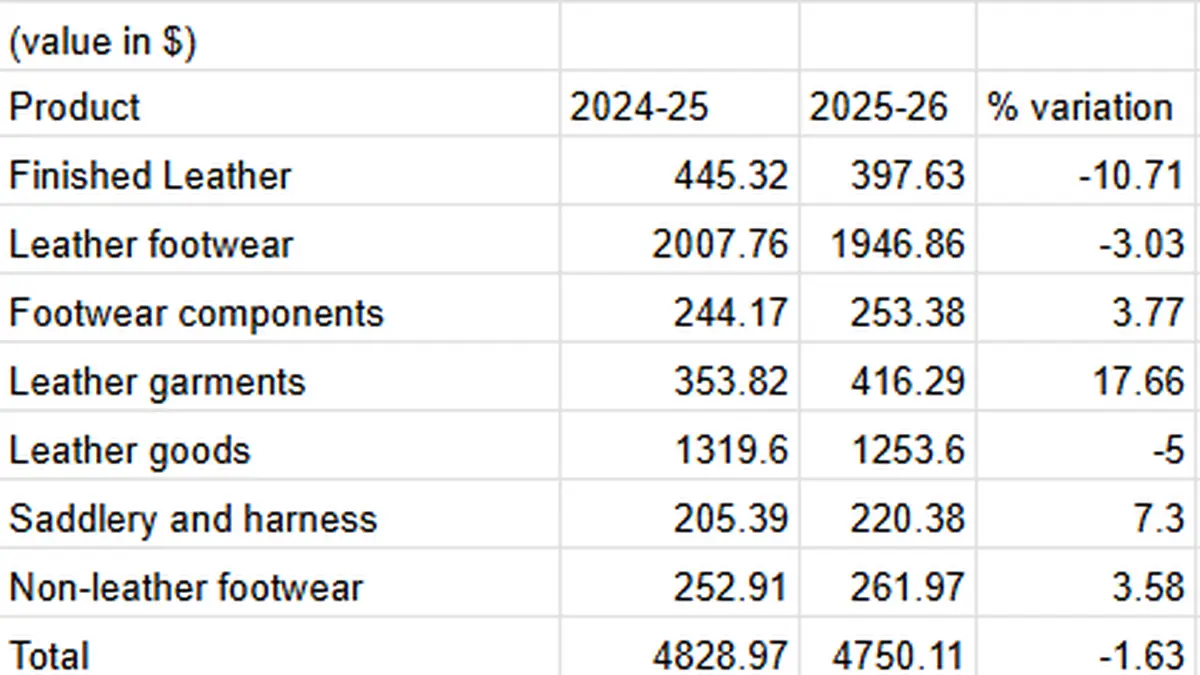
India’s leather, leather products and footwear exports declined 1.6 per cent in dollar terms to $4.75 billion in FY26 from $4.82 billion in the previous year, reflecting softer global demand and the twin impact of higher US tariffs and the prolonged West Asia crisis disrupting global trade flows. This comes after the sector has recorded around 3 per cent export growth in FY25.According to DGCI&S data, exports for the fiscal year ending March 31, 2026, however, increased 2.62 per cent in rupee terms to ₹41,902 crore from ₹40,833 crore in the previous year.The industry comprises finished leather, leather footwear, footwear components, leather garments, leather goods, saddlery and harnesses, and non-leather footwear.Among the segments, leather garments recorded the highest growth at 23 per cent in rupee terms, followed by saddlery and harness, non-leather footwear, footwear components and leather footwear. Exports of leather goods and finished leather declined during the year.Global headwindsIndustry observers said exports remained steady during the first half of FY26 before slowing sharply in the latter half due to rising US tariff barriers and the continuing West Asia conflict, which affected key markets such as the US, Europe and the Middle East.Sanjay Lulla, Managing Director of SM Lulla Industries Worldwide, said the sector was significantly impacted by higher tariff barriers and protectionist trade measures in the US.He added that the prolonged West Asia crisis disrupted shipping routes, increased freight and insurance costs, and delayed logistics movement, creating uncertainty in supply chains and affecting export competitiveness.Rafiq Ahmed, Chairman of Kothari Industrial Corporation Ltd, said the FY26 performance reflected the industry’s structural resilience despite global headwinds.“While the West Asia crisis inflated freight costs and shifting US tariff dynamics slowed dollar-denominated growth, the 2.62 per cent expansion in rupee terms proves that underlying global demand remains robust,” he said.M Abdul Wahab, Managing Director of KH Exports India Pvt Ltd, said the US remained the largest importing country for Indian leather exports.The imposition of a 50 per cent reciprocal tariff by the US during FY26 significantly affected shipments, but the subsequent withdrawal of the 50 per cent reciprocal tariff and replacement with a 10 per cent ad valorem import surcharge from February 24, 2026, has created a level playing field and could support export recovery in the coming months, he said.Market shiftEurope, which accounts for around 55 per cent of India’s leather exports, showed mixed trends. Exports to Germany, the UK, Italy and France declined, while shipments to Spain and the Netherlands grew.Wahab said implementation of the India-EU and India-UK FTAs would provide a major boost to exports in FY27, as leather and footwear products had been granted duty-free access under the agreements.The sector also increased exports to emerging markets such as the UAE, Japan and Australia during FY26.Published on May 20, 2026
Leather exports dip 1.6% in FY26 amid US tariffs, West Asia crisis
Leather exports from India fell 1.6% in FY26 due to US tariffs and the West Asia crisis affecting global demand.
460 words~2 min read