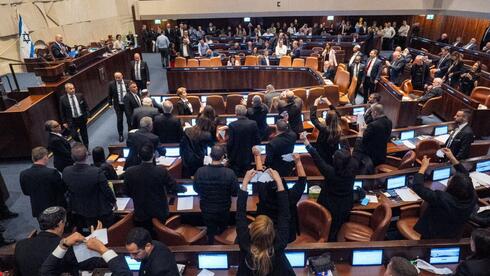
Netanyahu is still trying to revive the draft exemption bill to keep Haredi parties in the bloc, while final election timing remains disputed between September and late October Related TopicsThe Knesset on Wednesday approved in a preliminary reading a bill to dissolve the 25th Knesset, with 110 lawmakers from both the coalition and opposition voting in favor, launching the possible process of moving Israel toward early elections.With the agreement of the ultra-Orthodox parties, which are demanding early elections over the failure to pass the military draft exemption bill, a separate dissolution bill submitted by Blue and White also passed its preliminary reading.1 View gallery (Photo: Shalev Shalom)The approved bills will now move to the Knesset House Committee before returning to the plenum for a first reading. They will then return to committee and only later come up for second and third readings, when the election date would be set.Coalition chairman MK Ofir Katz presented the coalition’s dissolution bill in the plenum and criticized the opposition.“I don’t understand why the opposition is holding press conferences,” Katz said. “You caused the coalition to grow from 64 to 68. We are completing a full right-wing term, a record nine budgets, 520 laws passed. For four years, we played against an empty goal.”In practice, two parallel processes will now begin in the Knesset. On one track, the parliamentary process to dissolve the Knesset and move up elections will advance. On the other, Prime Minister Benjamin Netanyahu will continue efforts to block the move by reaching understandings with the ultra-Orthodox parties and reviving the draft exemption bill in an attempt to prevent the government’s collapse.The passage of the Blue and White bill gives the ultra-Orthodox parties a way to join the opposition in advancing a process that is not under coalition control.Even after the bills passed their preliminary readings, it remains unclear when elections would be held if the process is completed: at the end of October, as Netanyahu prefers, or already in September, as the ultra-Orthodox parties are demanding.Politically, Netanyahu is trying to pass the draft exemption bill to persuade the ultra-Orthodox parties to drop their demand for early elections. His central goal is to appease the Haredi parties and preserve a united bloc ahead of any vote.The statement by Rabbi Dov Landau, leader of the Lithuanian Haredi public, that “there is no bloc anymore,” along with signals from the ultra-Orthodox parties that they would be open to negotiations with the change bloc after the election if the right fails to win 61 seats, alarmed Netanyahu, even though political officials believe the threats may not be fully backed by action.As part of those efforts, Netanyahu met with wavering coalition lawmakers in an attempt to persuade them to support the draft exemption bill, or at least abstain. Netanyahu initially believed there was no majority for the move, but he is now personally lobbying lawmakers including Moshe Solomon of Religious Zionism and Eli Dellal of Likud.Coalition officials claim some of the wavering lawmakers could eventually support the bill or abstain in the vote.Comments
Coalition and opposition back Knesset dissolution bill, pushing Israel closer to early elections
Netanyahu is still trying to revive the draft exemption bill to keep Haredi parties in the bloc, while final election timing remains disputed between September and late October
507 words~2 min read