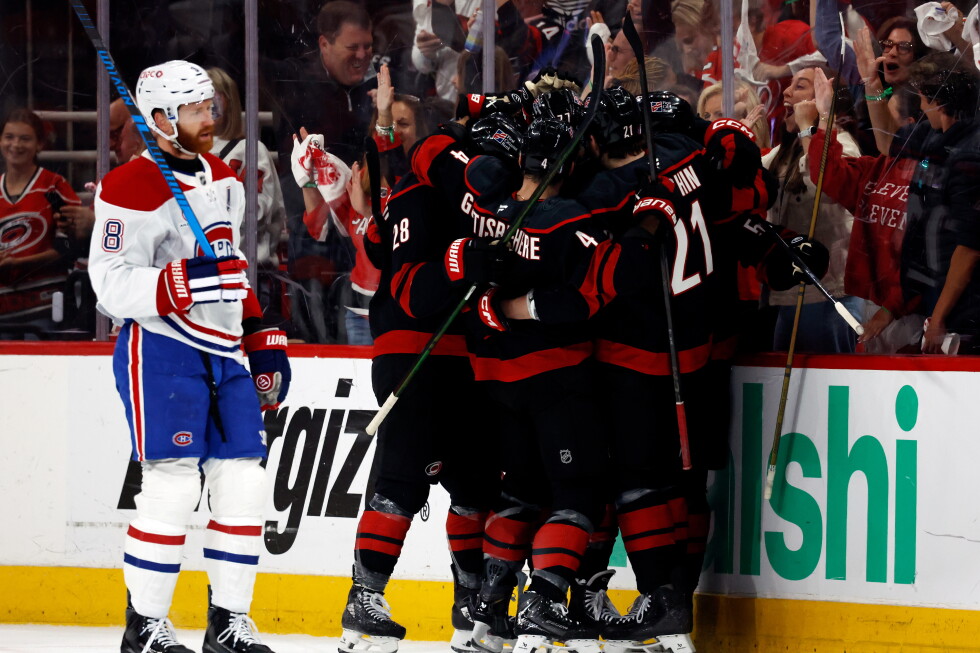
If you like hockey games played between teams with contrasting styles … boy, we’ve got the series for you.The differences between the Carolina Hurricanes and Montreal Canadiens aren’t confined to the on-ice product, either. By the time the puck drops, the Hurricanes will have had 11 days off between games and played just eight times in 36 days. The Canadiens, meanwhile, will be working on approximately 72 hours of rest.Beyond that, we’re getting the most traditional of traditional hockey markets vs. the poster child for the NHL’s southern expansion — which makes for an important bit of common ground. The atmosphere in both buildings is going to be wild. Will the series follow suit?The oddsAs is usually the case for the Canadiens, the odds simply do not matter. Montreal Magic™ is something you can set your watch to. It doesn’t matter how the games actually go — the hockey gods come through for their favorite team. Getting severely outplayed in Game 7 on the road in the first round and second round? No sweat, the Habs will literally just get the bounces.Carolina starts this series as heavy favorites and deservedly so after being the first team ever to sweep two best-of-seven rounds to start the playoffs. This is an elite team, the best version of the Hurricanes we’ve seen in this era; they should be well-equipped to handle Montreal with relative quickness. The vast playoff experience they’ve accumulated over the last five or so years is a point in Carolina’s favor, too.But that’s within the confines of general hockey logic. Montreal Magic™ is special. And this version of the team seems to have a whole lot of it. Discount it at your own peril.The numbersLook past the magic and Carolina has the edge by the numbers, with a plus-68 Net Rating that’s more than double Montreal’s plus-29.The Hurricanes play a high-pressure game on both edges of the ice, between their swarming forecheck and disruptive defense. But this postseason, their rush game has been a real difference-maker, too.Carolina was strong in Round 1, but even more dominant against a more one-dimensional opponent in the Philadelphia Flyers. It all added up to a 55.5 percent xG rate, second only to the Colorado Avalanche, and a 16-6 scoring edge at five-on-five.Montreal’s a completely different team stylistically, so Carolina’s going to have to adapt to that. In the regular season, the Canadiens made the most of their scoring chances and improved defensively down the stretch. So far this postseason, they’ve done a good job adjusting to different matchups so far, too.Against a star-studded but slower opponent, the Canadiens upped their defense at five-on-five to limit the Tampa Bay Lightning’s best. It just suppressed their offense in the process. In Round 2 against the Buffalo Sabres, Montreal upped its xG pace by a full goal to 3.01 per 60, but was much leakier defensively.That offensive boost extends to the power play, which was more efficient against Buffalo. That should be more of a challenge for the Canes to contain, compared to Ottawa and Philly, but their penalty kill (which might as well be called a power kill) should be up to the task. Montreal, on the other hand, has to tighten up its penalty kill if it’s going to find a special-teams edge in this series.The big questionStar power or depth: which will prevail?When the Hurricanes have made their recent postseason exits — in the second round three times in the last five seasons, in the conference final the other two — it’s been largely attributable to two factors: injuries and a lack of ultra-elite talent at the top of the lineup. Carolina fans are sick of hearing it, and we’ve gotten sick of writing it, but neither makes it any less true.This year, they’re as healthy as any team playing May hockey could reasonably expect to be. Maybe that holds up, maybe not. The second factor — whether they have true star power, and whether they need it — will be a question until they win the Cup.That they look as good as they ever have seems undeniable, but also, not a ton has changed atop the pyramid. As great as Logan Stankoven, Jackson Blake and Taylor Hall have been (and may continue to be), they’re still second-liners. For as much skill and creativity as Nikolaj Ehlers adds to the mix, he’s still on a line with Jordan Staal and Jordan Martinook. While the style Carolina plays has sharpened and added dimension, the approach is still, above all else, “strength in numbers.”There’s value in that, quite clearly. The Stankoven line, for eight playoff games and eight playoff wins, has largely driven the bus at five-on-five, providing a layer of offensive insulation Carolina has lacked in previous runs. And that might be where things have changed most dramatically for the Hurricanes — because you’d have a tough time arguing that past versions of this roster could’ve survived for one round, let alone two, while getting almost literally nothing from the top line of Sebastian Aho, Andrei Svechnikov and Seth Jarvis. Those three have just four five-on-five points between them. Aho and Jarvis have one goal each, and neither came with their typical linemates. As a unit, Carolina has lost their minutes 1-0 and controlled 43 percent of the expected goal share, compared to a 29-26 and 56 percent edge in the regular season.
Carolina Hurricanes vs. Montreal Canadiens 2026 NHL Stanley Cup playoffs preview
It's rest vs. rust up against Montreal Magic™ in the Eastern Conference final. The Hurricanes have an edge, but we're in for a treat.
2,608 words~12 min read