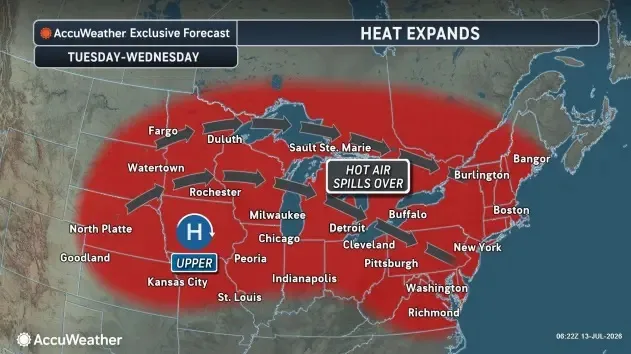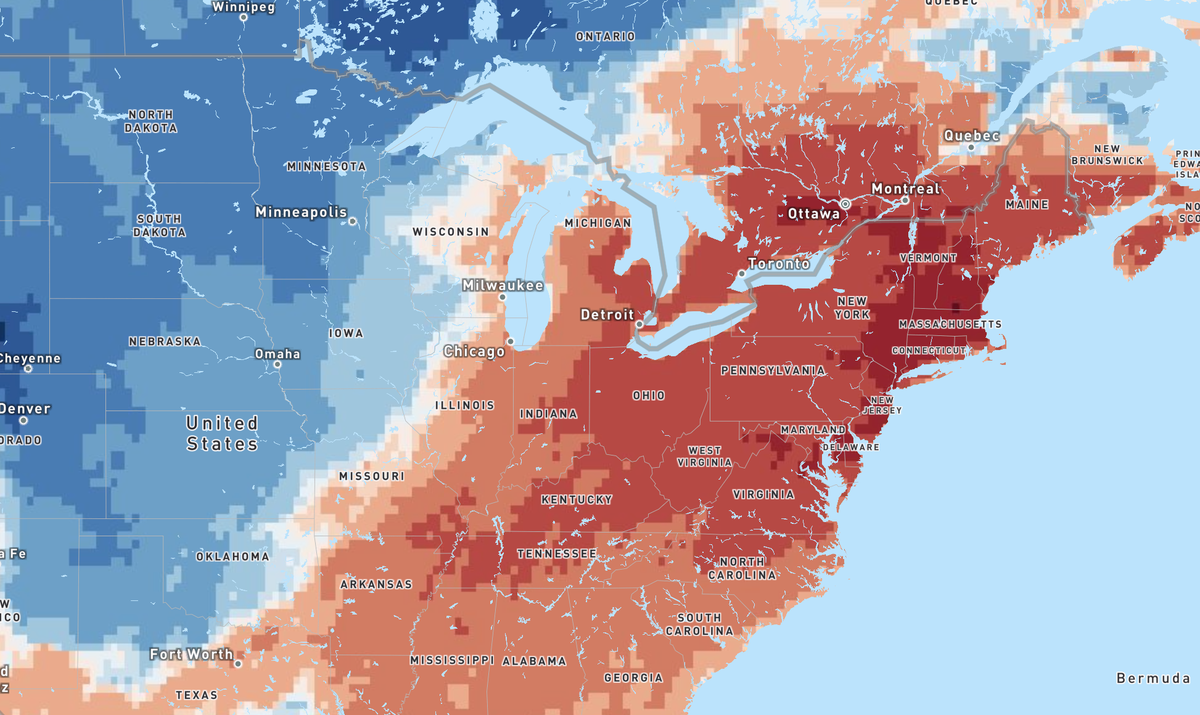
A Bermuda High parked over the western Atlantic is pulling sweltering air up from the South, challenging records in parts of the eastern U.S.By Andrea Thompson edited by Claire CameronTemperatures were more than 10 degrees Fahrenheit (the darkest red shades) above normal on Tuesday, May 19. Join Our Community of Science Lovers!For those in the eastern half of the country, mid-May is feeling a lot more like midsummer, with an early heat wave bringing record-breaking temperatures.Boston hit 96 degrees Fahrenheit on Tuesday, breaking the record for the date of 90 degrees F, set back in 1949. Dulles Airport near Washington, D.C., hit 94 degrees F, surpassing the previous record for May 19 of 92 degrees F. And Philadelphia reached 96 degrees F on Monday, besting the record of 94 degrees F set in 1962.The cause of the roasting heat is a weather system that always accompanies a big spike in temperatures: a high-pressure ridge. In this specific case, the system is called the Bermuda high, a semipermanent area of high pressure hanging out over the Atlantic Ocean to the east of North America that is also one of the atmospheric features that steers summer hurricanes. The clockwise flow of air around the Bermuda high pulls up warm, humid air from the south.On supporting science journalismIf you're enjoying this article, consider supporting our award-winning journalism by subscribing. By purchasing a subscription you are helping to ensure the future of impactful stories about the discoveries and ideas shaping our world today.READ MORE: How to Keep Your Home Cool in Extreme HeatThis heat wave is not as intense as the one that sent temperatures soaring well into the triple digits in the Southwest in March, but it’s still bringing temperatures into the 90s Fahrenheit from the mid-Atlantic to the Northeast—well ahead of average. Humidity is also rising, with dew points in the 60s F—that’s not as sweltering as they can be in the dog days of summer is the highest they have been so far this year, says Marc Chenard, a meteorologist at the National Weather Service’s (NWS’s) Weather Prediction Center.Though this week’s temperatures won’t challenge any all-time record highs, they still pose a health risk because people are less acclimated to heat this early in the year. The NWS’s HeatRisk map tool shows “major” heat risk—the second highest category—from Washington, D.C., up to Boston. Relatively high overnight temperatures are a particular concern because they mean people’s body doesn’t have a chance to cool down and recover.Climate change is driving this event, too. Overall, summer heat waves are becoming more intense, longer-lasting and more frequent. The high-heat season is also bleeding into spring and fall. For this particular heat wave, a tool from the nonprofit research group Climate Central shows that this heat event is two to five times more likely because of climate change.This heat wave will be short-lived for northern areas because a “back-door cold front” will roll through later on Wednesday, Chenard says. First, a more traditional cold front, with winds from the northwest, will move into the area, and then winds will switch to become northeasterly. That shift will reinforce the coolness and keep the heat from reasserting itself over the mid-Atlantic and Northeast. The Southeast, though, will continue to feel sultry temperatures amid a widespread drought that is raising wildfire risks.It’s Time to Stand Up for ScienceIf you enjoyed this article, I’d like to ask for your support. Scientific American has served as an advocate for science and industry for 180 years, and right now may be the most critical moment in that two-century history.I’ve been a Scientific American subscriber since I was 12 years old, and it helped shape the way I look at the world. SciAm always educates and delights me, and inspires a sense of awe for our vast, beautiful universe. I hope it does that for you, too.If you subscribe to Scientific American, you help ensure that our coverage is centered on meaningful research and discovery; that we have the resources to report on the decisions that threaten labs across the U.S.; and that we support both budding and working scientists at a time when the value of science itself too often goes unrecognized.In return, you get essential news, captivating podcasts, brilliant infographics, can't-miss newsletters, must-watch videos, challenging games, and the science world's best writing and reporting. You can even gift someone a subscription.There has never been a more important time for us to stand up and show why science matters. I hope you’ll support us in that mission.
Summerlike heat is breaking records in the East. Here’s why
A Bermuda High parked over the western Atlantic is pulling sweltering air up from the South, challenging records in parts of the eastern U.S.
755 words~3 min read