Modern AI, particularly large-scale language models (LLMs) and specialized reasoning architectures, has evolved beyond its role as a simple data analysis tool. It has become a new and unusual tool for scientific research, capable not only of processing massive data sets but also of simulating complex reasoning chains and virtual experiments. These chains – in physics, sequences of mathematically related computations – can be simulated in a unified digital environment. This capability enables a form of exploratory mathematical modeling, where AI can rapidly iterate through theoretical constructs, propose new relationships between fundamental principles, and generate testable hypotheses. Consequently, this method promises to significantly simplify and accelerate the creation and testing of new scientific concepts and fully-fledged testable theories built on AI computations. This fundamentally changes the epistemology of scientific discovery.
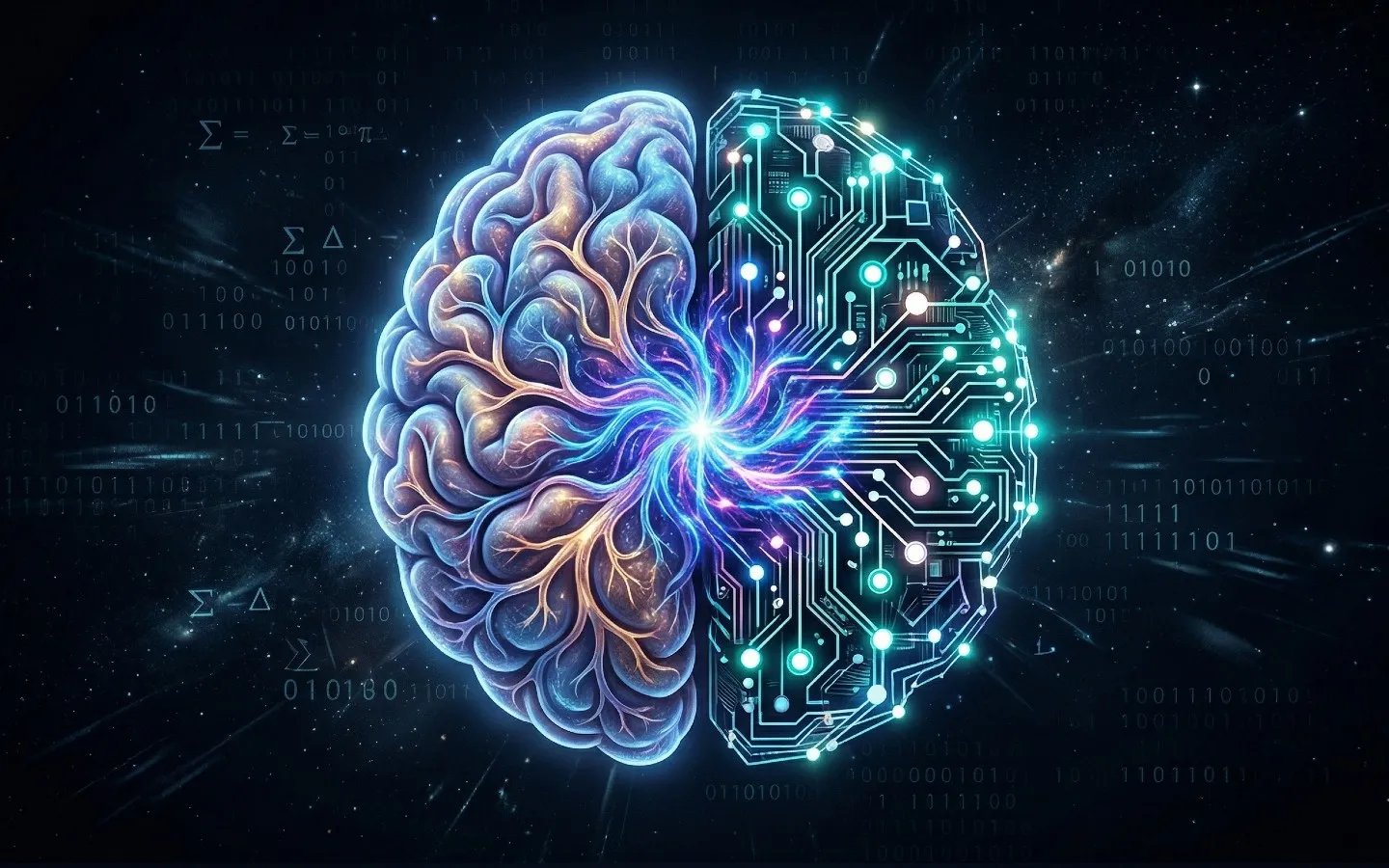
A performance paradigm shift: from biological to hybrid intelligence (individual AI in which the brain tightly collaborates with a machine)
Whether we humans like it or not, the computing power and information breadth of modern AI models leads to a dramatic disparity in efficiency. A single researcher skilled in tight collaboration with AI can achieve higher speeds of concept development and testing than a small team relying solely on traditional, biologically-based methods. This shift is not only quantitative but also qualitative. An AI system acts as a force multiplier for the analytical and creative capacity of the biological brain, offloading intensive computations, quickly and accurately comparing global scientific literature in real time, and suggesting analogies across different fields. This transition marks a historic turning point for science: the sudden and rapid replacement of the old paradigm, where biological intelligence was the sole driver of theory and experiment, with a new, more powerful research model based on the synergistic collaboration between biological and artificial intelligence.