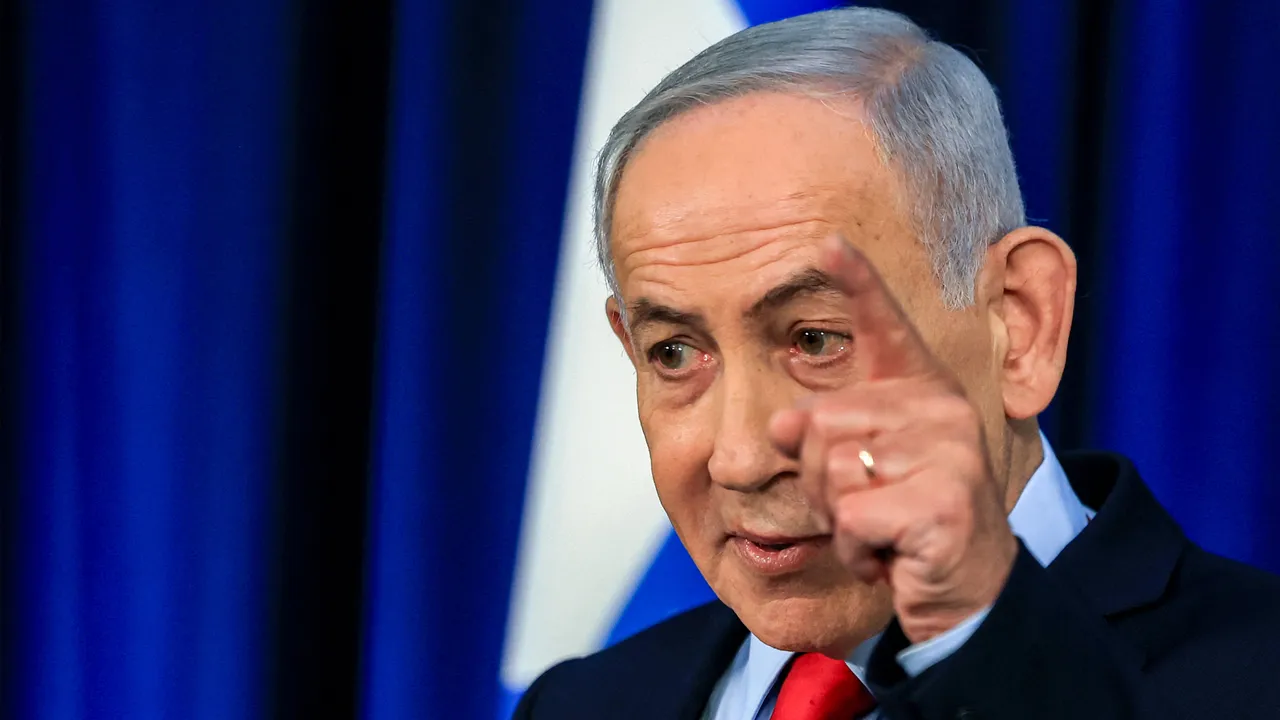
The Israeli Prime Minister’s government is bringing radical change to the country’s democratic institutions.May 18, 2026Photograph by Ronen Zvulun / AFP / GettyOn April 20th, Alex Sinclair, a novelist and part-time lecturer in Jewish education at Hebrew University, was typing away on his laptop at his favorite café in the city of Modi’in. On his head was a knitted kippah, or yarmulke, that he had worn for twenty years, embroidered with both the Israeli and the Palestinian flag—a tribute, he later wrote in a Facebook post, to “the messy ambivalence of my Jewish-Zionist identity.” (He immigrated to Israel from England, in 1997, at the age of twenty-five.) As he worked, he wrote, “a religious man came over to me with an angry face and shouted at me that my kippah is against the law.” Sinclair denied that it was and invited the man to sit down and talk. Not appeased, the man called the police. Five minutes later, two officers appeared, and one—a policewoman who, Sinclair said, looked about his kids’ age—declared the kippah illegal and said that he would be “detained.”In fact, displaying the Palestinian flag is protected speech in Israel, affirmed by the Supreme Court in a landmark decision in 2003. The Court, however, also ruled that an exception might be made in cases of “substantial, deep and severe injury,” such as waving the flag in front of victims of “terrorist activities.” Sinclair knew that Itamar Ben-Gvir, the extremist national-security minister, had exploited that exception, urging the police to remove the flag from public places, citing a danger of “incitement.” But, surely, Sinclair told me, the “top of my head presented no such danger.” Still, he surrendered his kippah when the officers demanded it. They also took his laptop, his phone, and the contents of his pockets, and then drove him to a police station, he said, where he was locked in a cell. But Sinclair was not arrested, and after twenty minutes his belongings, except for the kippah, were returned, and he was told that he could go. He said that he wouldn’t leave without the kippah. A minute later, the young officer gave it back to him; the Palestinian flag had been cut out.“I filed a complaint with the police’s internal-investigation unit for unlawful detention and destruction of property,” Sinclair told me. “I’m not holding my breath.” But he also posted before-and-after photos of the kippah online, which were circulated widely in Israeli media and reported on CNN and the BBC. “I am happy to be a catalyst,” he said, “but I also feel a little guilty that this trivial thing gets so much attention, and we ignore much more disturbing incidents involving Ben-Gvir’s police—anti-government demonstrators being roughed up, or settler attacks tolerated by the border police and Army in the Occupied Territories.”Sinclair’s humility does him credit, but—credit also to memes—it’s hard to imagine a more vivid symbol of what Prime Minister Benjamin Netanyahu’s coalition government has wrought: anti-Palestinian bigotry; politicization of the police; defiance of the courts; and the suppression of a more heterodox Judaism. Netanyahu is also laying the groundwork to cast doubt on any election in which his government does not prevail. After a thousand days of war with Iranian proxies, most recently with Hezbollah in Lebanon, the Prime Minister is trying, and failing, to effect regime change in Tehran. But he is having more success bringing radical change to governing structures in his own country.“Bibi put Ben-Gvir into the police” in 2022, and, more recently, “a messianic settler in command of the Shin Bet”—the secret security service—Hirsh Goodman, a veteran security reporter and the retired founding editor of The Jerusalem Report, a biweekly news magazine, told me. The summer session of the Knesset, Israel’s parliament, began on May 10th and runs to July, Goodman continued, “so there is time enough to put other lackeys in watchdog positions—a new state comptroller, a new civil-service commissioner. The government is overwhelming the Supreme Court and the Attorney General with myriad assaults, so that professional civil servants trying to preserve a functioning democracy are forced to shove fingers everywhere into a leaky dike.” Yohanan Plesner, the president of the Israel DemocracyInstitute, a nonpartisan think tank, is similarly alarmed. He told me that his group has identified some eighty initiatives, “some brazen and urgent, some on a back burner,” by which Netanyahu’s government is seeking to impair or subordinate the judiciary and the civil service—what the Prime Minister calls the “deep state.” (Netanyahu has repeatedly denied allegations that his government is attacking democracy.)Start with the police. Ben-Gvir’s management of it has been so disquieting that the Attorney General, Gali Baharav-Miara, a former Tel Aviv district attorney, filed a sixty-eight-page petition to the Supreme Court requesting that Netanyahu be made to defend his refusal to fire him. Ben-Gvir, she claims, has enforced a “system of pressure” to push the police force toward his extremist views. In one infamous case, he blocked the advancement of an officer who had investigated Netanyahu and then testified against him in a corruption trial, and the officer was finally promoted only when the Attorney General intervened. (Ben-Gvir has argued that he is responding to a mandate from voters and called Baharav-Miara a “crook.”) He also ousted the Tel Aviv police commissioner, who had accused him of demanding excessive force against protesters; and last year, in Jerusalem, police officers threw the leader of the Democratic Party to the ground during a protest against the Gaza war. Meanwhile, the policing of Arab Israeli cities has apparently been so lax that, since Ben-Gvir’s appointment, in 2022, more than seven hundred citizens of the Arab community have been murdered, a yearly homicide rate double what it had been in the year before he took office. “This is not a failure,” Gilad Kariv, a Democratic Party Knesset member, said. “It is a deliberate and planned act of neglect.” (The police have responded that the force treats violence within the Arab community “with the highest level of seriousness.”)In addition, Ben-Gvir’s border police have failed to prevent—and, according to the human-rights monitor B’Tselem, have abetted—Israeli settler attacks on West Bank towns; since 2022, more than forty Palestinians have been killed and more than two thousand injured, and these numbers do not include attacks by the police and the military. (Ben-Gvir has distributed more than two hundred and thirty thousand gun permits to communities deemed vulnerable to attack—including, in January, eighteen new West Bank settlement outposts.) Suspects in these attacks are rarely prosecuted, but Ben-Gvir induced the Knesset to enact the death sentence for Palestinian “terrorists.” (For his birthday, this May, he celebrated with a cake decorated with a noose.) He has further recruited what is arguably, in effect, a personal militia, a three-brigade, two-thousand-person force that is nominally part of the border police but operates within Israel’s borders without the oversight structures that govern that force. Since its inauguration, in January, 2025, it has been deployed in Jerusalem’s Old City and, this past winter, in Bedouin towns in the Negev desert—raiding homes for weapons, subjecting residents to checkpoints and a curfew, and violently breaking up demonstrations, including with the use of tear gas.On April 15th, when the complaint against Ben-Gvir by the Attorney General, Baharav-Miara, finally came before the Supreme Court, the attorney for the government, David Peter, issued a not-so-veiled threat against the Court. Peter invoked Actaeon, the hunter from Greek mythology who angered the gods by overstepping his boundaries, and who was, he said, “hunted down by his own dogs, his body torn to pieces.” The court subsequently declined to issue a decision, but sent Ben-Gvir and Baharav-Miara back into negotiations for a deal to curb the former’s undue influence over the police, though he has blatantly violated such deals in the past.Not coincidentally, Netanyahu’s coalition—which dominates the Knesset with a majority of sixty-four seats, out of a hundred and twenty—has renewed its legislative assault on the court. There are fifteen Supreme Court justices, who serve until the age of seventy, and are appointed by an appointments committee. This group has historically been composed of three justices and two Cabinet ministers, including the Justice Minister—currently Yariv Levin, a member of Likud—two Knesset members (including one from the opposition), and two Bar Association representatives. Seven votes were needed for an appointment. A year ago, the Knesset enacted a law to change the composition of the committee, swapping the Bar Association representatives for two lawyers nominated by the Knesset, one of whom is appointed by the government coalition, and lowering the number of votes needed to seat a justice to five—giving mainly coalition politicians, not jurists, what Baharav-Miara tactfully calls “precedence.” There are currently four vacant seats on the court, but they cannot be filled, because the government has retained a veto until the new law kicks in, after the elections.The Attorney General herself has come under attack. The Religious Zionist Party, which is part of the coalition, submitted a bill, which the Knesset approved in a preliminary vote, to dismantle the Attorney General’s power, separating her role as the cabinet’s legal adviser from her role as chief prosecutor—and making the Attorney General only the government’s in-house counsel, not its watchdog. Last summer, the Cabinet held an unprecedented vote to fire her. The Supreme Court unanimously annulled the firing in December, but this has sunk the country only further into a constitutional crisis.Such threats to the judiciary mirror others to the media and academia. Netanyahu’s administration has tried to close down the army radio, Galatz, which offers nonpartisan programming; it continues to broadcast only because of a court injunction. The coalition is advancing bills that appear aimed at shuttering or privatizing Kan, the public TV and radio broadcaster, and it is pushing a bill to put all broadcast-news sites and other media under a new regulatory council, with a majority of members chosen by the Communications Minister. At the same time, Netanyahu’s government is advancing a bill to put the Council of Higher Education—and its five-billion-dollar budget—under the direction of the Education Minister. The council manages university accreditation, authorizes programs, and controls academic salaries. The law would, in the words of the presidents of all nine of Israel’s public research universities, who signed a letter of protest, place oversight “into political hands.”Finally, there is the general election, which must be held by the end of October, perhaps sooner if ultra-Orthodox leaders in Netanyahu’s coalition follow through on a threat to vote for the dissolution of the Knesset later this week. Since the founding of Israel, in 1948, ultra-Orthodox youth have been effectively exempt from the military draft. The Supreme Court had long ruled their exemption to be unconstitutional; and in 2024 it unanimously ruled that the Army must begin conscripting them. But Netanyahu’s coalition, supported by ultra-Orthodox parties, has tapped only small numbers of willing men, and has been promising to advance a bill—one opposed by more than four-fifths of Israelis—that would supersede the court’s ruling. Indeed, Netanyahu’s Likud is itself divided on the question; so Netanyahu, apparently reluctant to go to an election as the exemption’s champion, first delayed, then tried and failed to fast-track the bill. In any case, it is to the delay that ultra-Orthodox parties have been responding, but they would have nowhere to go other than to a notional Likud coalition after the next election, and Likud, in turn, will need them. All the major opposition parties are united on the need to spike Netanyahu’s authoritarianism and to democratize the draft. Current polls show that Netanyahu’s bloc is not likely to win many more than fifty seats.Facing these and other headwinds, Netanyahu and his allies have been working to undermine the Central Elections Committee, an independent body that manages Knesset elections. The committee is made up of about thirty members, who are appointed by Knesset parties in proportion to their current representation, and it is presided over by a chair who is a Supreme Court Justice. The committee also has a legal adviser, a civil servant who, while reporting to the chair, may serve indefinitely, interpreting election law, representing the committee in court, certifying candidates' qualifications, and insuring a fair count at polling places. The adviser may also be asked to advise the chair on more controversial matters, such as determining whether a party’s messaging is “scurrilous”—a deep-fake advertisement or social-media post, for example—and so must be taken down, pending appeal on free-speech grounds. The outgoing legal adviser, Dean Livne, who held the job for thirteen years, told me that, in 2019, the chair had to issue an injunction to prevent “some parties” from placing “operatives with cameras in polling places.” (The polling stations were in Arab communities.)The current chair of the committee is Noam Sohlberg, a Supreme Court justice who has proved to be the most sympathetic to the Netanyahu governments. Nevertheless, Likud has contested the Committee’s impartiality, filing a petition to the Supreme Court challenging the competence of the new legal adviser, Yifat Siminovski, a senior Intel executive who has experience in managing risk and A.I. deep fakes. (Sohlberg dismissed the petition, calling it “baseless.”) The playbook seems to be: gain control over the levers of voter suppression, and, if that fails, foment skepticism about the election results. In this context, the Elections Committee has a crucial additional responsibility: it can seek to disqualify individuals or parties for violating codified legal standards. “One cannot run if one negates Israel as a Jewish and democratic state, or incites racism, or supports armed struggle by a hostile state or a terrorist organization,” Livne told me. But those standards can be easily stretched by demagogues, and a simple majority on the committee is enough to ban a party, though a panel of nine Supreme Court justices can overturn the decision on appeal. In 2019 and 2022, for example, the small Arab Israeli party Balad was banned for allegedly “seeking to eliminate Israel as a Jewish state” and supporting violent Palestinian resistance, but in both cases was reinstated by the court.The status of the Arab Israeli parties will be particularly important this year, moreover. Opposition parties should gain a comfortable majority; but Arab-Israeli parties will likely win ten or more seats, which means that their support for any opposition coalition may be pivotal. And, according to consistent polling since October 7, 2023, a majority of Jewish Israelis, particularly first-time voters, have begun identifying as right-wing. Arab Israelis, meanwhile, have recoiled from the pitiless methods by which the I.D.F. has prosecuted the war in Gaza, which Jewish Israelis tend not to confront—according to Molad, a liberal think tank, television coverage of Palestinian suffering has been sparse—and most anguish primarily over the welfare of their conscripted sons and daughters. As a consequence, according to a recent poll from the Israel Democracy Institute, more than seventy per cent of Jewish Israelis oppose including Arab parties in the government.and key opposition leaders have pledged not to rely on them. So a few thousand votes could make the difference between the election of a new government or, in effect, a stalemate that forces new elections, leaving Netanyahu in power as a “caretaker” Prime Minister for many months to come.Netanyahu, presumably, is hoping for just such a stalemate. That is likely why his coalition is planting the idea that the Elections Committee’s legal adviser is incompetent. The government’s majority on the committee seems poised to ban various Arab politicians, though the Supreme Court seems poised to reinstate them. Netanyahu, for his part, is already attacking the Jewish opposition parties as potential stooges of the Arab parties, and he’s setting up the Supreme Court—and the Elections Committee legal adviser, who would facilitate the appeals of banned parties—to be blamed for handing the balance of power to non-“Zionists.” Anti-Arab propaganda on the right might then be amplified by Netanyahu’s “poison machine”—Channel 14, and its related social media.It’s worth noting that most of the state institutions, including the Supreme Court, are in Jerusalem, where political violence is not unknown, and where the parties in Netanyahu’s coalition collectively won more than seventy per cent of the vote last time—and won more than eighty per cent in the surrounding settlements. If Netanyahu, like Donald Trump, were to go so far as to call his base into the streets to reject the election results, it’s not hard to imagine that some of Jerusalem’s neighborhoods would respond. As with Sinclair’s kippah, the point is to cut the Palestinians out—something that Israeli democracy could not survive. “I still have some faith in the professionalism of the police rank and file,” Yohanan Plesner said, “but even if there is no Israeli January 6th I’m worried about the process of delegitimizing our democratic institutions as a whole.” Spurious claims against those institutions, and against the judiciary that protects them, have curdled into polarizing hatreds. “The danger is people saying after the election that this is the outcome the Supreme Court, not the majority, wanted.” ♦A scientist with a Ph.D. from Harvard fatally shot three of her colleagues. Then revelations about her family history came to light.
Benjamin Netanyahu’s War at Home
The Israeli Prime Minister’s government is bringing radical change to the country’s democratic institutions.
2,843 words~13 min read