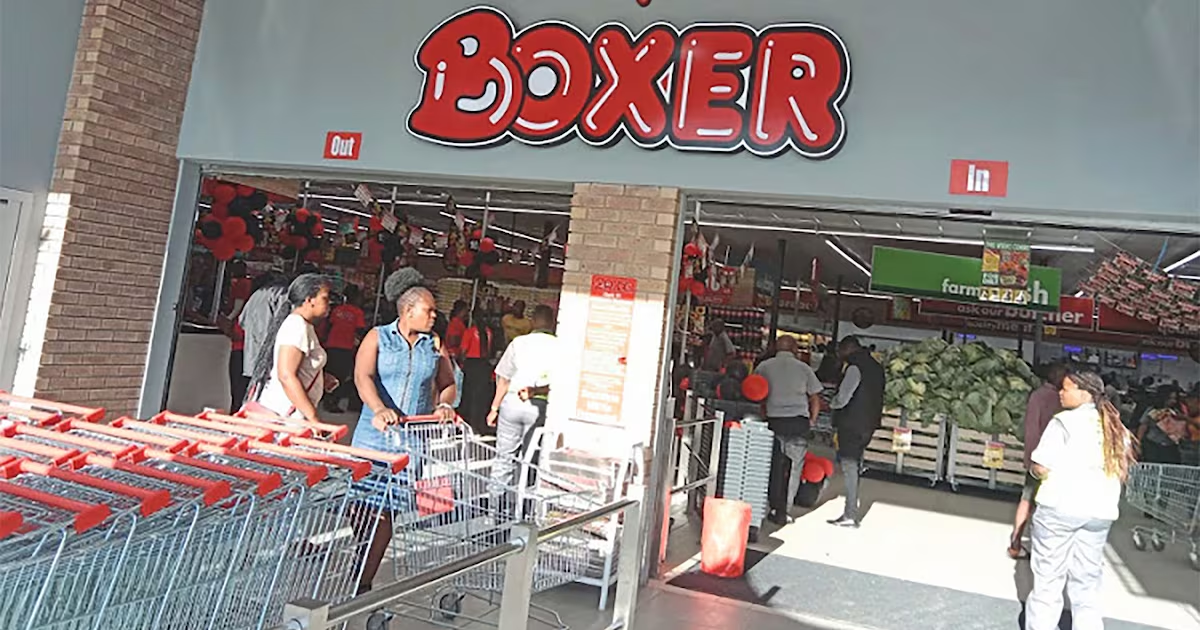
Pick n Pay has once again turned to its fastest-growing asset, Boxer, to support a struggling turnaround, selling part of its stake to raise cash as it races to break even by 2028. Pick n Pay faces multiple pressures, including a bruising dispute with staff over proposed changes affecting more than 22,000 workers and a sustained decline in market confidence that has left the company valued at less than half of Boxer’s market capitalisation.The retailer confirmed on Tuesday that it has sold about 12.5% of Boxer for R4.7bn through an accelerated bookbuild, reducing its holding but still retaining control of the discount chain. The proceeds will be used to fund its turnaround plan and strengthen financial flexibility, it added.The group’s shares were down 3.2% in midafternoon trade, while Boxer was down 5.6%. (Dorothy Kgosi) MP9 Asset Management CIO Aheesh Singh said that selling part of Boxer is not a sign of immediate financial distress, as Pick n Pay still has strong cash levels and relatively low debt. Rather, the move is aimed at funding a longer, more complex turnaround than originally expected, including possible costs from restructuring its workforce, he said.Singh said Pick n Pay’s core supermarket business is still underperforming, and fixing it in South Africa’s weak consumer environment will be slow and uneven. Investors thus remain sceptical.“Investors are discounting heavily Pick n Pay’s ability to fix the core business. The focus will be on whether labour restructuring is implemented without disruption, whether trading losses narrow consistently towards the now-delayed breakeven [by the 2028 financial year] and whether like-for-like growth reflects genuine volume recovery rather than price,” he said.Relentless pressure Pick n Pay has taken a series of measures over the past two years to stabilise its finances after a sharp deterioration in performance. In the 2024 financial year, the group reported an attributable loss of R3.2bn, driven largely by its core supermarket division, which recorded a trading loss of R1.5bn. That triggered a liquidity crisis and forced the company into a debt standstill with lenders.In response, the group implemented a two-step recapitalisation plan, raising R4bn through a rights offer and a further R8.5bn through Boxer’s listing. That process has reshaped the balance sheet, shifting the group from a net debt position of R6.1bn to net cash of R4.2bn by the end of the 2025 financial year.Financial performance has since improved, though the core business remains under pressure, with the group narrowing the attributable loss to R736m in 2025. Boxer has emerged as the standout performer in the portfolio, delivering double-digit sales growth and higher trading profits. Its low-cost model, rapid store payback and expansion potential have positioned it as a key driver of value, while the core Pick n Pay chain struggles to regain profitability.Operationally, the retailer has started reshaping its supermarket estate as part of its recovery plan. It has closed or converted underperforming stores, improved product ranges and pricing, and reported a recovery in like-for-like sales growth in company-owned stores.Shares in the group have declined more than 32% over the past three years, extending a 60% drop in the past five years.
Pick n Pay turns to Boxer again to fund intensifying turnaround
Grocer raises R4.7bn after selling a 12.5% stake in Boxer via an accelerated bookbuild
516 words~2 min read