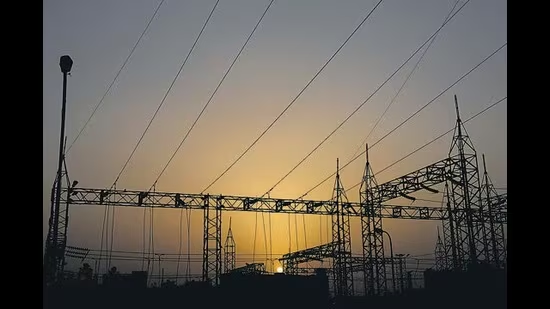
The Ministry of Heavy Industries (MHI) has approved ₹503.86 crore for the deployment of 4,874 public electric vehicle chargers under the first allocation of the Centre’s ₹2,000 crore PM E-DRIVE charging infrastructure programme.But some of India’s largest EV markets, including Maharashtra, Delhi and West Bengal, did not receive a single charger, signalling that in the first round of India’s biggest public charging push, administrative readiness mattered more than market size.The missing states, which also include Punjab, Bihar, Madhya Pradesh and Haryana, together account for nearly one-third of India’s registered electric vehicles and roughly half of the country’s economic output. Their exclusion highlights a central reality of India’s EV transition: building charging infrastructure is as much an execution challenge as a funding exercise.“This is only the first tranche. It is not that these states have been deliberately left out,” a senior Ministry of Heavy Industries official told businessline. “Several states are still completing their formalities and will be considered in the next rounds.”Winners circleKarnataka emerged as the largest beneficiary, securing ₹123.26 crore for 1,243 chargers, followed by allocations to Rajasthan, Uttar Pradesh, Kerala and Tamil Nadu. State-owned oil marketing companies HPCL, IOCL and BPCL together won ₹88.65 crore for 691 chargers, benefiting from ready access to land, existing fuel stations and established power connections.PM E-DRIVE is structured as a competitive infrastructure programme rather than an automatic allocation linked to EV registrations or state GDP. To qualify, states and agencies must identify sites, designate nodal agencies, ensure grid readiness and submit commercially viable proposals.“States that had completed the preparatory work moved faster,” the official said, noting that approvals are tied to the readiness of technically complete proposals rather than the size of a state’s EV market.Maharashtra misses outMaharashtra offers the clearest example. Despite ranking second in India in public charging infrastructure with more than 3,700 chargers and hosting large EV markets in Mumbai, Pune and Nagpur, the state missed out in the first round because charging-related approvals are spread across agencies such as BMC, MMRDA, MIDC, MSRTC and municipal corporations, making it difficult to package a coordinated proposal.“Few states have been proactive and aggressive in determining and defining charging infrastructure requirements and submitted proposals to the Ministry,” said Kartikey Hariyani, founder and CEO of ChargeZone. “We expect the remaining states to eventually submit their proposals.”The execution gapAkshay Singhal, co-founder and CEO of Kazam, said the challenge is not demand but execution. Fragmented approvals, delayed site readiness, grid and transformer constraints, and DISCOM bottlenecks continue to raise both costs and timelines. With most public charging stations operating at less than 5 per cent utilisation, high fixed demand charges can make the economics difficult to sustain.The consequences extend beyond project viability. When organised charging infrastructure does not keep pace with EV adoption, users often turn to substandard chargers, unqualified installers and overloaded residential circuits, creating an underappreciated safety risk in dense urban markets.What the industry wantsIndustry operators say the next phase of expansion will depend less on subsidies and more on improving the economics of deployment. Hariyani called for uniform EV tariff policies, waiver of fixed demand charges and lower cost of capital for charging infrastructure.Singhal advocated time-bound digital single-window approvals for electricity connections and greater focus on home, workplace and fleet-depot charging, where most EV charging actually takes place.More Like ThisPublished on May 20, 2026
Why Maharashtra and Delhi missed PM E-DRIVE’s first 4,874 EV chargers
The Ministry of Heavy Industries has approved ₹503.86 crore for 4,874 EV chargers under PM E-DRIVE, but Maharashtra and Delhi were among seven major states that did not receive a single charger
552 words~3 min read