Wednesday 20 May 2026 5:24 am
| Updated:
Tuesday 19 May 2026 12:32 pm
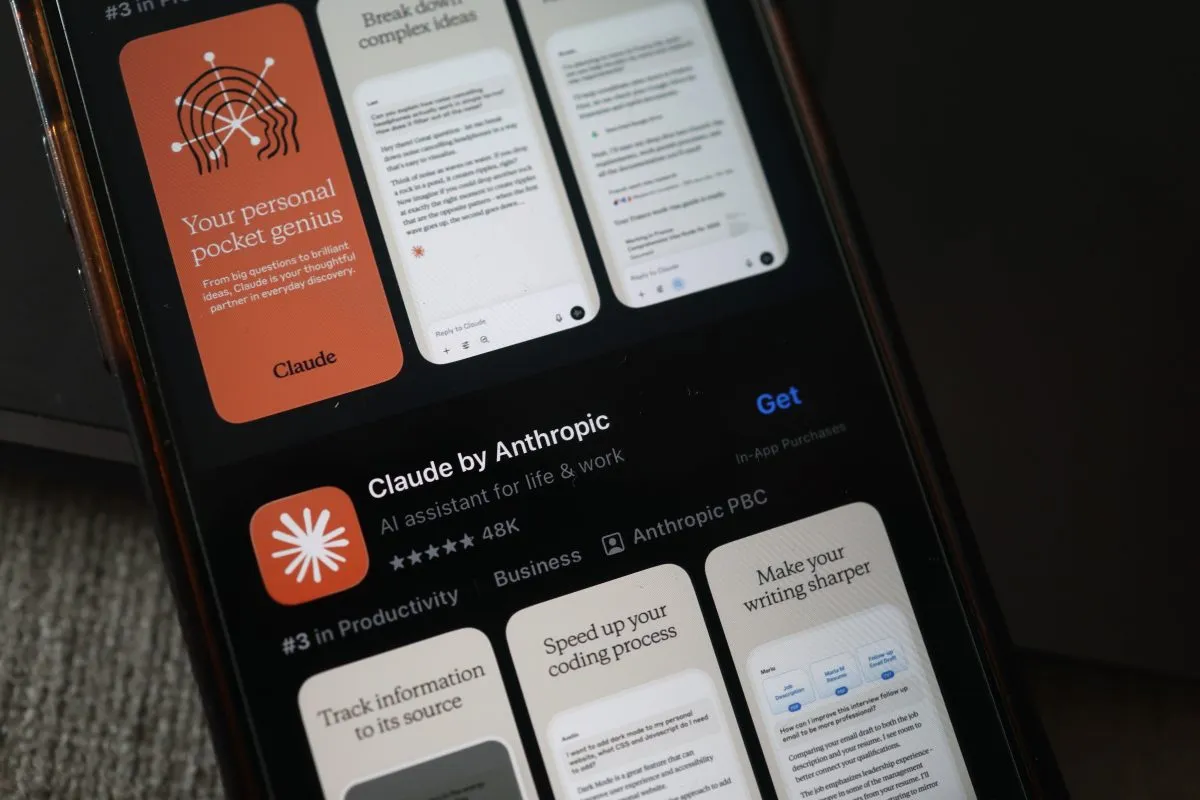
NEW YORK, NEW YORK - FEBRUARY 16: In this illustration, the Claude AI app is seen in the app store on a phone on February 16, 2026 in New York City. According to reports from the Wall Street Journal, the Defense Department used Anthropic's Claude Ai, via its Palantir contract, to help with the attack on Venezuela and capture former President Nicolás Maduro. (Photo illustration by Michael M. Santiago/Getty Images)
The narrative around Anthropic’s Claude, initially perceived as the “ethical AI company,” has recently shifted due to concerns over perceived hypocrisy, aggressive ambition, model degradation, platform restrictions, and vendor lock-in risk, causing customers and developers to seek alternatives, says Lewis LiuWorking title: Claude Was the Intellectual Nice Guy of AI. Then Something Shifted“You really feel like Claude is a real person that you are interacting with in the Bay,” my brother said to me over a Cantonese noodle dinner in the SoMa district of San Francisco last week. We are both AI founders. My brother, Samuel, Co-Founder & CEO of Fergana Labs, which is building shared-memory workspaces for AI agents, is ten years younger than me and has a strong pulse on the zeitgeist of the Bay Area.I was reflecting on this just as the narrative around Anthropic suddenly shifted over the past week. If OpenAI were an American high school character, it would be the star quarterback: popular, known by everyone, brash, speaking only in confident tones and expecting the world to bend to his will. Anthropic, by contrast, would be the intellectual old-money kid heading to Harvard, a bit bookish, a bit wordy, but deeply intelligent, capable and seemingly caring.Over the last couple of weeks, however, that polished façade around Anthropic seems to be cracking. For a while, Anthropic appeared on course to become the world’s most powerful, and perhaps most valuable, company. And then suddenly, something shifted.Last week, four separate things happened within the span of 24 hours: One, in a meeting with the CTO of a major financial institution, they told me they were terrified of Claude, feeling that Claude will “devour all of us”, and stop at nothing to eat everyone’s lunch. Moreover, this CTO said the bank was beginning to consider alternative options because of what they perceived as hypocrisy from Anthropic: presenting itself publicly as the “ethical AI company” while simultaneously appearing to celebrate the replacement of large swaths of white-collar work.Two, at a lunch roundtable with a very senior Silicon Valley venture capital executive whose firm is a major investor in Anthropic, this executive told me they “cannot stand Anthropic’s hypocrisy,” and this was coming from someone who stands to make an enormous financial windfall from the company’s success. Even some of the most AI-optimistic investors are beginning to feel uneasy about the relentless ambition and increasingly hype-driven rhetoric.Three, a Silicon Valley insider friend of mine who was considering jobs at both Anthropic and OpenAI told me that just two months ago they viewed Anthropic as “the most ethical of the Silicon Valley AI companies.” Within weeks, however, they completely reversed course and chose OpenAI instead, saying: “At least with OpenAI, you know where they stand.”Four, my own start-up decided to diversify and pivot slightly away from Claude. This was driven predominantly by customer complaints that our Digital Twins, AI agents that replicate the information flows and knowledge patterns of professional workers, were becoming increasingly slow and inconsistent. Looking into the issue, we found severe latency and availability problems, further exacerbated by what many developers, and we ourselves, observed to be a decline in Claude’s output quality despite using ostensibly the same model. As a company, we decided we should never become dependent on a single AI model provider and now architect our systems so we can switch between providers at any given moment.Devour everything and everyoneThese anecdotes are increasingly backed by data. According to recent analysis, during the week of April 26, Claude Code saw roughly 12m weekly installs compared to 6m for OpenAI Codex. Just one week later, however, Claude Code dropped to 7m installs while OpenAI Codexsurged to 86m. While these shifts are obviously influenced by multiple factors and accounting methodology, many developers I spoke with pointed to growing frustration around model degradation, platform restrictions, and fears that Anthropic increasingly wants to “devour everything and everyone.”Furthermore, over the last few weeks, the developer community has grown deeply frustrated with Anthropic restricting access to Claude for certain third-party open-source developer tools and apps such as OpenClaw, effectively pushing developers toward Anthropic’s own ecosystem. For a fiercely independent developer community, this kind of platform control triggers immediate concern. Many cutting-edge AI builders are now starting to question whether Anthropic intends to be a collaborative player in the broader AI ecosystem, or whether it ultimately plans to control the entire stack itself.To me, these developments point to three broader lessons.One, model providers are becoming increasingly commoditized. In the AI race, the “winner” and “loser” can change on a dime, with frontier capabilities across major players, including Chinese open-source models, converging remarkably quickly, sometimes within the span of just a few months. Declaring a permanent winner in this space is premature at best and misleading at worst. I further contend that, over the long run, open-source capabilities will increasingly converge toward proprietary frontier models, placing structural downward pressure on just how monopolistic companies like Anthropic or OpenAI can ultimately become.Two, vendor lock-in is a very real risk. Developers betting on Anthropic “playing nicely in the sandbox” suddenly found themselves blocked from certain tools and workflows; meanwhile, other builders saw model behavior change materially or costs rise orders of magnitudes in order to maintain the same level of service. Having readily available alternatives keeps the market honest. If your company relies on AI for critical workflows, make sure you have fallback model providers ready and ensure your AI application vendors themselves are architected to withstand these kinds of model shocks.