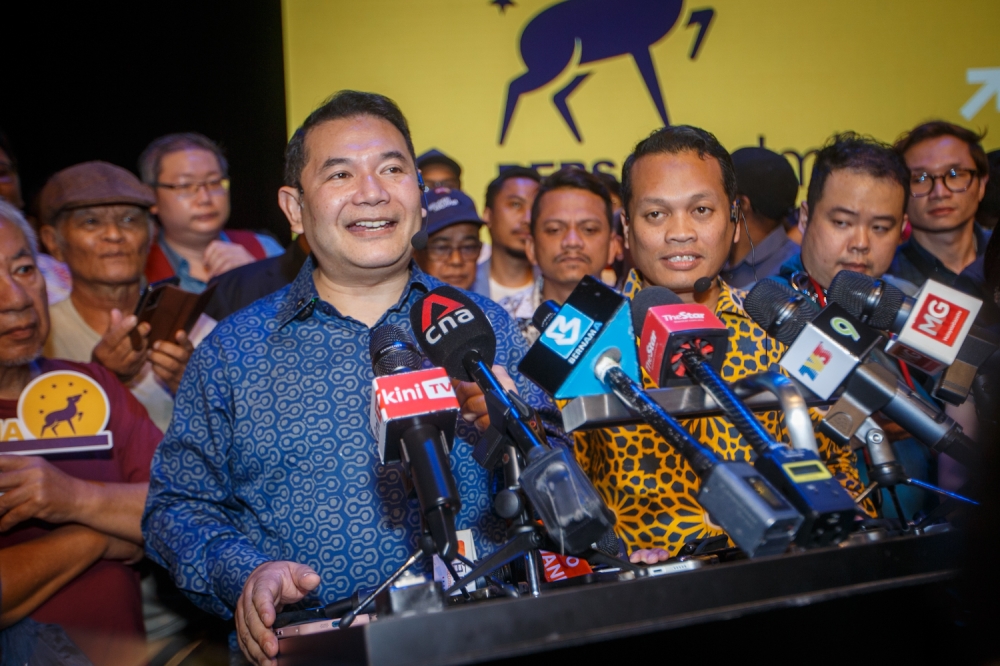
Analysts don't see 'Bersama' as making much inroads besides perhaps splintering votes for Pakatan Harapan. — Picture by Raymond Manuel (New users only) It's tax relief season! Get up to RM300 when you save with Versa! Plus, enjoy an additional FREE RM10 when you sign up using code VERSAMM10 with a min. cash-in of RM100 today. T&Cs apply. By Syed Jaymal Zahiid Wednesday, 20 May 2026 7:00 AM MYT KUALA LUMPUR, May 20 — Malaysian politics again faces a major realignment following the dramatic takeover of Parti Bersama Malaysia (Bersama) by former federal ministers Datuk Seri Rafizi Ramli and Nik Nazmi Nik Ahmad.The duo vacated their respective parliamentary seats effective Monday, having exited the ruling PKR following nearly a year of tension after both were defeated at last May’s party polls.Both former PKR leaders alleged the elections were marred by irregularities.While Bersama positions itself as an independent, policy-driven alternative, analysts said its entry introduces a volatile variable at the upcoming elections.Three analysts explain how Bersama could alter Malaysia’s political board:It could split the urban liberal-centrist votesThe immediate consequence of Bersama going solo could be the fragmentation of the country’s liberal and centrist voter base, said Shazwan Mustafa Kamal, director of Vriens & Partners, a government affairs and public policy consultancy.Urban, multi-ethnic, and centrist constituencies are typically bedrock seats of the ruling Pakatan Harapan (PH) coalition but since Bersama is effectively a PKR splinter party, it would likely target these exact demographics, possibly triggering a classic vote-splitting scenario. “I think the biggest disruption caused by Bersama would be vote splitting among urban centrist voters. If they split this base, would it be possible they could hand victory to the conservative opposition in marginal seats? I think this could be a possibility,” Shazwan said.To mitigate this, analysts suggest Bersama will likely be selective and micro-target specific urban profiles. Rafizi and Nik Nazmi had already said they would defend the Pandan and Setiawangsa seats, so it’s more than likely other party candidates would vie for seats with similar profiles, such as Subang.“What we know now is Bersama is definitely contesting in Pandan and Setiawangsa, and possibly Subang. So they will likely aim for seats with a similar profile,” said Adib Zalkapli, managing director of Viewfinder, a global affairs consultancy.Bersama unlikely to be vanguard of a strong ‘third force’, for nowThe emergence of yet another party championing centrist politics have spurred hope for a third force capable of uprooting the two-party system. But Ibrahim Suffian, who heads Merdeka Centre, a respected pollster, said this is unlikely.“If you look at Malaysian political history never has a so-called third force succeeded unless they align with a larger, more established coalition,” he said, noting that voting trends over the last few decades have consistently shown little public confidence in small break-off outfits.Even PKR itself, which is technically an Umno splinter party, had to collaborate with more established parties like PAS and DAP to stand a chance. Even then it won just five seats initially,” the analyst added.Ibrahim said the case of Malaysia United Democratic Alliance (Muda) corroborates the trend, despite being led by the popular former minister Syed Saddiq Syed Abdul Rahman.There is potential to be a ‘kingmaker’ Given current trends, no single coalition or party is projected to win an outright parliamentary majority in the next General Election. Political pundits generally predict the next government will almost certainly have to be cobbled together through post-election negotiations once again.And in a hung parliament, a five to ten seat bloc would theoretically turn Bersama into a crucial swing vote required to break any deadlock, although Rafizi’s launch speech strongly implied that Bersama intends to maintain strict independence and is positioning itself to sit strictly on the crossbenches. Still, this independence could give Bersama some leverage to dictate policy concessions in exchange for confidence and supply. “They could have some leverage if the matter involves a deadlock (in Parliament) and a deciding swing vote is required. But the biggest kingmakers in any coalition moving forward for now would be Sabah and Sarawak,” said Shazwan.
How Rafizi-led ‘Bersama’ could disrupt Malaysia’s political calculus
KUALA LUMPUR, May 20 — Malaysian politics again faces a major realignment following the dramatic takeover of Parti Bersama Malaysia (Bersama) by former federal ministers Datuk...
675 words~3 min read