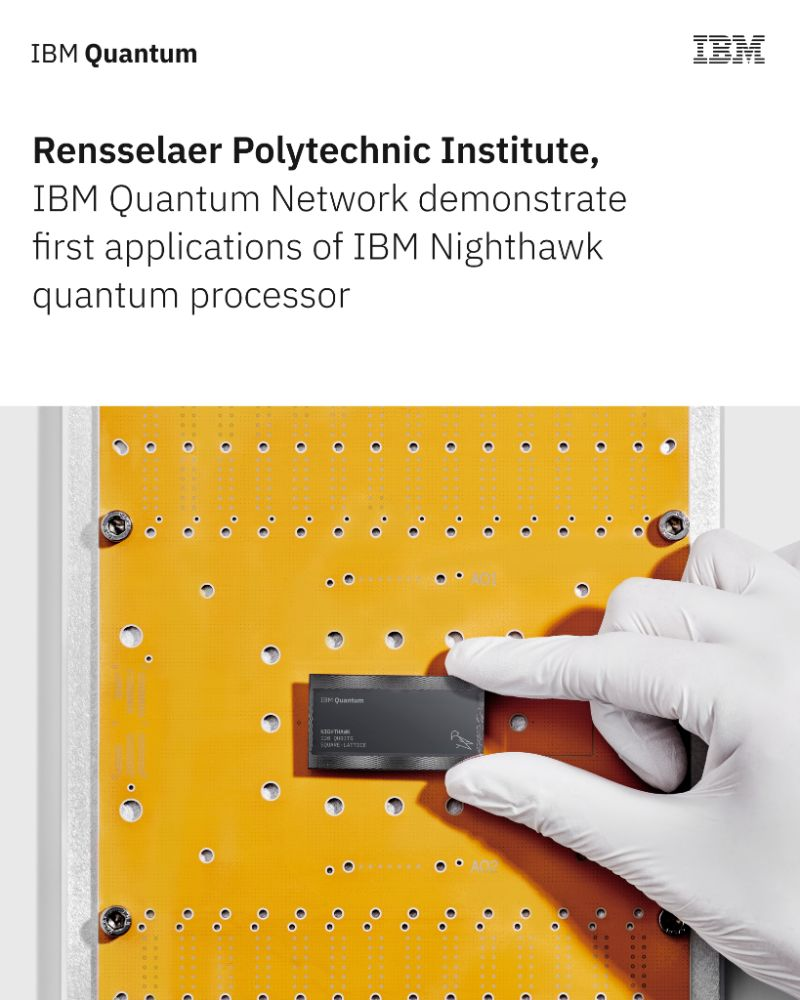
Q1 2026More runtime for Open Plan usersIBM Quantum Open Plan users are getting new learning resources, expanded QPU access, and a special one-time offer: eligible users can now unlock 180 minutes of runtime after using 20 minutes within past 12 months. Sign in to IBM Quantum Platform to view your status.Check your eligibilityRead the blogBest EPLG0.19%On ibm_bostonBest CLOPS330K+Across 7 QPUsTotal available qubits2344Across 16 QPUsTotal papers5857Citing IBM Quantum or QiskitLearn quantum-HPC workflowsDive into the world of quantum-centric supercomputing with our new course, "Integrating quantum and high-performance computing." Get free, hands-on guidance covering:Computing resource managementQuantum and classical programming modelsSQD and SKQD algorithmsStart the course(opens in a new tab)Heron r3 & Nighthawk for deeper circuitsTarget deeper, more demanding circuits on IBM’s latest QPUs. Heron r3 delivers low error rates for complex hybrid workflows. Nighthawk’s square-lattice connectivity enables new kinds of experiments, like a recent study using 2D disordered Heisenberg‑model simulations to examine the thermalization of isolated quantum many‑body systems.Read the study(opens in a new tab)Designing quantum projectsNew course helps you make the most of expanded Open Plan runtime.Learn how to:Scope projectsChoose high-impact use casesSecure fundingStart the course(opens in a new tab)Qiskit v2.4—for software devsQiskit v2.4 makes it easier to build fast, compiled tooling. New C‑API features, improved Python extension support, and faster fault‑tolerant compilation. Better performance without requiring changes to existing workflows.Read the release notes(opens in a new tab)Additional updatesIntroducing Qiskit FermionsQiskit Fermions is a new quantum chemistry library that extends Qiskit with tools for fermionic systems. Use built‑in fermionic mappers, operator tools, and an extensible circuit‑synthesis library—or build your own mappers and circuits with Python or the C API.Browse the Github repo(opens in a new tab)Tutorial: Low-overhead error detection with spacetime codesTry out a novel method that uses spacetime codes to detect errors, balancing the accuracy of fault-tolerant error correction protocols with the lighter-weight computational cost of error mitigation.Run the tutorial(opens in a new tab)Qiskit Functions add real-time logsReal-time execution logs provide visibility into execution stages, applied optimizations, and job metadata. Use `job.logs()` to monitor progress, debug failures faster, and analyze how Functions run—while they're running. Try it now in the Quantum Portfolio Optimizer Function, more soon.Learn about real-time logs(opens in a new tab)Recent blogs
What’s new at IBM Quantum - Q1 2026 | IBM Quantum Computing Blog
Explore new updates, releases, and resources from IBM Quantum and Qiskit with this convenient one-pager, designed to get you started with the latest capabilities right away.
363 words~2 min read