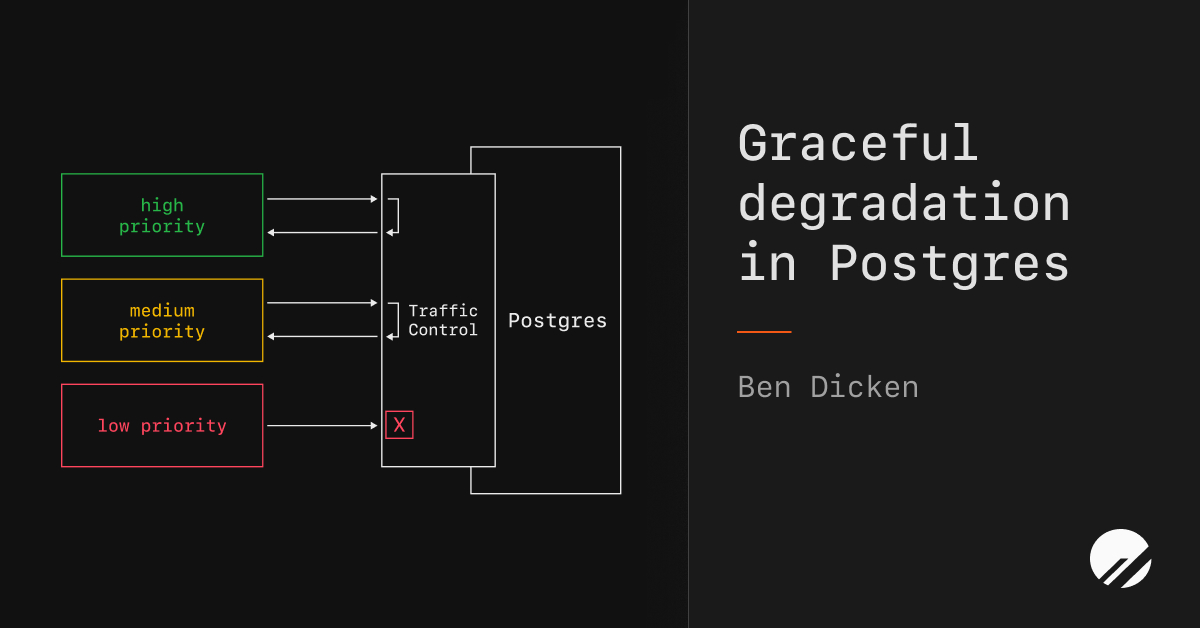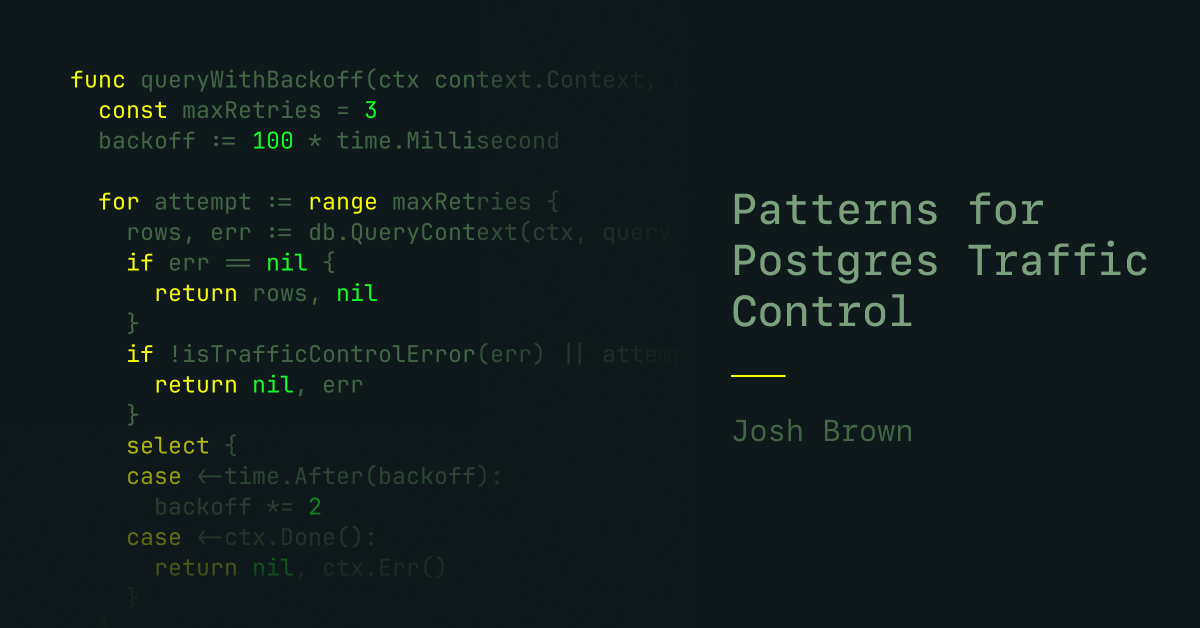
Introducing Database Traffic Control™: resource budgets for your Postgres query traffic.Learn moreBen Dicken [@BenjDicken] | May 5, 2026Transparent database benchmarks help customers make better decisions and push vendors to build better products. →Ben Dicken [@BenjDicken] | May 5, 2026Benchmarking is hard. Done wrong it is very misleading, and unfortunately it is frequently done wrong. Let's explore how not to make silly mistakes. →Ben Dicken [@BenjDicken] | March 31, 2026Not all traffic is created equal.When a database is overwhelmed, you want the important queries to keep executing, even if that means shedding lower-priority work.This is a much better outcome than the alternative: a total database outage. →Ben Dicken [@BenjDicken] | March 13, 2026PgBouncer is the perfect pairing for Postgres's biggest weakness: connection management. Tuning it just right is important to make this work well, and here we cover everything you need to know →Ben Dicken [@BenjDicken] | January 14, 2026What are database transactions and how do SQL databases isolate one transaction from another? →Ben Dicken [@BenjDicken] | October 14, 2025Postgres 18 brings a significant improvement to read performance via async I/O and I/O worker threads. Here we compare its performance to Postgres 17. →Ben Dicken [@BenjDicken] | September 24, 2025Processes and threads are fundamental abstrations for operating systems. Learn how they work and how they impact database performance in this interactive article. →Ben Dicken [@BenjDicken] | July 8, 2025Every time you use a computer, the cache is working to ensure your experience is fast. →Ben Dicken [@BenjDicken] | July 1, 2025Benchmarking Postgres in a transparent, standardized and fair way is challenging. Here, we look at the process of how we did it in-depth →Ben Dicken [@BenjDicken] | March 13, 2025Take an interactive journey through the history of IO devices, and learn how IO device latency affects performance. →Ben Dicken [@BenjDicken] | January 9, 2025Learn about the database sharding scaling pattern in this interactive blog. →Ben Dicken [@BenjDicken] | November 7, 2024Run Vitess workflows right from within PlanetScale. Migrate data from unsharded to sharded keyspaces, manage traffic cutover, and easily revert when problems arise. →Ben Dicken [@BenjDicken] | September 9, 2024B-trees are used by many modern DBMSs. Learn how they work, how databases use them, and how your choice of primary key can affect index performance. →Ben Dicken [@BenjDicken] | August 19, 2024For big databases, IOPS and throughput can become a bottleneck in database performance. Learn how sharding helps scale out IOPS and throughput beyond the limitations of a single server. →Ben Dicken [@BenjDicken] | July 30, 2024Sharding a database comes with many benefits: Scalability, failure isolation, write throughput, and more. However, one of the lesser-known benefits comes from improved backups and restore performance. →Ben Dicken [@BenjDicken] | July 10, 2024Large databases often have a small number of very large tables that makes scaling difficult. How can you scale with these while keeping your database performant? This article covers three techniques. →Ben Dicken [@BenjDicken] | April 24, 2024The adaptive hash index helps to improve performance of the already-fast B-tree lookups →Ben Dicken [@BenjDicken] | March 29, 2024MySQL has built-in functionality for collecting statistics on and profiling your MySQL queries. Learn how to leverage these features to identify problems. →
Posts by Ben Dicken — PlanetScale
Blog posts by Ben Dicken on the PlanetScale blog.
527 words~2 min read