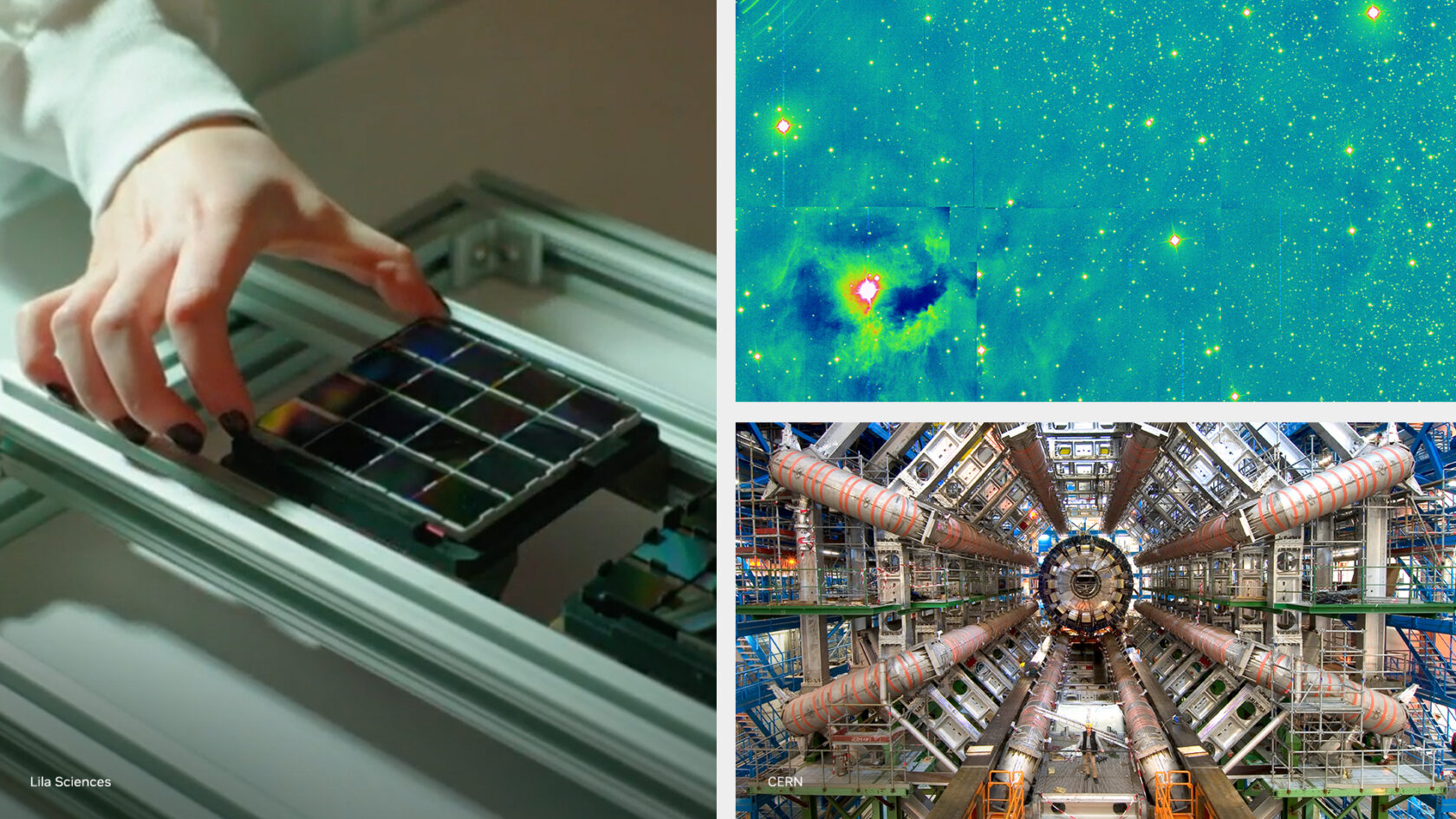
Scientists and engineers who design and build unique scientific research facilities face similar challenges. These include managing massive data rates that exceed current computational infrastructure capacity to extract scientific insights and driving the experiments in real time. These challenges are obstacles to maximizing the impact of scientific discoveries and significantly slow the pace of knowledge growth.
Scientists and engineers at NVIDIA work with these facilities to develop new solutions built on parallel and distributed computation that remove these blockers. This post will walk through two notable examples of formalizing complex physics problems into tractable mathematical puzzles that benefit greatly from GPU-accelerated scientific computing, involving the U.S. Department of Energy: NSF-DOE Vera C. Rubin Observatory and SLAC’s Linac Coherent Light Source II (LCLS-II).
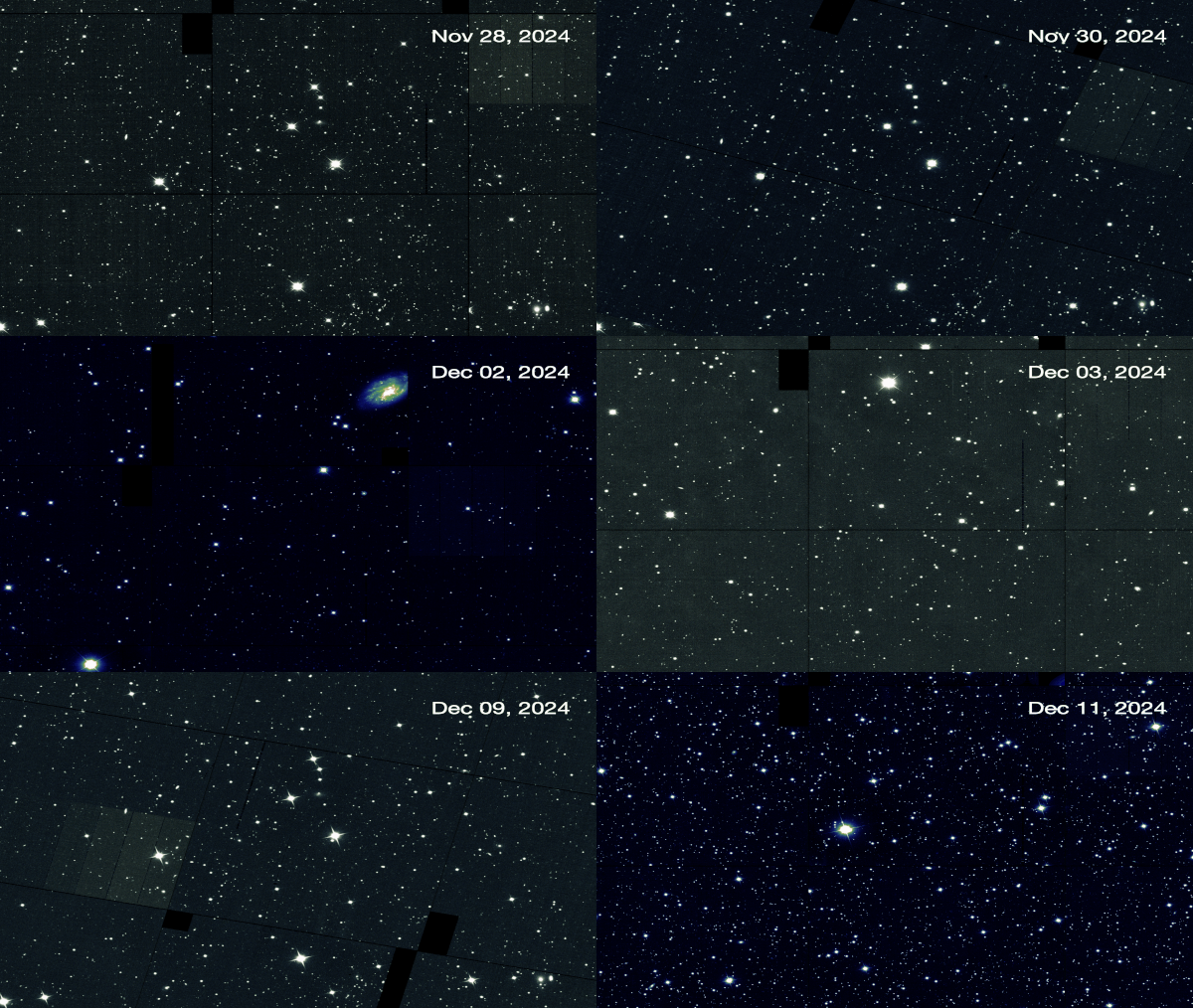
These unique and massive-scale research facilities both took a decade to build and enable unprecedented scientific discoveries to serve worldwide scientific communities. NVIDIA accelerated computing together with the GPU-accelerated Python libraries CuPy and cuPyNumeric are enabling live feedback for experiment steering, which was previously impossible. The team leveraged Accelerated Space and Time Image Analysis (ASTIA) to process real-time “movies” of the southern sky and X-ray Analysis for Nanoscale Imaging (XANI) using cuPyNumeric and CuPy to achieve real-time steering of LCLS II experiments.