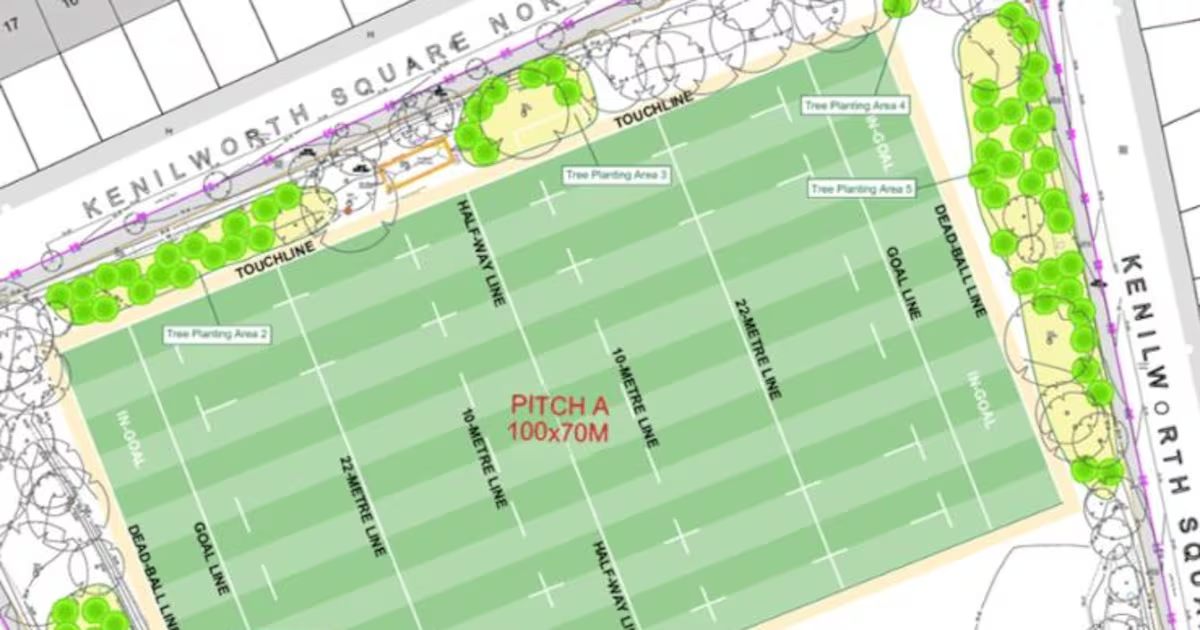
A Dublin residents’ group has got leave to appeal a ruling that a fee-paying school does not need planning permission for changes to its rugby pitch at Kenilworth Square in Rathgar.The Protect Kenilworth Square group, and local resident Martin Joyce, are concerned about the impact of the proposed redevelopment by St Mary’s College on the Victorian-era square.Their lawyers applied to High Court judge David Nolan on Tuesday for the necessary certificate to appeal his judgment, of last February, rejecting their case. Dublin City Council, which decided in 2024 that the works were exempted development, and the school opposed the application.In his ruling granting a certificate, Nolan said the proposed works are a matter of “serious public disquiet and dispute” in the community and the case showed the degree of concern and the competing interests involved.Under planning law the High Court may only certify an appeal if it decides its ruling involved a point of law of exceptional public importance and an appeal is desirable in the public interest, he said.He said he would permit an appeal on one of three grounds raised by the residents – whether he was correct in ruling the relevant regulation did not impose a limitation on such development.Class 33C in part one of the Planning and Development Regulations 2001 provides the “laying out” and “use” of land for athletic or sporting use is exempted development once certain conditions are met, including that no charge can be made for public admission to the land.While he was “not certain” that his finding raised a point of law of exceptional public importance, it was always possible he was wrong and there should be some limitation on the development of lands in the context of class 33C, he said. [ https://www.irishtimes.com/ireland/dublin/2026/02/26/i-would-like-to-preserve-the-square-rathgar-has-mixed-views-on-kenilworth-square-plan/Opens in new window ]He certified the issue to be decided on appeal is whether it is correct, on a proper construction of class 33C, that development involving the laying out and use of lands contains no express or implied limitations as to the type or extent of works permitted and is thus capable of encompassing significant works without requiring planning permission. The judge said he considered “peace and harmony” will only be restored to the community when the Court of Appeal (CoA) has determined the matter.While his decision to permit an appeal may be seen by some as “adopting the road of least resistance”, he believed it is “vitally important to help the community to come back together to have the issue finally determined”. He continued a stay restraining tree felling works for the development. Any further stay will be for the CoA when it makes directions about the hearing of the appeal and costs issues will also be decided later. The proposed redevelopment involves changing the existing grass surface to an artificial all-weather surface, changing the orientation of existing pitches and installing a fence around the reconfigured pitch.While accepting the works would be “disruptive to the beautiful square”, Nolan ruled in February that the council validly granted a planning exemption in August 2024. The residents had argued the exemption was limited to “two-dimensional surface works” and the development would involve “major” excavation with heavy machinery at the square. The judge held, having regard to the definitions of “development” and “works” under the Planning and Development Act 2000, subterranean works were permitted under the exemption class. He disagreed the exemption can only apply to “minor or insignificant” developments.He held the works did not require an environmental impact assessment because the development was not an “infrastructure project”, as defined under the exemption regulations.The judge noted that, “sadly”, the square is not a protected structure, nor is it owned by the residents. The square is private property owned by the school since 1948, which has used it for sporting facilities since then, he said.
Kenilworth Square residents get leave to appeal over school’s rugby pitch redevelopment
Judge says proposed works are matter of ‘serious public disquiet and dispute’
634 words~3 min read