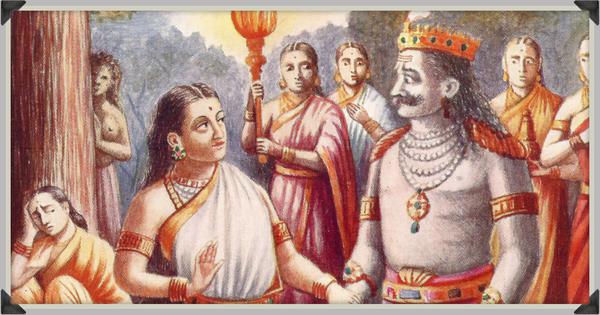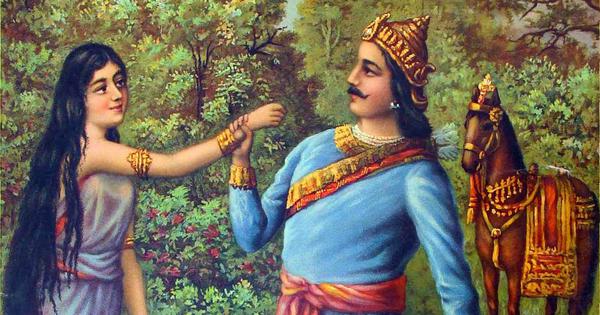
Once, Devayani, the proud daughter of Shukra – the powerful guru of the Asuras – was wandering in the forest with her friend Sharmistha, daughter of the Asura king Vrishaparvan. During the walk, the two friends argued bitterly, leading to a deep rift between them. Sharmistha, angered by Devayani’s condescension, pushed her into a well and left her there, stranded. It was the Chandravamsha king Yayati who chanced upon her and rescued her. As soon as Devayani saw Yayati, she was struck by his strength and nobility and became determined to marry him. She informed her father, Shukra, of her choice, and soon, Yayati and Devayani were wed. Shukra sent Sharmistha as a companion to Devayani. He imposed only one condition: Sharmistha would serve Devayani in their household but would keep her distance from Yayati. Yayati honoured this condition, devoting himself to Devayani, and for a time their life together was harmonious. Years passed, and Devayani bore Yayati ’s sons who grew up in a household filled with wealth and respect. Sharmistha, meanwhile, lived on the fringes of their life, watching silently as the years slipped by. As she matured, her longing for love and companionship intensified. She grappled with her unfulfilled desires, seeing Devayani as a mother and wife while she remained bound to a life of duty.The moon hung low over the palace of Hastinapura, its silver light spilling across marble corridors and into the shadowed gardens where secrets bloomed like night jasmine. King Yayati, his royal robes trailing like a river of gold, walked in the shadowed grove beyond the royal chambers, deep in thought, the state’s myriad issues weighing heavily on his mind. At the far end of the grove, a lone figure stood watching him. Sharmistha had followed the king with a purpose. Her raven hair cascaded like a waterfall, catching the moonlight, and her eyes burnt with a resolve that could ignite empires. It was now or never. As Yayati passed her, she came out of the shadows and stood in his path. Startled, Yayati stopped in his tracks. Sharmistha didn’t say anything, but her eyes were filled with desire. Yayati looked into her eyes and quickly averted his gaze. Hesitating, his royal mantle heavy with the weight of duty, he took a sharp breath, his heart stirred by the fire in her gaze. The cool jasmine-laden air did nothing to arrest the turmoil in his mind. “Why do you linger here, Sharmistha?” Yayati’s voice was a low rumble, like distant thunder. “This grove is no place for a servant at such an hour.”Sharmistha stepped closer, her crimson uttariya (upper garment) shimmering like embers in the dark. “A servant?” she said, her tone sharp as a dagger. “I was a princess, Yayati, before Devayani’s pride cast me low. I come not as a servant, but as a woman who demands her due. Will you deny me a future, a lineage, when your eyes betray your heart’s desire?”Yayati’s breath caught once again, his fingers tightening around the hilt of his ceremonial sword. The air was thick with the scent of earth and betrayal. “You speak boldly,” he said, his voice wavering. “I am wed to Devayani, bound by vows I made to her father. What you ask…it is a path of shadows.”“Shadows?” Sharmistha’s laugh was a spark, fierce and unyielding. “I live in the shadows, Yayati, cast there by your wife’s hand. Marry me, give me sons, and let my blood rise from this disgrace. Or do you fear the fire of a woman scorned?”The king’s resolve faltered, his eyes tracing the curve of her defiance, the storm in her stance. Sharmistha’s demand was no mere plea – it was a challenge, a claim to her stolen dignity. The grove, with its gnarled banyan roots twisting into the earth like unspoken truths, bore witness to their pact. Yayati yielded, drawn not only by desire but by the weight of her will. In the palace, Devayani moved through her days unaware, her silken robes trailing like a river of jade. But her triumph over Sharmistha, having reduced a rival to a servant, and securing her marriage to Yayati had also planted the seeds of treachery. She remained a distant figure, her presence a quiet hum beneath the storm brewing in the shadows. Months turned to years, and Sharmistha bore Yayati three sons – Druhyu, Anu, and Puru – their births cloaked in secrecy, their cries muffled in hidden chambers. Each child was a monument to betrayal, a silent rebellion against Devayani’s dominion. Sharmistha’s heart, though fierce, carried the weight of her deception, for every stolen moment with Yayati was a knife twisted in the trust of her mistress. But secrets are as fragile as glass. One evening, as the sky burnt with the hues of the dying sun, Devayani stood at the grove’s edge, her emerald eyes wide with the sting of truth. She had followed the whispers of the palace, the sidelong glances of servants, to this moment of reckoning. There, beneath the banyan’s ancient canopy, she saw Yayati and Sharmistha, their intimacy a wound laid bare. “You dare!” Devayani’s voice cracked like a whip, the leaves trembling above. “Sharmistha, my servant, and Yayati, my husband, how could you weave this tapestry of lies?” Her hands clenched, nails biting into her palms, as tears glistened like diamonds on her cheeks. Sharmistha faced her, unbowed, her voice steady as stone. “You call it betrayal, Devayani, but I call it survival. You took my crown, my pride, and made me your shadow. I demanded of Yayati what you denied me. A name, a future. If you seek blame, look at your own cruelty.”Yayati stepped forward, his face a mask of guilt and defiance. “Devayani, I am the king, yet I am flawed,” he said, his voice heavy as iron. “Sharmistha came to me, fierce and unbroken, and I could not refuse her. My heart remains yours, but my weakness has undone us all.”“Weakness?” Devayani’s laughter was a jagged edge, cutting through the humid air. “You have shattered our honour, Yayati, and you, Sharmistha, have stabbed me in the dark. My father will judge you both.”She fled to Shukracharya, her sobs echoing through the palace’s marble halls. The sage, his eyes blazing like twin suns, confronted Yayati in the royal court, where torches cast flickering shadows on silken banners. “Yayati, you have betrayed your vows and my daughter’s trust,” he thundered, his staff striking the floor like lightning. “For this, I curse you – may old age claim you now, your youth withered as your honour!”Yayati fell to his knees, his golden crown glinting mockingly in the firelight. “Mercy, great sage!” he pleaded. “I faltered, swayed by Sharmistha’s fire, but I am not beyond redemption.”Sharmistha stood apart, her sons hidden in the palace’s depths, her betrayal now a crown of thorns. Devayani, though wronged, receded into the background, her pain a quiet undercurrent to the clash of wills. The curse took hold, and Yayati’s form crumpled, his hair turning to ash, his eyes dimming like fading embers. Desperate, he turned to his sons, begging them to bear his burden. Only Puru, Sharmistha’s youngest, agreed, a final act of loyalty amid the wreckage of trust. The palace stood silent, its walls whispering of a servant who demanded a king’s affection, a king who betrayed his queen, and a love that burnt too fiercely to endure. The banyan tree, its roots drinking deep from the earth, held the tale close, as if to guard its secrets for eternity.Excerpted with permission from The Foundation of a Fulfilling Life: Lessons from Indian Scriptures, Deepam Chatterjee, Aleph Book Company.
Lessons on pride and forgiveness from Yayati, Devayani, and Sharmistha’s tale from the Mahabharata
An excerpt from ‘The Foundation of a Fulfilling Life: Lessons from Indian Scriptures’, by Deepam Chatterjee.
1,284 words~6 min read