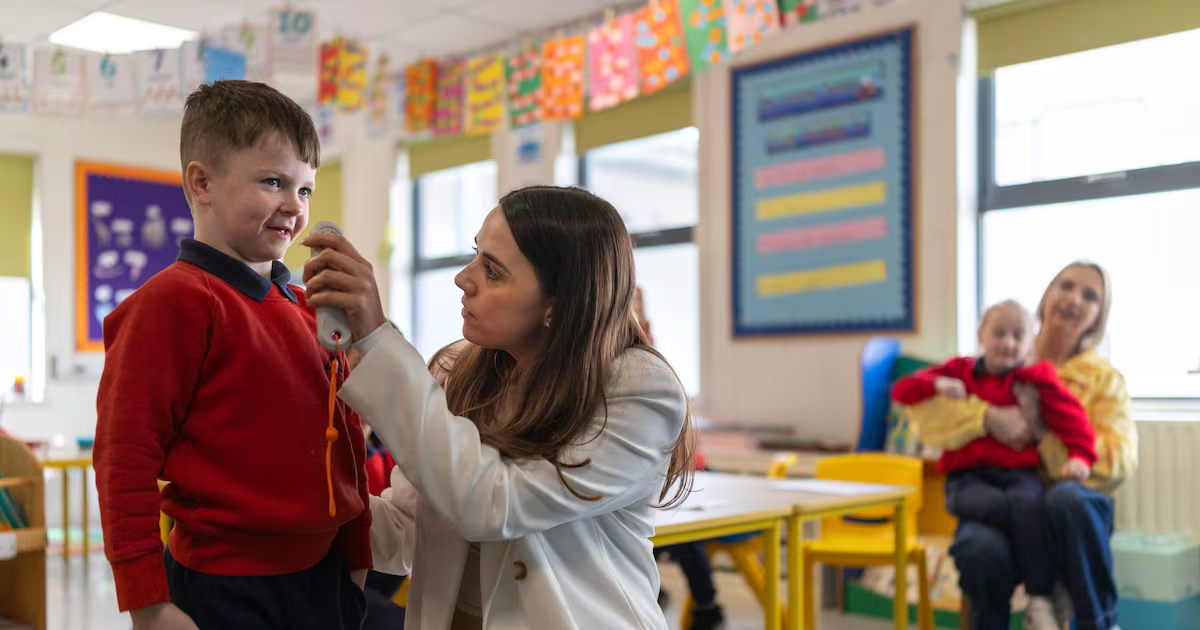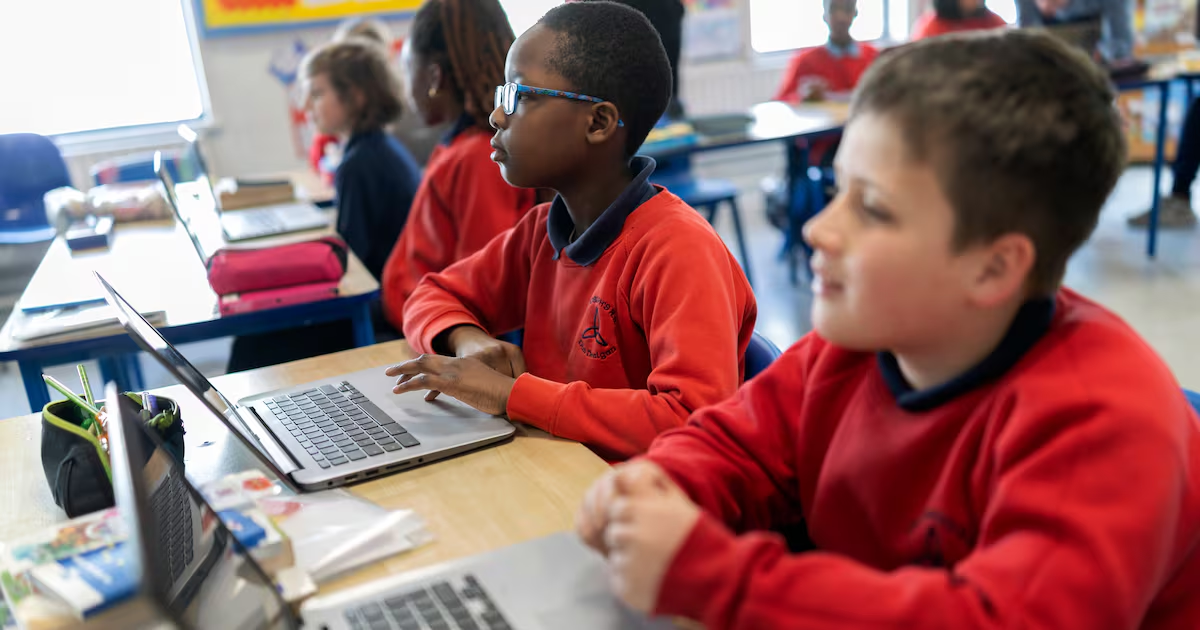
How long do butterflies live for? Why do they have wings? And where do they live? These are some of the questions the junior infants class of St Joseph’s Primary School in Dundalk, Co Louth, ask their artificial intelligence (AI) voice assistant, named Merlyn, one Thursday morning. The butterfly’s lifespan varies greatly depending on species, Merlyn tells them. They have wings so they can fly and they live everywhere except Antarctica, the AI bot says.“They wouldn’t like it down there. It’s too cold,” one of the infants says in response. St Joseph’s is a Deis Plus school, one of about 120 across the country identified as having the highest risk of educational disadvantage and poverty among its students. Children at St Joseph's benefit from learning via AI. Photograph: Chris Maddaloni The school has almost 600 students and 64 staff, with an autism class, a speech and language class and a multitude of nationalities and languages.At the start of this academic year, Alan O’Connor, a special-education teacher, introduced to the school a pilot programme with Merlyn Origin.Alan O'Connor, digital technology co-ordinator and special-education teacher, says AI can benefit teachers, too. Photograph: Chris Maddaloni This is an AI voice assistant that allows teachers and students to ask it questions through a remote microphone that links in with the classroom’s whiteboard and the teacher’s laptop.It also has a generative AI tool that teachers can use to draw up lesson plans and create tests. “The main convenience of this is it frees the teacher up from their desk, so they can be working with the children, but yet they can operate all of their computer devices, their interactive whiteboards. You don’t have to constantly return to your desk,” O’Connor says.The use of AI in Irish classrooms has become the source of recent heated debate, particularly amid a revamped senior cycle curriculum at second level. Teachers have raised concerns about students using tools such as ChatGPT, one of the most popular AI bots, to complete their coursework, which will form up to 40 per cent of some Leaving Certificate subject grades from next year.There has also been criticism of the Department of Education’s engagement with schools on the issue and the difficulty of keeping Government policy in line with the pace of change in the sector. Teacher Charlotte Irwin uses Merlin AI in her junior infants class at St Joseph's. Photograph: Chris Maddaloni Alongside this, teachers have pointed to reduced deep-learning skills and attention spans among students and fear pupils may not properly critique or analyse the information they receive from the technology. Richie Bell, history teacher at Coláiste Muire Máthair in Galway city, says AI is “like a dirty little secret” in Irish classrooms because “people are using it, but nobody’s talking about it”.“I liken it a little bit to doping in sport – that kind of notion that everybody’s at it, but nobody’s talking about it,” he says.Does he see the use of AI as the same thing as doping in sport in that it constitutes cheating?“If the aim of education is to broaden the human mind and make us more intuitive, to make us more philosophical, to make us better speakers, better writers, if that’s the aim of education, then of course you’re cheating,” he says.“But if the aim of education is to produce people to do jobs and do work, then you’re not cheating, because AI exists and you can use it down the road.”He is one of several teachers who have expressed a wish for further guidance from the department on the use of AI in the classroom.The Department of Education says decisions on using digital technology are a matter for the board of management. Photograph: Chris Maddaloni Last October the department published Guidance on AI in Schools, what it called a “dynamic document” that would be “reviewed periodically to incorporate new developments in AI”. It explains what AI is, what its benefits and risks are and how it is being used in schools. It includes a roadmap for how it could be used in future. However, it does not include any practical guidance for teachers on what specific technologies are out there and how to use them, but rather refers simply to “GenAI” as a general term for all different programmes.Is Bell happy with the level of guidance and training on AI that has been given by the Department?“There is none. It’s like looking at tumbleweed rolling down a western village,” he says. “In terms of using it in the classroom, you’re largely on your own. I have nothing to tell me how to use AI. It’s largely up to myself or anybody who tells me. That’s all I have.”In response to questions from The Irish Times, the department says: “There is no obligation for schools and teachers to facilitate the use of AI. Decisions regarding the use and deployment of digital technology in schools [are] a matter for the board of management of each school.”It points to a new taskforce established in April on the safe use of AI across the school system.This taskforce will work with “education stakeholders” to update the guidelines published in 2025 and will focus initially on the impact of AI on assessment.Teacher Joe Rayfus says schools waited too long for AI guidance from the department Joe Rayfus, an art teacher at Mullingar Community College who co-ordinated the Merlyn AI pilot programme in 48 schools across Ireland, says schools are struggling to cope with the emergence of AI.“It’s the wild wild west. There is some basic enough guidance from the department published last year, which we waited a very, very long time for, and it’s very broad and very general,” Rayfus says.Ireland has a problem, too, in that “we talk about AI as this broad, collective term – we have to realise that it’s a disjunctive term and start breaking that down”, he says.“It’s like going shopping and having a carton of milk, an apple and a packet of tissues in your basket. While technically they’re all groceries, they all serve a totally different function. “It’s like that with AI. If we really want to make inroads, we need to look at what teachers actually want and need and what supports their practice in a classroom.“The real art of teaching is what happens in that 60-minute period in the classroom and we need to ask, ‘How do I use AI to support that?’.”Teacher Yvonne McCabe uses Merlin AI in her class at St Joseph's. Photograph: Chris Maddaloni When it comes to fairness and potential downsides, Rayfus believes proper training and information sharing for teachers are key to addressing these issues.“If you properly resource and train and empower teachers, teachers do what they do best and they will transfer that moral guidance, they will transfer the appropriate use of AI to students organically,” he says.“Will there still be some who will take advantage and try and cheat a test? Yes, but they were doing that long before AI; you always have to try and put in safeguards around that. But we can’t just assume that suddenly every single student is going to cheat the test using AI.” The principal of St Joseph’s, Roz Morris, is aware of the checks and balances needed to ensure its accuracy, but believes it holds huge potential for her students.Principal Roz Morris says children can learn to be critical thinkers about the answers that AI is giving. Photograph: Chris Maddaloni “We’re living in a world where misinformation is rampant, where bias is there, where racism is there, where children are exposed on social media to a lot of misinformation and believing that it’s true,” she says. “Children here are going to get the opportunity, in real time, to be confronted with information during the lesson, that they will use their critical thinking to say, ‘Teacher, I don’t think that’s right’ or for a teacher to say in real time, ‘Let’s look at another source’.”She says children will, from a young age, “learn to be curious, to be creative, but also to be critical thinkers of the answers that the AI is giving them”.For fourth class at St Joseph’s, it’s time for a lesson on Italy. Children log into the session through their laptops and start by typing in all the facts they know about the country, with their responses popping up on the whiteboard to be discussed as a class.Then, it’s time for them to ask Merlyn some questions about Italy – and there is one burning issue we would all like to know the answer to.“Has pineapple always been on pizza?” one student asks. No, Merlyn responds, pineapple has not always been on pizza.
‘I liken it a little to doping in sport’: Is use of AI in classrooms a help or hindrance?
Artificial intelligence has been compared to the ‘wild west’, and teachers say they need proper guidance
1,445 words~7 min read