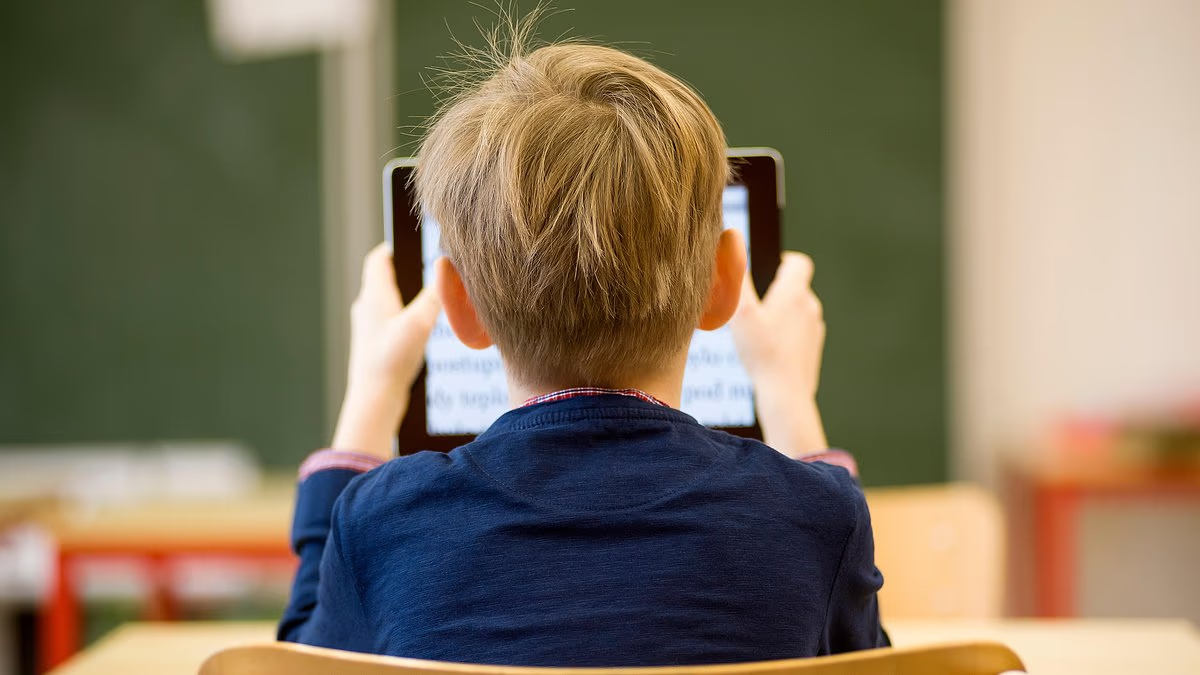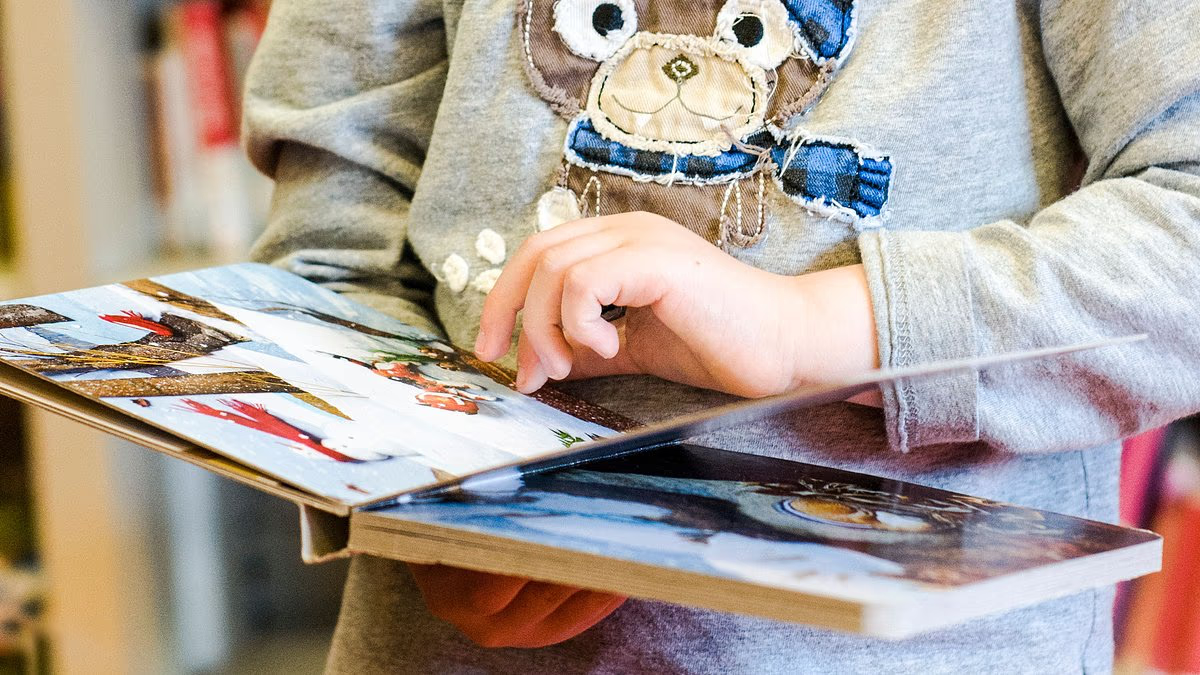
Children are so addicted to screens they have started swiping books as if they are tablets - and teachers are warning things are about to get even more dystopian. Young pupils turn up on the first day of school completely baffled by the traditional methods of teaching after an early childhood dominated by digital devices.This has led some to grow instantly bored during their first day on the classroom carpet, once they realise they cannot doom-scroll their way through the lesson, school staff told the Daily Mail.Michelle Windridge, who has been teaching at a school in Birmingham for 20 years, said she had seen the phenomenon spiralling out of control in the last six or seven years.'It has been more apparent that children are starting school more familiar with iPads and screens than toys or story books and you'll often see children touching to try and swipe a book when they first start school,' she said.Almost farcically, the teacher, 43, has on numerous occasions offered children an apple during snack time, only to have them start searching for an iPad.More terrifying still, Ms Windridge is becoming increasingly accustomed to kids starting school with American accents 'because they're watching YouTube so much'.Dr Tej Samani - who runs Performance Learning, which collects data and visits schools in a bid to improve how students learn - said he was unsurprised to hear about the latest worrying sign that children are becoming hooked on screens.Children are so addicted to screens they have started swiping books as if they are tablets - and teachers are warning things are about to get even more dystopian (Stock Photo) Michelle Windridge, who has been teaching for 20 years, said she had seen the phenomenon spiralling out of control in the last six or seven yearsNevertheless, the teaching expert admitted the stories had 'scared' him, adding: 'It is not cute - it's a red flag.'He said: 'The screens are beginning to steal the practice children need to grow up with. 'I've come across so many examples where you take the screen away and the child has a meltdown. My fear is teachers are having to parent before they can even start teaching. 'How does a teacher deal with a child who swipes a book exactly? It's the dawn of a new, very scary time.'Dr Samani contrasted the 'disruptive reactions' prompted by removing a screen from a child with the 'trance-like, unhealthy levels of calmness' when they are handed back.'Take the screen way, it's severe,' he said. 'Give the screen back, instant calmness. And replace the screen with a book, a board game or a walk, it does not have the same effect.'More than a quarter (26 per cent) of five to 12-year-olds spend three or more hours on such devices every day, with 7 per cent racking up over five hours daily, according to stats by children's play experts Outdoor Toys. Karen Simpson, 43, who runs an online private tutoring business based in Scotland, saw this unsettling new development coming a mile off. 'What did we expect when all these things were introduced?' she said. 'They assume that everything they use that's got some form of screen must be swipeable. 'Anything that takes their eye or might be engaging, they expect they'll be able to touch it or swipe it. 'There wouldn't be a thought of, "maybe I've just got to read here and nothing else".'Ms Simpson added that her own experience as a mother had revealed just how addicted children are to screens. 'My own kids, if we go to a museum or something, if there is a screen they just expect there must be stuff they can do it,' she said.In a previous epoch, story time was once the highlight of a primary school day with children rushing to the carpet to listen to an exciting tale.But now, most would rather be left to their own devices.Ms Simpson said: 'Now you're struggling to get nursery children to sit and listen to a story for a few minutes.'In Scotland, you can't make kids come to the carpet if they don't want to sit there.'These stories are not just symbolic, peddled by doom-mongers with a nostalgia for the old way of things - although they certainly serve that purpose. Karen Simpson, who runs an online private tutoring business, saw this unsettling new development coming a mile off and said many children no longer enjoy story timeThey also have long-term consequences, teachers warn, with digital addiction taking root at an early age likely to be much harder to banish as the children grow older. 'It massively impacts their ability to problem-solve,' Ms Simpson said.'They are just so used to that instant gratification that comes from online doomscrolling, that dopamine hit all the time. And they don't want to have to work anything.'The expert has spotted a sharp decline in children's creative writing skills, and their ability to come up with ideas - in all subjects. Ms Windridge added that excessive screen time was even damaging pupils' ability to speak fluently. 'We've got massive delays in speech and language now as well,' she said. 'Some children don't know the basic movements required to form words with their mouth and tongue because we get that from looking at other people face to face and imitating what they do, and you can't get that from a screen.' Children of course are not the only ones hooked on their digital devices. Even adults who grew up in a smartphone-free era spend much of their day staring at their phones and tablets.Eye-watering figures last year from the Institute of Practitioners in Advertising (IPA) revealed over-15s spend an average of 7.5 hours a day on screens - including mobiles, laptops, tablets, games consoles and watching TV.Overwhelmed by digital temptations from the moment they can walk - or even before - today's children have perhaps understandably become wary of the myriad dangers they can pose.The term 'brain rot' was wheeled out repeatedly by pupils concerned about their screen use during a survey of those aged eight to 17 conducted by Ofcom last year. Dr Samani argued that while phone-fixated parents are able to 'self-regulate', children require others to set the right example.'Tech is a quick fix,' he said. 'It's a distraction and attention grabber for the child. It's too easy to give the child the iPad and the phone. 'As a result of that, it's too easy for them to get addicted to it and this is firsthand proof and evidence it's beginning to take over in quite an alarming way.'I think it starts really early on at home, they [should] begin to get the old sort of behaviours that have served us so well - getting them interested in things, getting them using their hands, getting them building stuff, getting them playing, getting them reading.'They can't achieve that level of satisfaction and self-regulation from scrolling on a phone. They have to be given the phone to begin with.'Replace the phone, or don't bring the phone into the equation until much later on.'Confused children swiping books is just the latest worrying development coming out of the classroom, with the Daily Mail reporting last year that some pupils were struggling to sit up straight on the carpet thanks to a childhood spent staring at screens instead of playing outside.Many are unable to cope with the long hours in class when they first enter school, often slumping onto the floor or falling out of their seats.It's all being attributed to an astonishing increase in tablet and smartphone use among young children, introducing a screen addiction at a young age which soon becomes their main source of entertainment over visits to the playground or the park.Unsurprisingly, this leaves little time for exercise and traditional forms of fun, with less than half (44 per cent) getting two hours of outdoor play each day and a whopping 30 per cent not getting out the house at all most days.This inactivity has had a huge impact on children's muscle development, making it difficult for them to sit up straight for substantial periods of time.Who's to blame for letting tech take over schoolkids' lives? 'I would say fundamentally it lies with parents,' Ms Simpson said. 'Every time I'm asked about whose fault it is... who else's fault will it ever be in all these situations? You are their parents. Every situation, the fault lies with you. Dr Tej Samani said he was unsurprised to hear about the latest worrying sign that children are becoming hooked on screens'Smart technology and smartphones impact adults to the same extent and so in parenting, we have parents that just want things instantly fixed.'It is learned behaviour from bad parenting, which is because parents have now been conditioned through social media to think their tolerance and ability to be a parent is decreasing.'Ms Windridge refused to directly blame parents - although she noted the widespread prevalence of mothers and fathers 'scrolling' as they waited by the school gates.But she also defended her and her colleagues who have at times come under fire for not clamping down on screen addiction in the early primary school years, claiming they are simply following government programmes.'A lot of the time we rely on tech in schools and that isn't the school's fault,' she said. 'We have to teach phonics from a government-validated scheme and these schemes involve tech.'It's great the government are giving guidelines to parents but it needs to be more. It needs to be embedded in society, how to balance [tech].'A few years ago, we'd get excited when it was our class's turned have the iPads. But now we are thinking actually, "whatever lesson it is, can we do it without the iPad? Can we do it without tech?"' Government proposals to ban social media for under-16s were meanwhile branded 'the tip of the iceberg of what needs to happen' by Ms Simpson. Labour has been consulting on a blanket ban, but may have to settle for a set of restrictions on their use. Dr Samani added: 'I don't necessarily think it's anyone's fault but I think the genie's out the bottle and we need to deal with it.'It is a huge red flag. It's mainstream. We're aware of it but it's still early enough to do something about it.'
How screen time is seeing children SWIPE books as if they are tablets
Young pupils turn up on the first day of school completely baffled by the traditional methods of teaching after an early childhood dominated by digital devices.
1,719 words~8 min read