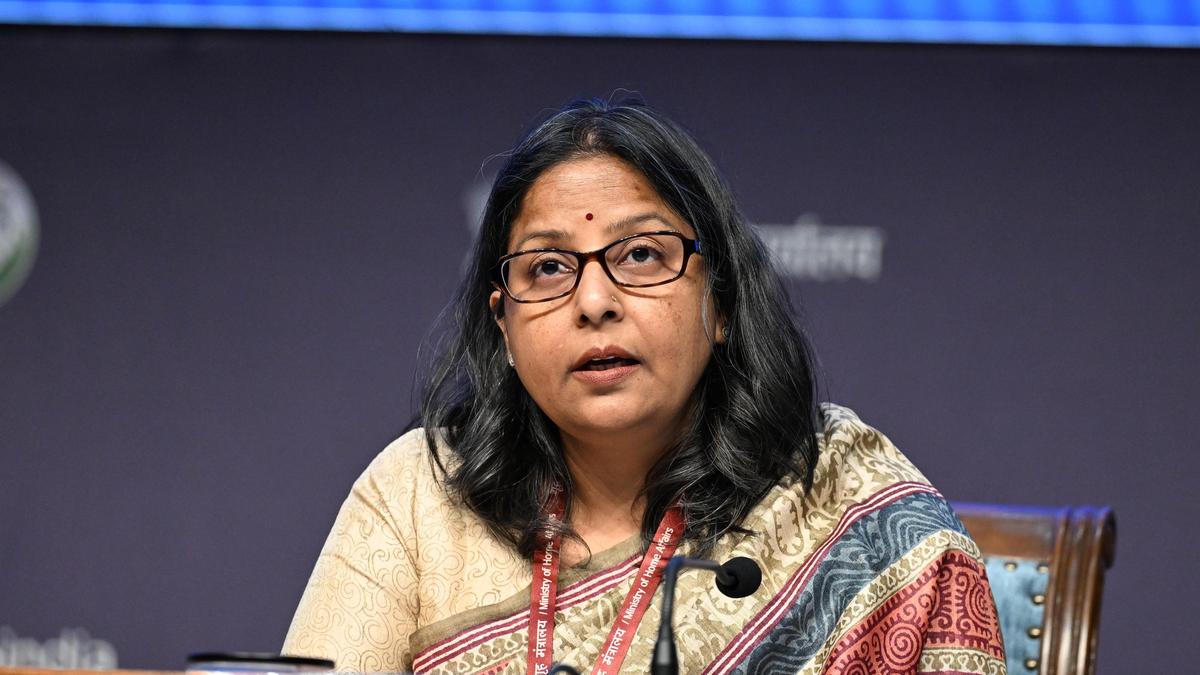
Sujata Sharma, Joint Secretary, Ministry of Petroleum & Natural Gas
| Photo Credit:
India will continue to buy Russian crude oil regardless of the status of the US sanctions waiver, based on commercial viability, after Washington let the waiver on Moscow’s seaborne crude oil expire over the last weekend.Asked about India’s position on the expiration of the US sanctions waiver, Sujata Sharma, Joint Secretary at the Oil Ministry, said “Regarding the American waiver on Russia, I would like to emphasise that we have been purchasing from Russia earlier... I mean before the waiver also, during the waiver also, and now also.”The statement also reiterates India’s position vis-a-vis its energy security, particularly at a time when crude oil and refined product prices are hitting north adversely impacting the profits and margins of the PSU oil marketing companies (OMCs).“It is basically the commercial sense which should be there for us to purchase. There is no shortage of crude. Enough crude has been tied up repeatedly... and this, whatever waiver or no waiver, it (availability) will not affect,” Sharma emphasised.Kpler noted that even with the waiver uncertainty, it remains difficult to see India materially stepping back from Russian barrels. The issue is no longer purely about sanctions optics, but increasingly about supply security and economics in a much more fragile global crude system.“With continued geopolitical uncertainty and the Strait of Hormuz (SoH) situation still far from normal, including restricted transits, higher freight risk, and slower flows, Middle Eastern barrels are no longer as straightforward or secure as they were previously. In that environment, Russian crude continues to offer a clear advantage through both pricing and relatively stable logistics via non-Strait routes,” emphasised the global real time data and analytics provider.Sumit Ritolia, Kpler’s Kpler’s Lead Research Analyst for Refining & Modeling, explained that even if the waiver lapses, flows are likely to remain broadly stable, although they could ease modestly from March levels.A key distinction often missed is that Russian oil itself is not sanctioned but certain entities, vessels, and financial channels are. Russia will continue to be a core supplier for India, but procurement must strictly ensure no involvement of sanctioned sellers or intermediaries, use of non-sanctioned vessels, fully compliant financial, insurance, and trading channels, he added.“Russian crude has remained the backbone of India’s import slate, with flows recovering back toward around 1.9-2 million barrels per day (mb/d) in March (2026) after easing earlier in the year. May import is around 1.9 mb/d till date with overall expected to be around 1.8-1.9 mb/d,” Ritolia said.India’s procurement of almost 2 mb/d of crude oil from Russia is the highest since June 2025.The shift has not been a direct replacement of West Asian barrels from a single source, but rather a broader re-optimisation of the crude slate based on availability, refinery compatibility, freight economics, and sanctions exposure, he opined.Aggressive buyersRefiners have remained more aggressive buyers of Russian and opportunistic Atlantic Basin barrels, along with bypassed flow of Saudi and UAE grades where available. Venezuelan crude has also made a notable return to India in recent months, partially offsetting the decline in Gulf-linked supply, Ritolia added.Sharma also said the May 15 hike in retail prices of diesel, petrol and compressed natural gas (CNG) has helped the OMCs cut their losses. Earlier, the OMCs were faced with a loss of ₹1,000 crore per day, which post the price rise has come down to around ₹750 crore a day.She, however, added that a bailout package to make up for OMC losses for selling petrol, diesel, CNG and LPG below cost, is “still not on the table”.Recently, Prashant Vasisht, Senior VP and Co-Group Head Corporate Ratings at ICRA, said that the modest hike in retail price of ₹3 a litre for petrol and diesel provides limited relief to the OMCs.Published on May 18, 2026