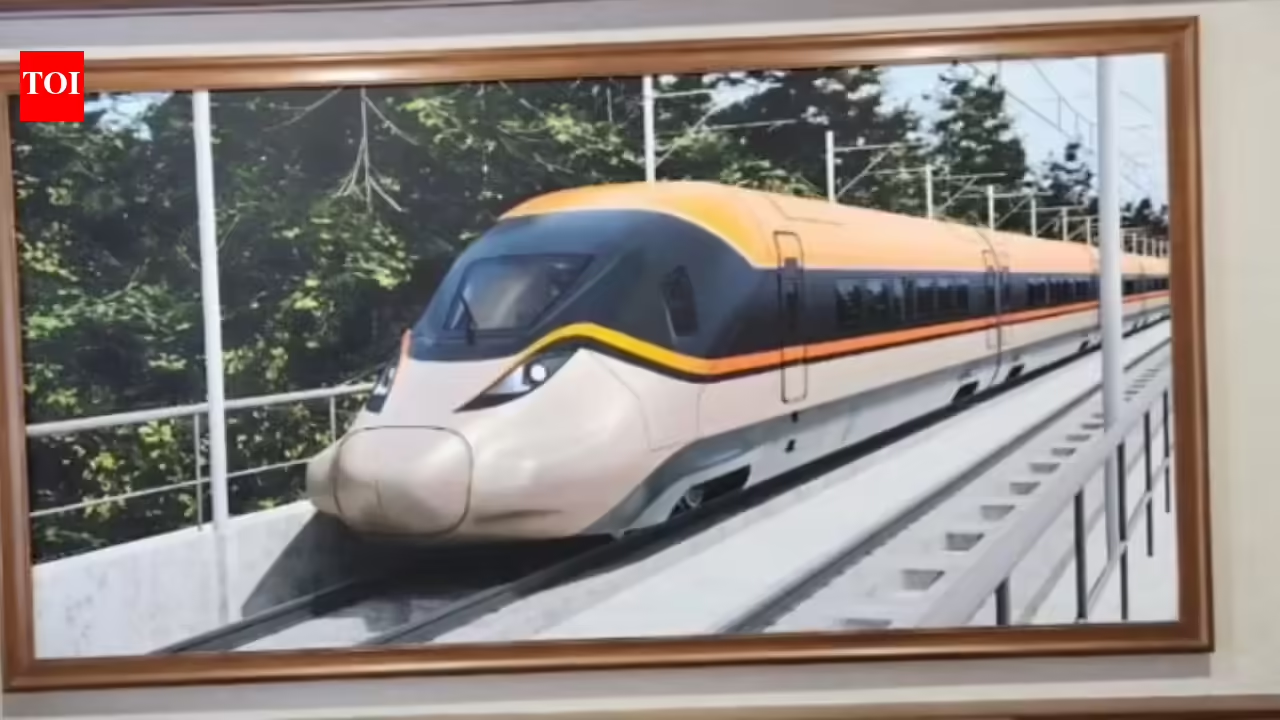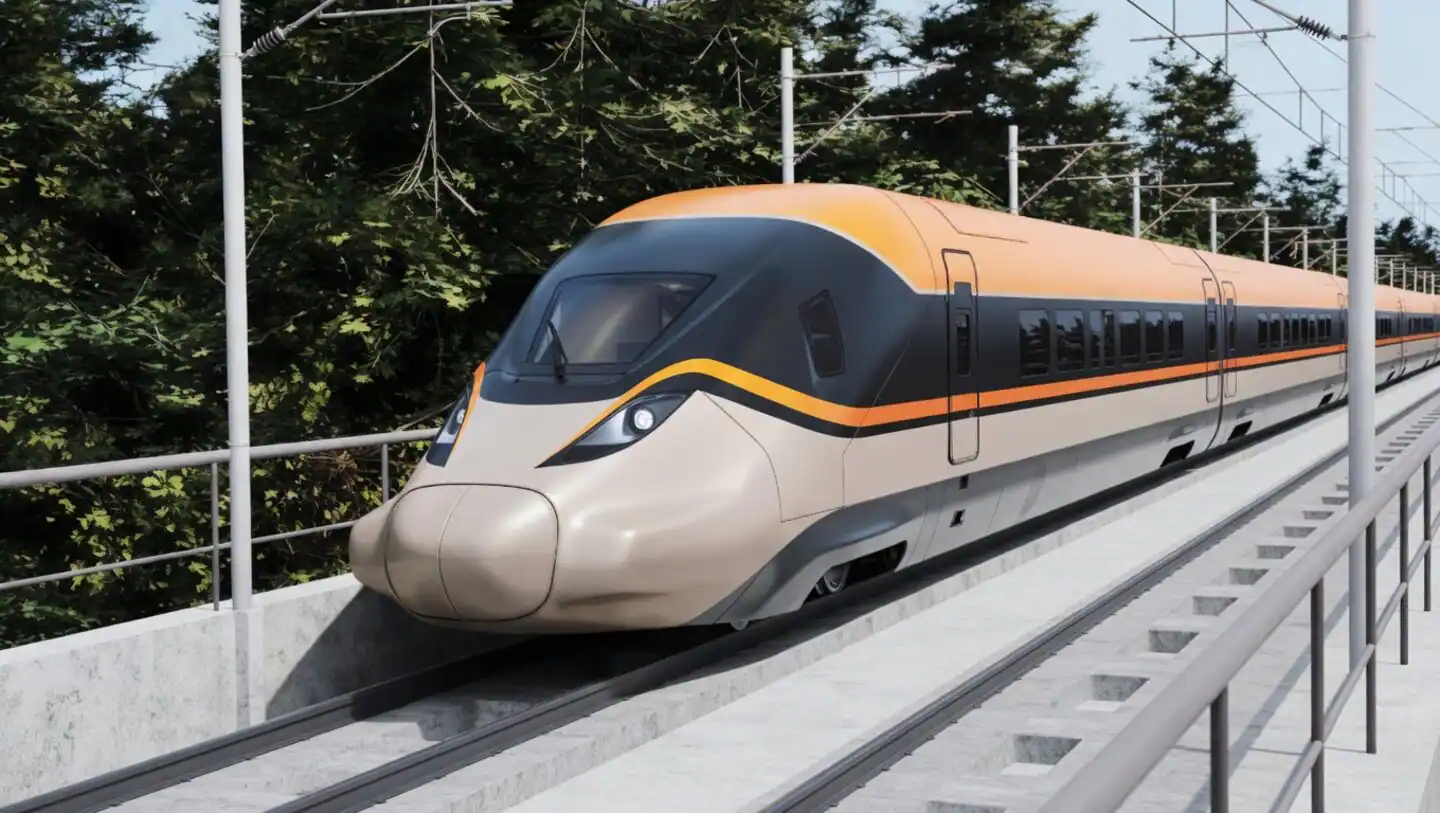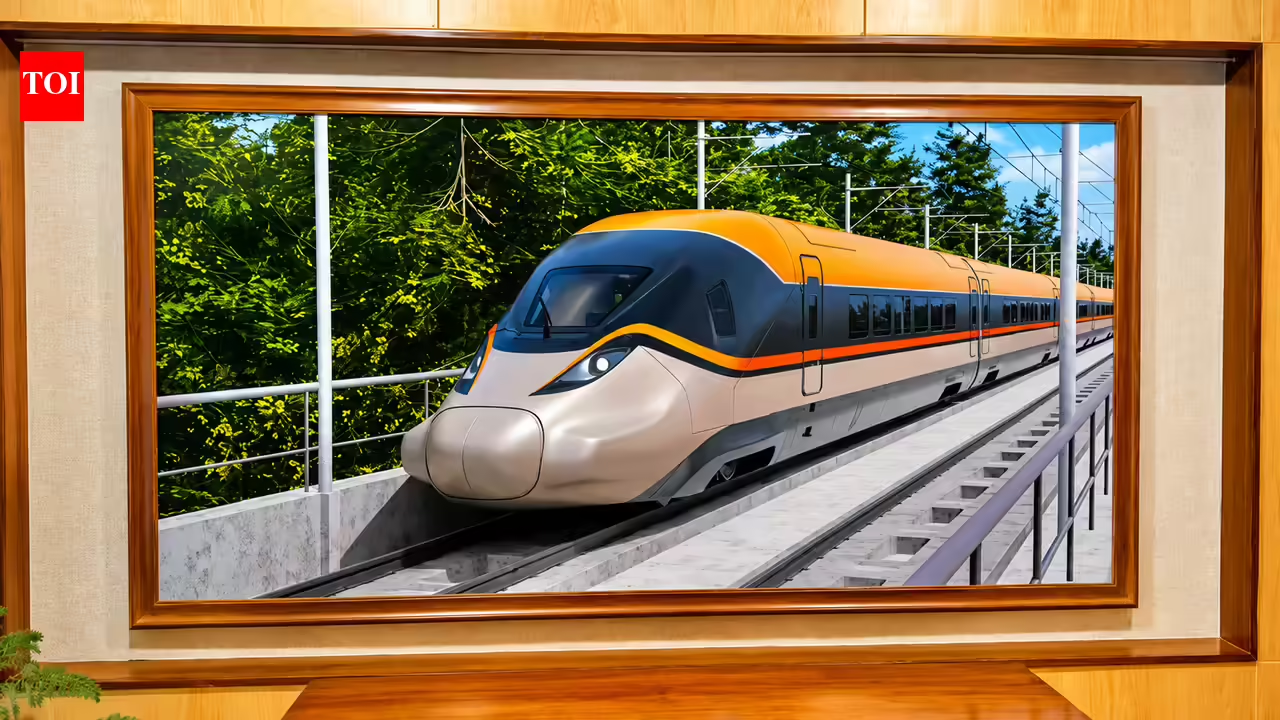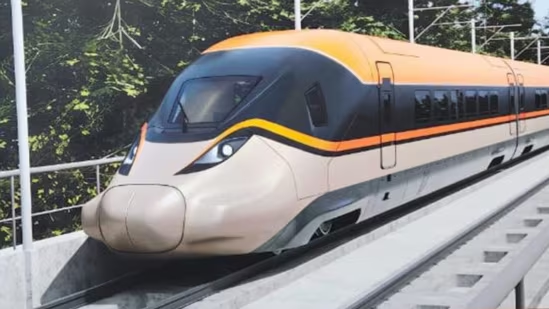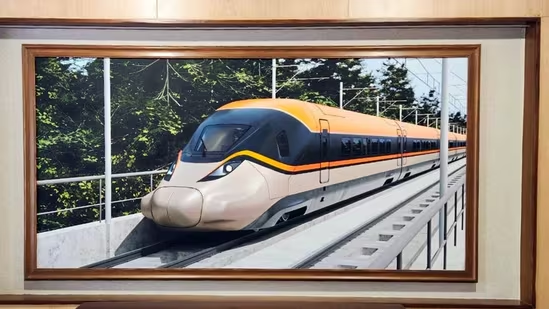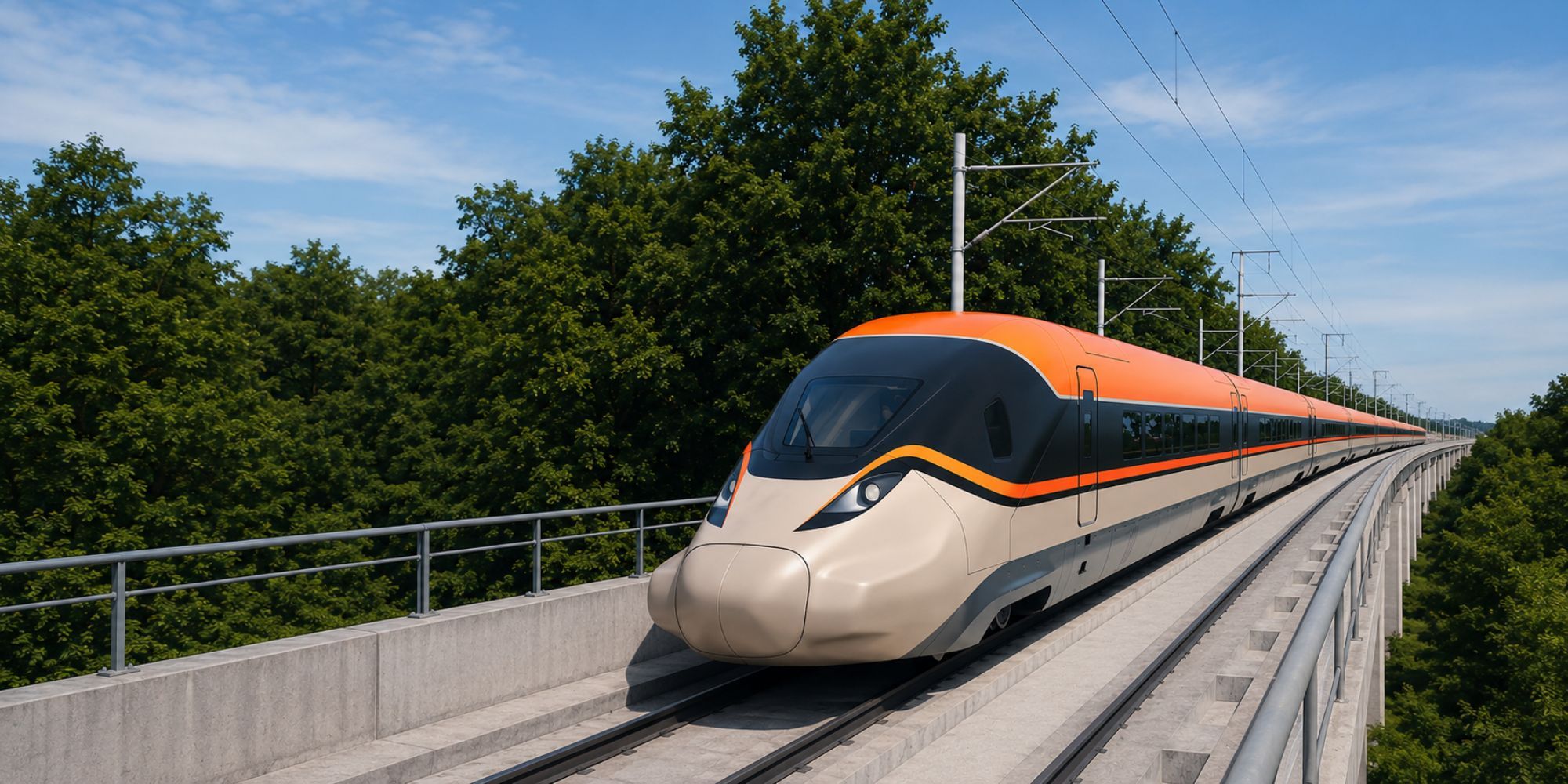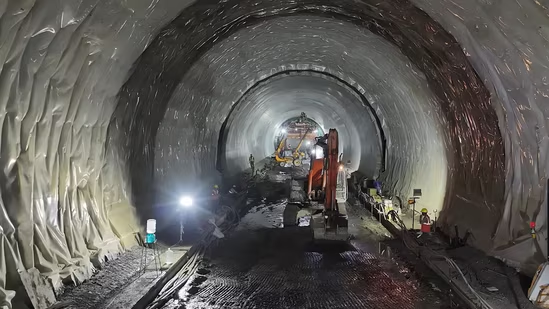
Image showed a train with grey body, orange-gold livery, rounded nose reminiscent of Japan's Shinkansen, gliding along an elevated viaduct A framed image at Gate 4 of the Ministry of Railways building in New Delhi on Monday showed a sleek, aerodynamic train — grey body, orange and gold livery, a rounded nose reminiscent of Japan's Shinkansen — gliding along an elevated viaduct through a green landscape. It appeared the government had put a face to its most ambitious infrastructure project.Minister Ashwini Vaishnaw recently shared videos showing progress on key tunneling work, among other steps of progress on the bullet train project between Ahmedabad and Mumbai. (Video grab: YT: @AshwiniVaishnawBJP)But a picture, possibly a rendering, at a ministry gate is not the actual bullet train. So where does the Mumbai-Ahmedabad High Speed Rail (MAHSR) corridor actually stand, nearly nine years after Prime Minister Narendra Modi laid its foundation stone?An image of India's first proposed bullet train displayed at the Ministry of Railways in New Delhi on Monday. (ANI)What numbers sayThe most authoritative recent snapshot comes from Union railway minister Ashwini Vaishnaw, whoshared construction figures as on May 4:According to details by the minister via social media, 349 km of viaduct — the raised, bridge-like elevated structure that carries 90% of the corridor above roads, rivers and existing rail lines — has been completed along the 508-km route, along with 443 km of piers, the supporting pillars that hold the viaduct up.Over 7,700 OHE (overhead equipment) masts, the electric poles carrying the wires that will power the trains, have been installed across 179 km of the mainline.More than 5.7 lakh noise barriers have gone up along 288 km of the stretch, and 374 track-kilometers of track bed base construction has been completed (covering roughly 187 route kilometres), with the laying progressing incrementally.And in Maharashtra, where construction has lagged earlier due to land acquisition constraints, 5 km of the critical 21-km tunnel between Bandra-Kurla Complex (BKC) in Mumbai and Shilphata has been excavated.The 21-km tunnel part of the project is now underway. (YT/@AshwiniVaishnawBJP)The National High Speed Rail Corporation Limited (NHSRCL), the government body executing the project, said in a February 2026 Lok Sabha reply that all 1,389.5 hectares of land required has been acquired; all statutory clearances obtained.Speed of execution has picked upVaishnaw said in early May that India is now laying 15 km of high-speed rail track every month on the bullet-train corridor. Construction speed, he said, had been scaled up from an initially estimated 2 km per month. He credited IITs, industry partners and railway engineers. He said comparable projects globally have averaged just 0.5 km per month.That trajectory would mark a significant departure from the project's troubled early years, when land disputes in Maharashtra, political resistance, and the Covid pandemic combined to push back timelines. The original target had been August 2022.Critical tunnelling moment in MumbaiA hugely consequential development of the past week came from Mumbai. The NHSRCL said on May 17 that the cutter head of India's largest tunnel boring machine (TBM) — the giant rotating cutting disc that does the actual digging — weighing 350 tonnes and measuring 13.6 metres in diameter, roughly the width of a four-lane highway, was successfully lowered into a shaft at Vikhroli in Mumbai.It is the biggest TBM cutter head deployed for any railway project in India, Vaishnaw also said on his social media channels.This machine will bore through the most technically demanding section of the corridor, a 21-km underground stretch between BKC and Shilphata that includes India's first undersea rail tunnel, seven kilometres beneath Thane Creek.What about stations: Gujarat ahead, Maharashtra catching upThe corridor's 12 stations are Mumbai, Thane, Virar, Boisar in Maharashtra, and Vapi, Bilimora, Surat, Bharuch, Vadodara, Anand/Nadiad, Ahmedabad and Sabarmati in Gujarat. A small portion runs through the Dadra and Nagar Haveli UT.Above-ground construction at all Gujarat stations is at an advanced stage, according to the NHSRCL. Station plazas at Surat, Bilimora, Vapi, Bharuch, Anand and Vadodara have already been contracted out.In Maharashtra, work has commenced on all three elevated stations, and the concrete foundation at the BKC underground terminus in Mumbai is being laid, said the agency.The train itselfThe design shown in the image at the ministry in Delhi is not a Shinkansen imported wholesale from Japan. In late 2024, the government-run Indian Railways' own Integral Coach Factory (ICF) awarded a ₹867-crore contract to Bengaluru-based BEML to design, manufacture, and commission the indigenous high-speed trains.These trains are being engineered to run at an average speed of 250 kmph and a maximum of 280 kmph, with each coach estimated to cost around ₹28 crore.The track itself is being built for a maximum speed of 320 kmph, leaving room for faster trains in the future.Two service types are planned. One, a rapid express halting only at Surat and Vadodara, completing the Mumbai-Ahmedabad journey in a little two hours by trains currently being planned; and a slower, all-stations service taking just under three hours.Conventional trains between the two cities took around seven hours, though the newer, Ahmedabad-Mumbai Central Vande Bharat Express completes the journey in about five hours and a half, at a top operational speed of 130 kmph.When will it run?The project was originally sanctioned at approximately ₹1.08 lakh crore. It is now estimated to cost around ₹1.98 lakh crore, attributed to land acquisition delays and scope changes. The extra burden is likely to be absorbed through central budgetary support rather than additional borrowing from Japan, whose concessional loan, at 0.1% interest over 50 years, covers about 81% of the original sanctioned cost.On January 1, 2026, Vaishnaw said: "On Independence Day in 2027, the country will get its first bullet train.” That would mean August 15, 2027. A phased rollout may open first on a roughly 100-km section possibly between Surat and Vapi in Gujarat, followed by further sections progressively.Also read | HT Ground Report: Living in the dark shadow of the bullet trainAs for the full corridor, Vaishnaw told news agency ANI that high-speed rail operations are expected to extend to Thane by 2028, with the corridor reaching Mumbai by 2029.The train would complete the 508-kilometre journey between Ahmedabad and Mumbai in an hour and 58 minutes when the trains run at their highest speed of 320 kmph but with station halts factored in.Aarish Chhabra is an Associate Editor with the Hindustan Times online team, writing news reports and explanatory articles, besides overseeing coverage for the website. His career spans nearly two decades across India's most respected newsrooms in print, digital, and broadcast. He has reported, written, and edited across formats — from breaking news and live election coverage, to analytical long-reads and cultural commentary — building a body of work that reflects both editorial rigour and a deep curiosity about the society he writes for.
There’s now an image of India's first bullet train. Where's the project really at | Explained
Image showed a train with grey body, orange-gold livery, rounded nose reminiscent of Japan's Shinkansen, gliding along an elevated viaduct | India News
1,389 words~6 min read