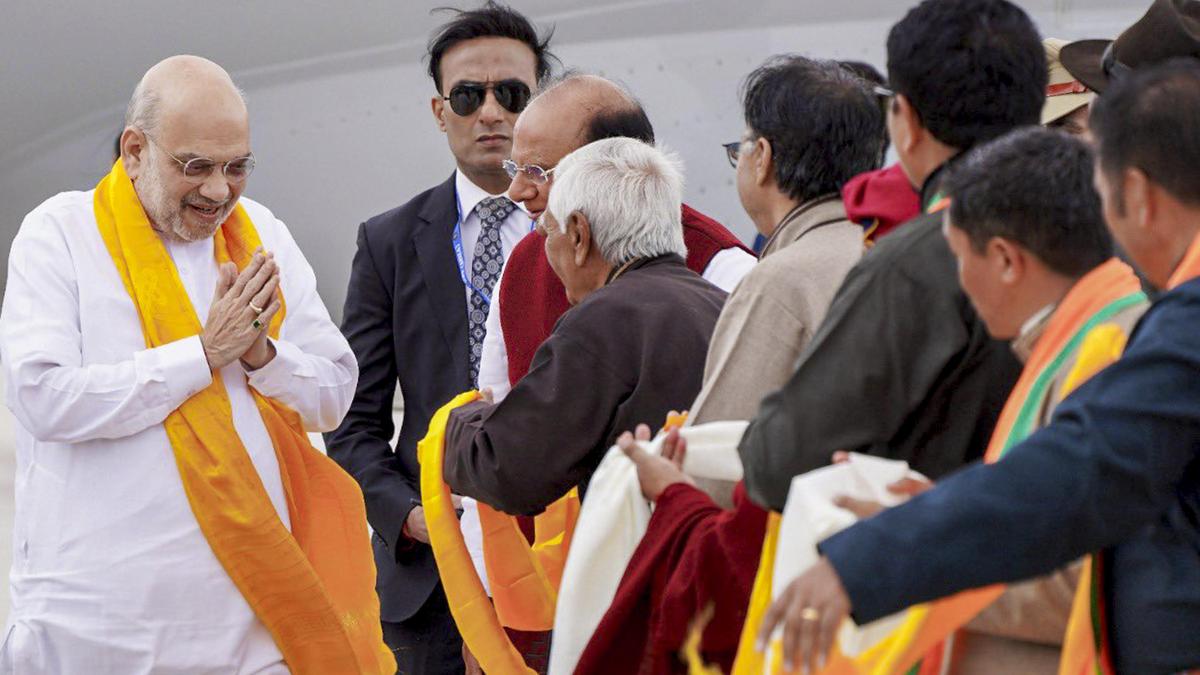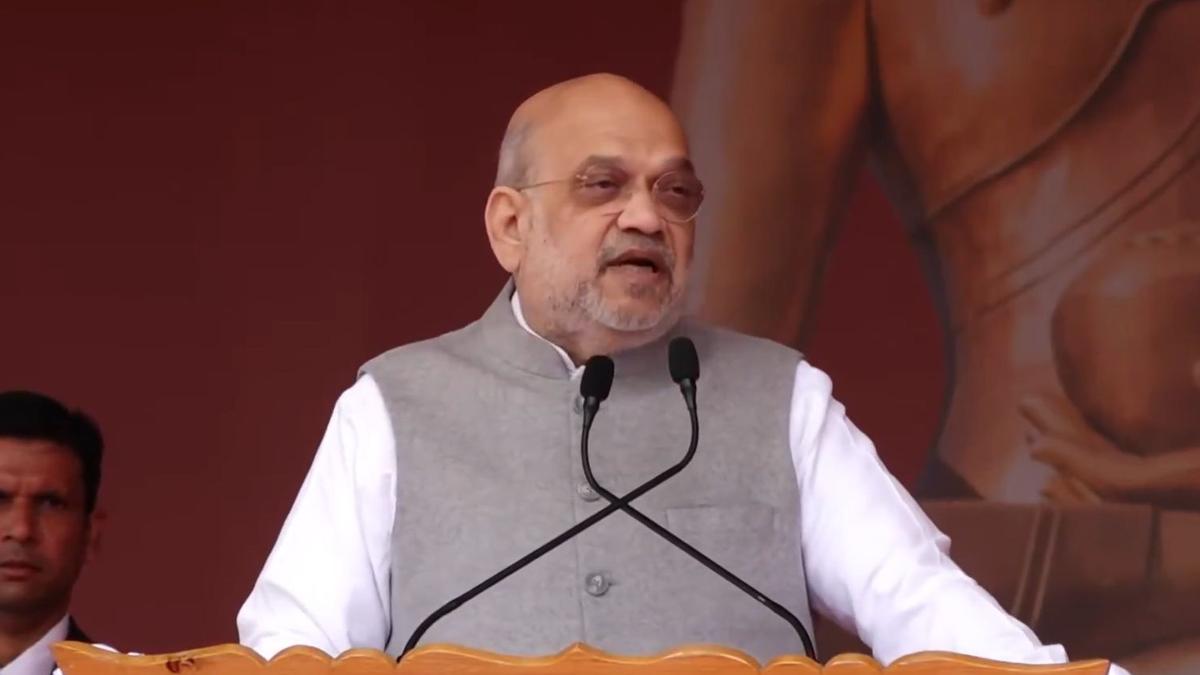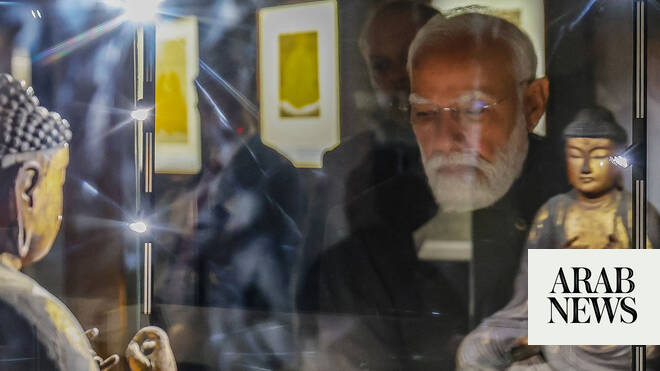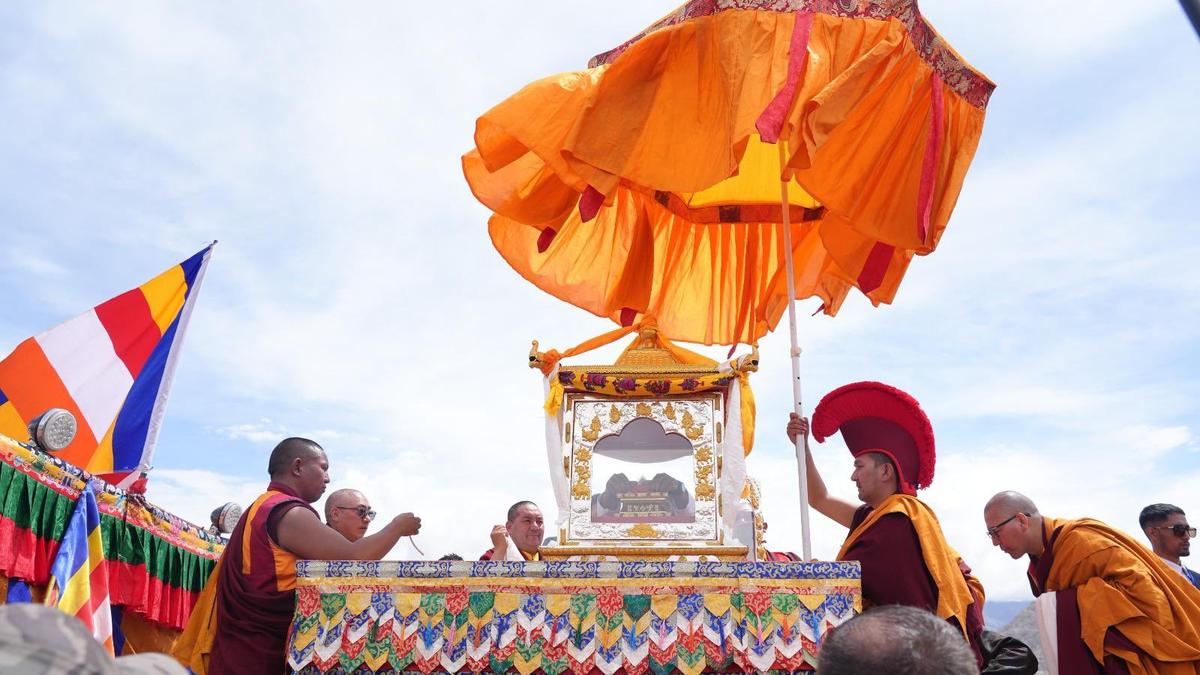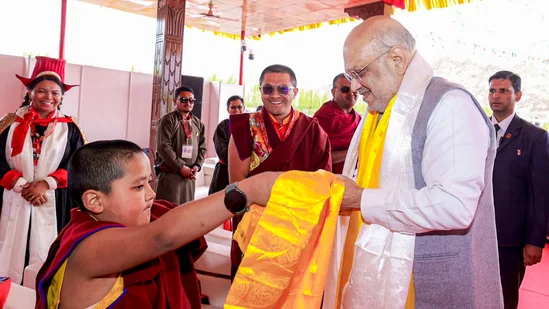
In a significant cultural and diplomatic gesture, Union home minister Amit Shah inaugurated the first international exposition of the sacred Piprahwa relics of the Tathagata Buddha on May 1, 2026, at Jive-Tsal in Leh, Ladakh. The relics, linked to the ancient Piprahwa Stupa in Kapilavastu and excavated in the late 19th century, had returned to the region after 75 years. Prime Minister Narendra Modi underscored the event’s importance in his message on Buddha Purnima, noting that the exposition, running until May 14 before proceeding to Zanskar, offers devotees across Ladakh an opportunity for reverence while boosting spiritual and cultural tourism. Union Home Minister Amit Shah interacts with a novice monk during the inauguration of the first international exposition of holy relics of Lord Buddha on the occassion of Buddh Purnima, in Ladakh. (PTI)Shah’s address framed the occasion explicitly within India’s civilisational narrative: Ladakh, he observed, quoting the Dalai Lama, is “not merely a geographical land” but “a living laboratory of Buddhist culture and compassion,” where knowledge has been preserved for millennia. India’s civilisation, he added, has conveyed the message of peace for thousands of years. These statements, echoed in official communications and reported widely, signal more than devotional observance. They represent a deliberate assertion of India’s historical and living stake in Buddhism at a moment when its legacy is being contested on the Himalayan frontier.Ladakh’s centrality in this narrative is both historical and strategic. As a high-altitude Union Territory bordering China along the Line of Actual Control (LAC), Ladakh occupies a pivotal position in India’s northern defences. Its ancient monasteries, over 108 established between the tenth and eleventh centuries, including the renowned Alchi complex, bear testimony to its role as a crucible of Mahayana and Vajrayana traditions. Envoys of Emperor Ashoka laid early foundations; during the Kushan period (first to third centuries CE), Mahayana philosophy and art flourished here. The Silk Route facilitated not only trade but the transmission of ideas, monks, manuscripts, and artistic traditions linking Kashmir, Leh, Yarkand, Khotan, and Tibet. Tibetan influences from the 7th to 10th centuries further enriched these traditions, creating the distinctive Himalayan Buddhism practised across the four major Tibetan schools: Nyingma, Kagyu, Sakya, and Gelug. Minister Kiren Rijiju and the International Buddhist Confederation highlighted the accompanying cultural programmes, including performances by Mongolian and Arunachali artists, as embodiments of this shared heritage.Strategically, Ladakh’s importance transcends the spiritual. It forms part of India’s forward defences against Chinese military posturing along the LAC, where infrastructure development and troop deployments have heightened tensions in recent years. The region’s geography, rugged passes, glacial valleys, and proximity to Aksai Chin, make it indispensable for monitoring and keeping India’s territorial integrity secure. Yet its cultural resonance amplifies its geopolitical weight. Ladakh has historically served as a bridge between Indian and Central Asian Buddhist worlds. When Buddhism faced internal or external crises elsewhere, Ladakh preserved its teachings, later helping to revive and disseminate them. Shah’s invocation of this resilience carries implicit resonance in the contemporary context: Just as Ladakh safeguarded the Dharma historically, it now symbolises India’s resolve to protect its civilisational inheritance against external encroachment.China’s attempts to appropriate Buddhism stand in stark contrast to this ethos of preservation and sharing. Beijing has long pursued a strategy of historical revisionism and religious instrumentalisation. Official narratives have at times claimed the Buddha as Chinese in origin, portraying Tibetan Buddhism as an indigenous Chinese tradition rather than one rooted in the Indian subcontinent. The Chinese Communist Party, an avowedly atheist organisation, has positioned itself as the arbiter of Buddhist legitimacy, most notably by asserting control over the reincarnation of the Dalai Lama, a move widely seen as an effort to install a compliant figurehead and erase the institution’s spiritual autonomy. This appropriation extends to the broader Sinicisation campaign, which seeks to subordinate religious practice to party ideology, transforming Buddhism into a tool of soft-power projection along the Belt and Road Initiative. Temples and cultural centres abroad are promoted under Chinese auspices, while domestic suppression in Tibet and Xinjiang continues unabated.Such manoeuvres are not benign cultural diplomacy. They represent a calculated effort to sever Buddhism’s Indian roots and reframe it as an extension of Chinese civilisational influence. By claiming historical suzerainty over Tibet and advancing territorial assertions in Ladakh and Arunachal Pradesh, Beijing attempts to rewrite the narrative of trans-Himalayan connectivity. Shah’s remarks in Leh directly countered this propaganda: Buddhism originated in India, spread to China and beyond via Ladakh’s ancient routes, and remains a living Indian tradition. The exposition of relics excavated on Indian soil and displayed in a region intimately tied to Tibetan Buddhist practice serves as a quiet yet firm rebuttal. Unlike China’s top-down control and selective historical amnesia, India’s approach is invitational. The relics are not hoarded; they travel, fostering devotion, reflection, and tourism. Cultural troupes from Mongolia and Arunachal Pradesh performing alongside local artists exemplify an organic, non-coercive exchange rooted in shared reverence rather than political dominance.This distinction matters profoundly in an era when religion is increasingly weaponised for geopolitical ends. India’s Buddhist outreach, exemplified by relic expositions, the promotion of the Nalanda tradition, and engagement with global Buddhist organisations, embodies the middle path taught by the Buddha himself: Compassion without proselytism, influence without hegemony. By highlighting Ladakh’s role as a “guiding force for many people around the world,” Shah and the government underscore a civilisational continuity that predates modern nation-States. The event’s timing on Buddha Purnima and its extension to Zanskar further integrate remote communities into this living heritage, strengthening social cohesion in a strategically sensitive border region.In the domain of soft power, this carries strategic weight. While China invests in infrastructure and military presence, India beyond infrastructural investments and military preparedness, also invests in the intangible, shared memory, spiritual resonance, and cultural affinity, that binds communities across borders more enduringly than concrete or coercion. The relics’ journey from Piprahwa to Leh is not merely logistical; it is a reaffirmation that Buddhism’s essence lies in its Indian origins and its universal message of peace. As global attention turns once more to the Himalayas, India’s demonstration of stewardship, peaceful, inclusive, and historically grounded, offers a compelling alternative to revisionist narratives. In preserving and sharing its Buddhist legacy, India does not merely assert ownership; it invites the world to partake in a tradition whose enduring relevance lies precisely in its refusal to be possessed. (The views expressed are personal)This article is authored by Sriparna Pathak, professor, China Studies and International Relations, Jindal School of International Affairs, OP Jindal Global University, Sonipat.
Celebrating Buddhist heritage in the Himalayas
Authored by Sriparna Pathak, professor, China Studies and International Relations, Jindal School of International Affairs, OP Jindal Global University, Sonipat.
1,081 words~5 min read