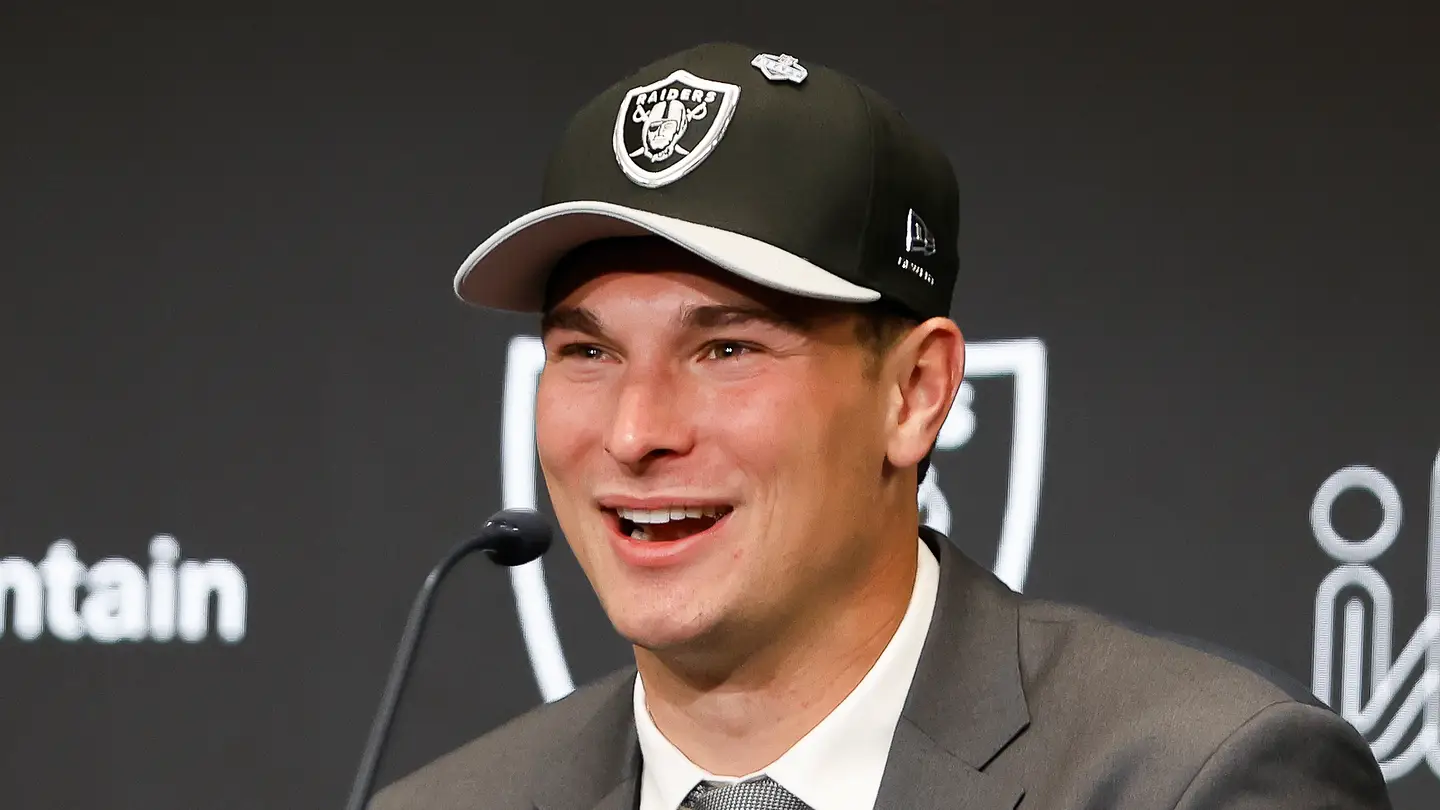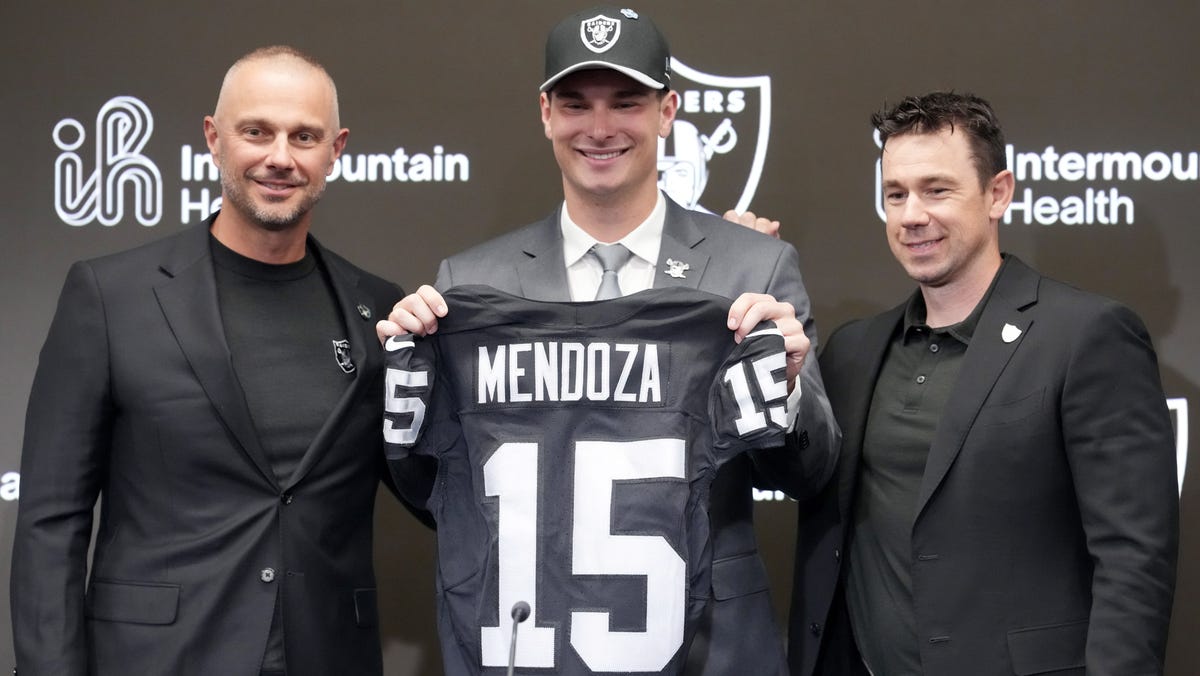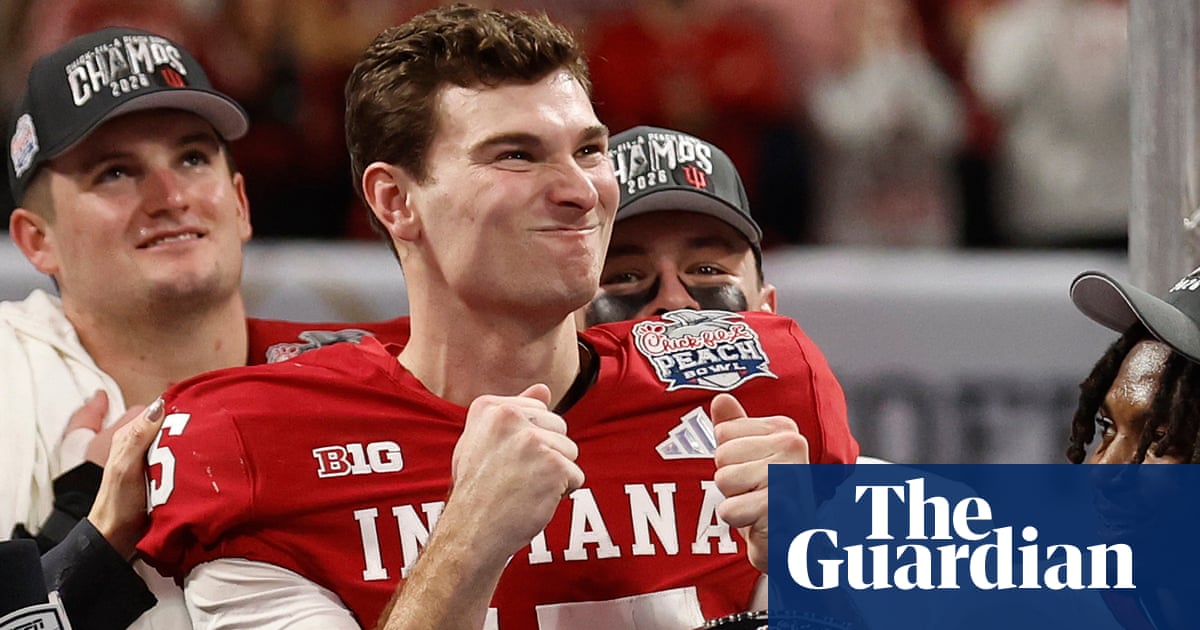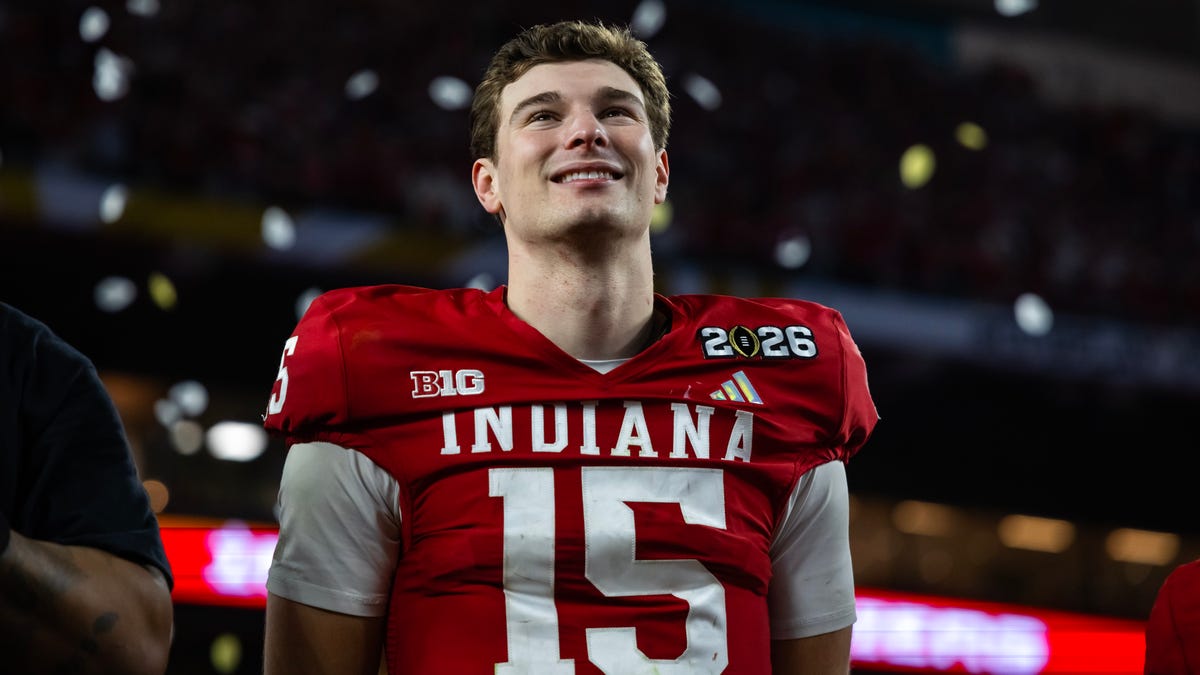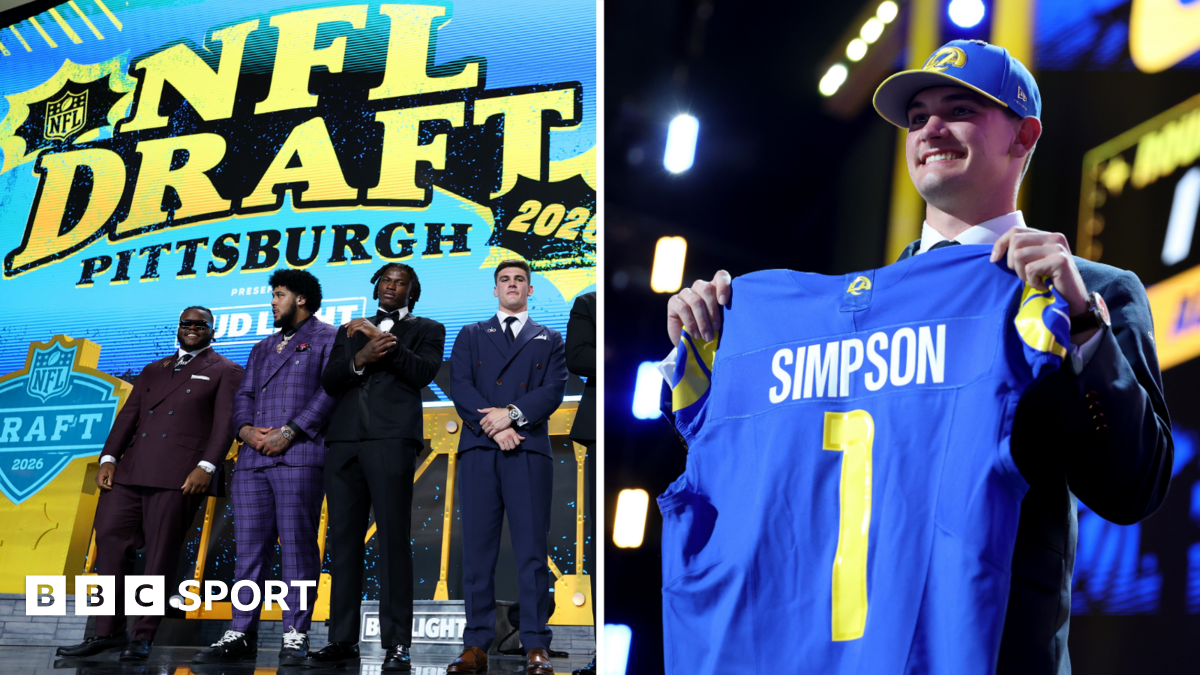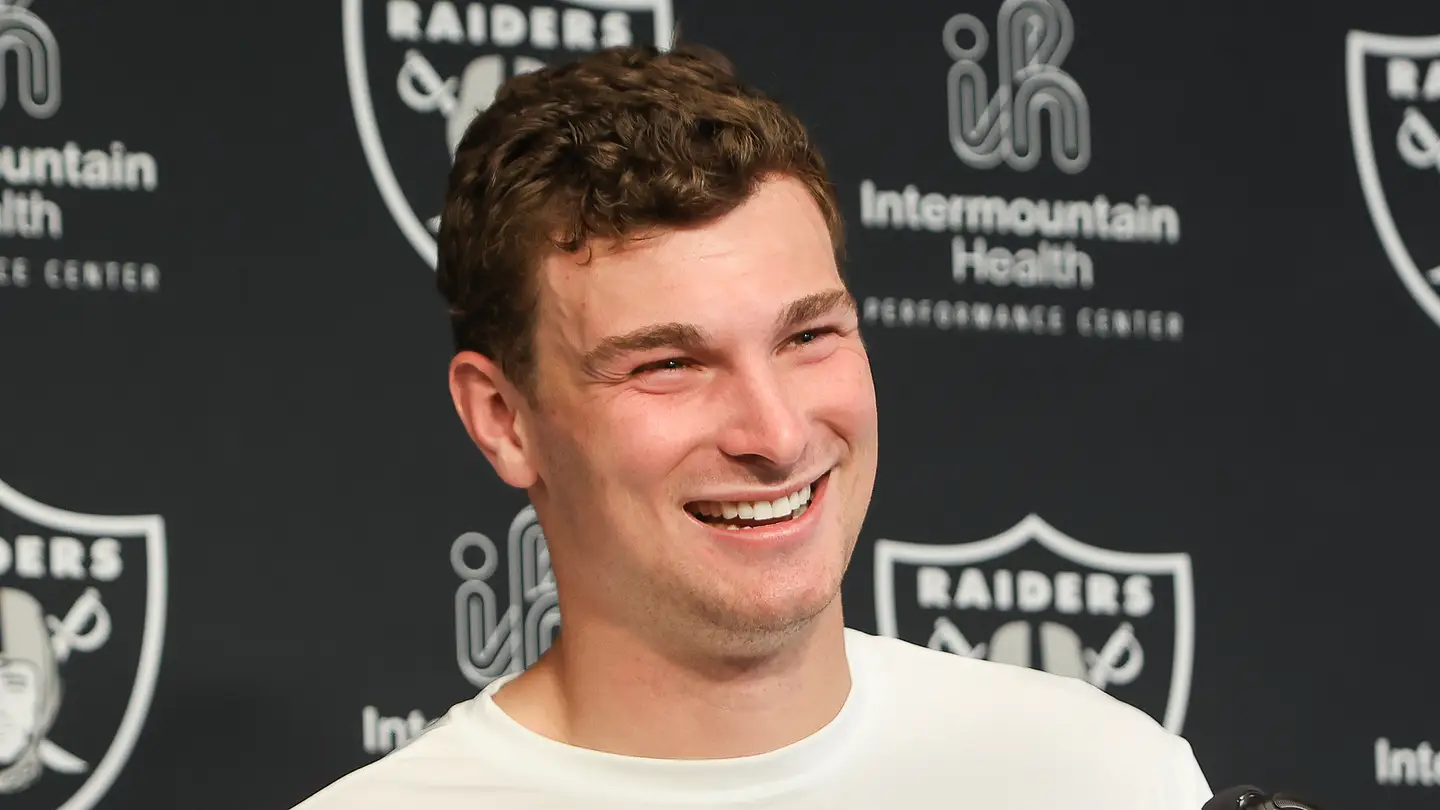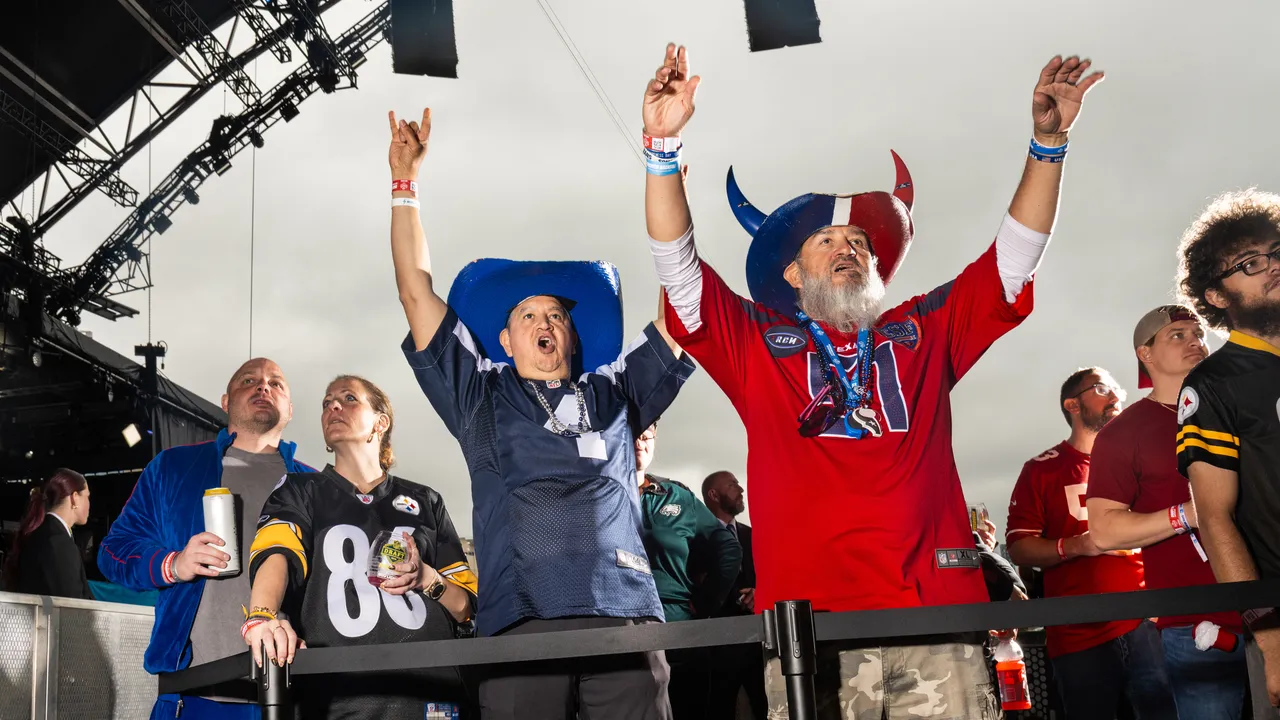
The most widely witnessed first-job offer among the class of 2026 surely came last month, when Fernando Mendoza, an M.B.A. student at Indiana University, was selected by the Las Vegas Raiders to be their new quarterback. Mendoza was the first player chosen in this year’s National Football League draft, in Pittsburgh, an honor announced by the league’s commissioner from a one-and-a-half-million-pound stage that had been built outside the city’s football stadium. The event was broadcast simultaneously, in prime time and in two languages, across four TV networks, which averaged thirteen million viewers total, and attended in person by hundreds of thousands of people. The audience was predominantly men, mostly clad in team jerseys and drinking twenty-dollar beers. A select but nontrivial few adorned themselves further: masks, makeup, armored chest plates. One, a middle-aged Iowan who had painted his face to resemble a skeleton’s, introduced himself to me as Baron Raider. He explained that his getup—including a black top hat and plastic bone necklaces—was inspired by Baron Samedi, a vodou spirit who digs graves. His hope was that Mendoza would help the Raiders do the same, figuratively, for their opponents.Every year in the N.F.L., guys retire, get hurt, get worse; contracts expire. Teams need new players. The draft, in which N.F.L. teams take turns, for seven rounds, selecting college players to join their rosters, is the most cost-effective, and thus preferred, way to acquire them. Some draftees have an immediate impact—this year’s Super Bowl champions, the Seattle Seahawks, started two key players who were drafted last spring—but the process is mainly a means of incremental, long-term improvement. This is as important, and as boring, in theory, as picking a fund for your 401(k), yet, improbably, the draft has become one of the largest events on the sporting calendar. Its telecast is part reality show, part débutante ball, part award ceremony. As one league executive put it to me, “It’s amazing, the interest in what’s essentially a name being read from a paper.” For fans of some teams, particularly the ones that tend to stink (say, the Jets), the draft, with its promise of better days, can be bigger than the games themselves. The draft order is determined by the previous season’s record; the worst teams go first. During a mediocre season, many fans, hoping to improve their team’s draft position, root for their side to lose.The main thing to know about the draft is that no one really knows anything. There’s the not-knowing of which team will select which player; once a player gets selected, there’s the not-knowing of whether he’ll be any good. The most productive college players do not necessarily make the best pros—football is an endlessly interconnected game, with twenty-two players interacting within complicated strategic schemes, and the quality of collegiate competition varies widely. In the aggregate, there is a correlation between earlier picks and better outcomes, but exceptions abound. A study by economists at the University of Chicago suggested that the likelihood of a given player having a better N.F.L. career than the next draftee who plays the same position is basically a coin flip.Despite this crapshoot, or maybe because of it, an entire media class of so-called draftniks has emerged to guess which players might go where and how they might turn out. The draftniks produce player rankings and mock drafts that predict each team’s selections. The first mock drafts tend to go up just after the previous year’s real draft ends. There are draftniks at ESPN and NBC and the Athletic but also at niche upstarts like Draft Diamonds and Draft Nerds and DraftNasty. Fans take their own stabs pro bono, posting to Reddit their predictions for the draft’s first round, or their bespoke guesses for all two hundred and fifty-seven picks. Websites offer draft simulators that let users draft against a league of computerized opponents. Mel Kiper, Jr., the salesman-like face of ESPN’s draft coverage, likes to compare the draft to Christmas morning. It’s the not-knowing that’s fun. Everyone loves searching for a “sleeper”—an underrated prospect, like Tom Brady, who was famously the hundred-and-ninety-ninth selection in his class, then led his teams to seven Super Bowl wins—even though it’s just as likely that you’ll get stuck with a “bust,” picking Mitchell Trubisky, now a backup quarterback, instead of Patrick Mahomes, for example. Sleepers can enliven years of your fall Sundays. A bust could one day be the reason that a bartender cuts you off at a Buffalo Wild Wings.Earlier this year, I got to know a draftnik named Thor Nystrom, a bearded forty-one-year-old who works for the Minnesota sports outlet SKOR North. He covers the draft with a particular focus on the Vikings, of which he has been a lifelong fan. When I asked about sleepers he liked for this year’s draft, he mentioned Ephesians Prysock, a six-foot-three defensive back from the University of Washington. “The Vikings desperately need a boundary cornerback, and they like ones with longer arms, who are good at pressing receivers,” Nystrom said. He expected Prysock to be available in the draft’s middle rounds, meaning the Vikings could fill that need while using their earlier choices for other positions—the sleeper’s surplus-value ideal.Nystrom also told me about a player who was not the draft’s most promising prospect but was among its most intriguing: Tyren Montgomery, a wide receiver from John Carroll University, a Division III school that hadn’t had a player drafted in thirty-five years. (That player was the 1991 draft’s final selection, a distinction affectionately known as Mr. Irrelevant.) Nystrom researches the draft tirelessly, keeping a spreadsheet of data (ages, game stats, hand widths) on nearly two thousand players, and publicly ranks his top five hundred—nearly twice as many as will actually be drafted. But in January, when he attended the Senior Bowl, an all-star showcase of draft prospects, Montgomery was unfamiliar to him. “I know everyone,” Nystrom told me. “I’d never fuckin’ heard of this guy.”Nystrom, who has an M.F.A. in nonfiction from the University of Iowa, was struck by Montgomery’s trajectory: he had only begun playing football in college, but at the showcase he had stood out against surefire early-round defenders. He now had a chance to be picked in the draft’s later rounds, where draftees typically have to fight to make the team but occasionally become starters or even stars. “You have this wide band of outcomes,” Nystrom said. “He’s new to the sport, comes from D-III, but we just saw him lick a bunch of top-hundred prospects.” Such is the draft’s central allure: a player might amount to nothing. But he could also become anything.For a league that is run by some of America’s most fervent capitalists, the N.F.L. has an odd relationship with free markets. These days, teams’ payrolls are capped and the league’s revenue is shared. The goal is to create competitive parity, or at least the appearance of it—to sell the idea that on any given Sunday any team can win. The draft was the league’s first step in this direction. In 1935, the owner of the then sad-sack Philadelphia Eagles grew tired of better teams scooping up all the best players, and proposed the draft as a remedy. For some reason, the better teams agreed. It began the next year as a simple affair, with coaches smoking cigars in a hotel room and scrawling names on a chalkboard. This year, Mendoza was in line for a four-year contract worth nearly sixty million dollars, whereas, in 1936, the No. 1 pick, Jay Berwanger, a running back from the University of Chicago, turned down a contract for a thousand dollars a game and never played professionally. Instead, he went into rubber and plastics.In 1980, when ESPN was not yet a year old and was desperate to partner with major leagues, the network proposed to Pete Rozelle, then the N.F.L.’s commissioner, that it televise the draft. “Pete started laughing his ass off,” Steve Bornstein, a former ESPN president, recalled. As the longtime Sports Illustrated writer Peter King told me, Rozelle “thought it would be embarrassing, because nothing effing happens.” But Rozelle agreed, and ESPN set out to make an event of it. “The higher-ups said, ‘If this thing is not working, make a graceful exit and get off the air,’ ” Bob Ley, who anchored ten drafts for ESPN, told me, of that first TV draft. It aired on a Tuesday morning, and mostly consisted of guys placidly chatting at a desk. The action shots were of men making unheard phone calls in the New York Sheraton ballroom. “It’s like the difference between Edison’s first kinetoscope and the latest movie at the Cineplex,” Ley said, comparing the draft then versus now. “Technically they’re part of the same family of entertainment, but just barely.”“Let’s have another kid so she can have someone to play with.”Cartoon by Jeremy NguyenThat year, ESPN aired eight hours of draft coverage (amazingly, only the first third of the draft’s selections), a number it gradually increased until it began televising every pick, over the course of two days, in the mid-nineties. It had discovered what now feels obvious: at the nadir of the football calendar—three months after the Super Bowl, three months before preseason games—fans hunger for even the idea of the sport. “Sports fans have an amazing ability to seem to care more about the future than the present,” Daniel Wann, a psychology professor at Murray State who focusses on sports fandom, told me. “They live in a world of unknown.” Uncertainty and anticipation are central to dopamine release: the countdown to vacation, the planning of a perfect party, the thrill of the chase. It’s fun to watch your team win. It can be just as fun to hope they will, and to imagine how. “It’s theatre of the mind,” Nystrom told me. A colleague of mine once likened it to football fan fiction.The most transformative change to ESPN’s coverage came in 1984, with the addition of Kiper, the ur-draftnik. A few years earlier, he had quit community college to compile and sell draft guidebooks out of his parents’ Maryland basement. He was sharp and sharp-looking, with a vaguely avian face beneath a dark pompadour, and was doggedly dedicated—year-round—to a subject with which few in the media even engaged. When a team drafted some linebacker from Appalachian State in the fifth round, Kiper could offer a torrent of assessment. “Before we had the flashy graphics and pre-produced research packages, we had Mel,” Ley said. Writers have likened his Baltimore-tinged, auctioneer-like patter to “a breathless cross between machine gun and Morse code,” and have described him as having the “mind of a savant beneath the immovable coiffure of a lounge act.” Chris Berman, one of ESPN’s earliest anchors, told me, of Kiper, “I didn’t know anybody like this existed.”Fans of the Green Bay Packers, part of the Coachella-size crowd that watched the draft proceedings from a large concrete lot outside Pittsburgh’s football stadium. The lot can look like a cosplay convention: feathered headdresses, tutus, white guys in team-color faux dreads.Crucially, Kiper had firm opinions and little filter. There were obscure picks, in his frank estimation, that were actually brilliant heists, and college stars whose selections were actually costly blunders. His innovation was to turn the draft into something like a game itself, where fans could watch their team win and lose in the moment. He once declared on air, with good reason, that “the Jets just don’t understand what the draft’s all about.” That his own record is far from perfect is both part of the fun and somewhat irrelevant: his job is to inform and compel—more Jim Cramer than Nostradamus. “With others, it feels like opinion,” Bill Fitts, a retired ESPN producer, told me. “With Mel, it feels like fact.” Not everyone has agreed. In 1994, after Kiper blasted the Indianapolis Colts’ strategy, the team’s general manager, Bill Tobin, kicked off a mid-draft interview by saying, “Who in the hell is Mel Kiper, anyway?” He then compared Kiper’s credentials, unfavorably, with his mailman neighbor’s. When the cameras cut back to Kiper, he was laughing. “I’m secure in my position,” he said. “Obviously Bill Tobin is not.”Kiper’s first ESPN deal paid him four hundred dollars for one day of draft coverage and sporadic additional appearances. Now he’s gainfully employed and featured on the network nearly all year, including on a draft-centric studio show that airs every weekday afternoon for the ten weeks preceding the event. “That’s how it’s gotten so big,” King, the former S.I. writer, said of the draft. “They’ve forced it down the throats of the American public.” That public has continually widened its gullet and gulped. The draft moved through New York City’s event spaces (hotel ballrooms, Madison Square Garden’s theatre, Radio City), outgrowing them all. Since 2015, it has been held in ten different cities, including Las Vegas, where a red carpet was constructed atop the Bellagio’s fountain pool, and Nashville, where rowdy attendees ruined bachelorette parties on Broadway. Hundreds of thousands have attended each of them. “I really thought the draft could be what it is right now,” Kiper said. “I’ve been wrong on some players. I was right on that.”Draft season informally begins shortly after the Super Bowl, with what’s known as the Scouting Combine, a weeklong convention built around some three hundred top prospects being subjected to medical exams, physical measurements, meetings with teams, and on-field performance drills: timed sprints and agility courses, calibrated jumps, bench presses. The league often bills it as “the ultimate job interview,” and airs forty hours of live coverage on its eponymous cable network. Indianapolis hosts the Combine every year, which means each February its downtown briefly becomes the world capital for strong-jawed men in athleisure who could be described as broad, brawny, buff, burly, built, boxy, or otherwise physically notable. It’s a bad week to be a porterhouse.The three hundred players are identified during the preceding summer and fall, when team scouts scour the country to evaluate prospective college talent. Scouting is not a glamorous job. Scouts spend hundreds of days on the road each year—long drives, cheap hotels, fast food. Their lexicon has a certain charm. To a scout, you can be just a guy (forgettable), a dude (good), or a dog (great). They are wary of receivers with “loud hands.” Look for good “bubbles,” or “anchors,” a.k.a. butts—a prodigious rear suggests a powerful engine. A “rolling ball of butcher knives” refers to a player who’s appealingly relentless. Hips should be “oily”; you want “a bender,” not a guy who’s “stiffer than a honeymoon dick.” Because teams are deciding whether to devote millions of dollars and precious roster spots to occasionally unreliable males in their early twenties, much of a scout’s work is akin to investigative reporting. “You talk to literally anybody who is willing to talk to you,” one scout told me. “You’re trying to mitigate risk.” How does a star treat the equipment manager? Who are his parents’ friends? How stable are his moods? As a former Giants general manager once put it, “The bigger asshole you are, the better the player you have to be.” Another G.M. joked that if Hannibal Lecter ran fast enough, teams would say he just has an eating disorder.The Combine is as much about behavioral analysis as it is about football assessment. Players cycle through speed-date interviews with team staff, mainly about football schematics and what makes them tick. But, as in an interview at McKinsey, there are occasionally curveball questions, to gauge their thinking or emotional state. Prospects have been challenged to games of rock-paper-scissors and been asked whether they find their mothers attractive. They are also scanned, prodded, and interrogated about every ligament or bone they’ve damaged since grade school. (A cabdriver shared with me the unconfirmed theory that Indianapolis hosts the Combine because of its rare concentration of MRI machines.) For all the attention paid to how fast the players run or how high they jump, this private reconnaissance is often the most pivotal, a way for teams to gain an edge and find the right fit. For the draftnik class, “it’s sort of a black box,” Nystrom told me. “Which sucks.”Nystrom was, like me, one of sixteen hundred media members credentialled for this year’s Combine. He went primarily to gather intel and do live radio shows. When the drills started, he headed to a bar. “It’s better on TV,” he told me. Having seen it on TV before, with its repetitive visuals—every athlete in black spandex, performing the same tasks with minute variations—this seemed dubious. But in the mostly empty stadium, without the benefits of commentary and closeups, the litany of drills felt like watching warmups for a game that never came. At one point, cameras appeared to catch the Jets’ head coach, Aaron Glenn, nodding off. (A team spokesman said that Glenn was looking down at his iPad.) The optics—underclad, mostly Black young men having their hands and limbs measured to the eighth of an inch, then paraded for physical evaluation—have reliably drawn comparisons to slave markets.“It’s always high noon somewhere.”Cartoon by Liam Francis WalshSince 2012, the public has been allowed to attend the workouts. To the surprise of many, it has. This year, depending on the day, somewhere between a few hundred and a few thousand people were in the stands. (Entry is free. A “Combine Authentic” polyester hoodie costs a hundred and forty-six bucks.) The crowd seemed to be mostly locals and other Midwesterners, often parents with football-loving kids. There were also fans of nearby college teams cheering on their guys, plus some participants’ encouraging families. On the concourse, I met Randy Talley, a lithe fiftysomething wearing a Green Bay Packers shirt, three black hoop earrings, and a stopwatch around his neck. (“I get confused for a scout a lot,” he told me.) He was a Wisconsin transplant to Indianapolis whose childhood desire to know all things Packers burgeoned into a need to know all things potentially Packers as well. In high school, he played hooky to watch the draft on TV, and since 2020 he has attended every hours-long Combine workout, in the same front-row seat, armed with a clipboard and color-coded homemade spreadsheets. “I stay until they kick us out,” he said. League staff now recognize him, a power he used this year to successfully lobby for the music to be turned down.In another life, Talley was a modern dancer, trained in the Humphrey-Limón technique. “I’ve been on every stage, big and small, in Milwaukee,” he told me. Dancing honed his eye for body movement, and he said that his front-row perch allowed him to “get a sense of a player’s center of gravity” and other details: “How much do they kick their heels up when they run? Do they wave their elbows? I like compact striders.”On the field, prospects were doing short runs forward and backward, known as W drills. In the stadium’s lower bowl, I found a seat behind Fran Duffy, a respected and bespectacled millennial draft analyst for the sports outlet ALLCITY, and Greg Cosell, a puckish and bushy-browed sexagenarian who works as an NFL Films producer. (His late uncle Howard was America’s most famous sportscaster.) Cosell spends his off-seasons poring over prospects’ game tapes to assess their viability as pros. Yet he does neither rankings nor mock drafts. “For me, it’s truly an academic and intellectual experience,” he said. “I just care about the process of evaluating.” In 2004, he produced the NFL Network’s first Combine broadcast. The league refused to let the workouts be filmed or to disclose players’ measurements; it was mostly guys in suits gabbing.As the players ran this way and that, Duffy and Cosell explained what to look for: fluid shoulder pivots, nimble feet when changing directions. I had my eye on Prysock, Nystrom’s darling. At six-three, Prysock was tall for his position. Cornerbacks require quick, reactive agility to match the movements of the receivers they defend, and those with greater size often offer less mobility. To my novice eye, Prysock moved without defect. When I asked Duffy for his take, he flashed a handwritten note: “smooth.” Talley was impressed, too. “Really nice hips, drop-and-drive,” he said.For Prysock, no drill was more important than the forty-yard dash, a laser-timed sprint. His agent, Jackson Magnini, told me that one team scout had confessed that, though he loved Prysock, he’d need to run the dash in less than 4.55 seconds to be seriously considered. Magnini watched the workouts alongside Prysock’s affable father, Sean, who wore a sparkly hoodie with “PLYMKR” on the back. As Prysock ran his turn, Magnini and Sean watched, rapt, then immediately checked the result: 4.46 seconds. They erupted and high-fived; a lemonade spilled at their feet. When Magnini sat back down, he told me that the time may have improved Prysock’s draft position by an entire round. “He just made some money,” he said.Ephesians Prysock, a defensive back from the University of Washington, was drafted by the San Francisco 49ers in the fourth round. A draftnik named Thor Nystrom said, “He has a suffocating presence. He’s so athletic, and then the surface area of him just kind of washes over you.”On the field, Prysock learned his time from a fellow-prospect. “I was, like, ‘Oh, I can run faster than that,’ ” Prysock told me later. (On his next try, he did, by a hundredth of a second.) When we spoke, Prysock was in a drab hotel in Fort Lauderdale, where he had been living for two months to train at XPE Sports, a facility that specializes in the technical specifics of Combine workouts. (For the forty-yard dash, Prysock had focussed on keeping his torso from becoming overly upright.) After the Combine, his stock had risen in most observers’ eyes, but he wasn’t following the coverage. Teams often visit with players for further interviews, which inevitably get covered in the football media. His friends had been clamoring over reports of his meeting with this or that N.F.L. team, not unlike during college recruitment, when top high schoolers, as Prysock had been, have their choice of suitors. This time, the agency was inverted. “They don’t really get it—it’s different,” Prysock said of his friends. “The team picks me now.”Montgomery, the small-school receiver who had wowed Nystrom, didn’t get invited to Indianapolis. By the time he impressed at the Senior Bowl showcase, in January, the Combine invites had gone out. But Montgomery had hope: every year, a couple of dozen non-invitees get drafted, and just as many invitees don’t. On a Zoom call from his home, in Houston, Montgomery wore his hair in tawny-hued locs and sipped from a Whataburger cup. He said that he was used to improbable odds. When he’d arrived at the Senior Bowl, some of his fellow-players turned up their noses. Then practice started, and his acrobatic catches began. “I was, like, ‘Look, I tried to tell y’all I belong here,’ ” he said.Montgomery only began playing football in 2020. He was a walk-on basketball player at L.S.U., but moved home when his mother got bladder cancer. His brother, then a high-school quarterback, suggested he try football. (“You’ve got nothing else going on,” his brother told him.) He filmed himself running routes in his back yard and uploaded them online. A competitive-flag-football coach took notice, then helped him land at Nicholls State, a small Division I school in Louisiana, where a teammate had to show him how to put on shoulder pads. When he ran out of Division I eligibility, he ended up at John Carroll, a Division III school in Ohio, and immediately started setting school records. His mother, who died last year, had long insisted that she foresaw him in pro football someday, despite his never having played the sport. “Sure enough, after she passed, all this stuff started popping off,” he said.Without a Combine invite, Montgomery had joined a workout at the University of Toledo to be evaluated by scouts. His numbers didn’t stand out—a thirty-five-and-a-half-inch vertical jump, a 4.59-second forty—but they seemed to be enough. N.F.L. teams would have to rely on his performance on film at John Carroll and in the Senior Bowl. Some analysts’ projections had him going as high as the fourth round. Others had him in the seventh. “I don’t know where the hell I’m going,” he said. “My goal was always just to get a chance.”That week, I visited Nystrom at his home, in suburban Minneapolis, to crunch film. Such studies are the lifeblood of a draftnik’s work: deciphering a player’s underlying traits—reaction time, form, technique. We sat in his living room, in front of three TV screens mounted on a brick chimney next to a five-foot replica of a Chinese terra-cotta warrior; Nystrom, who is from Brainerd, Minnesota (“The town that movie ‘Fargo’ was in,” he said), had seen the real ones during a year he spent teaching English in Chongqing. On the walls hung vertical scrolls of Chinese calligraphy. Downstairs, in his office, a wall was dotted with more than a hundred miniature college-team helmets. “My décor is half classy Asian, then just, like . . . football,” he said.Five decades ago, when Kiper was stapling together his first draft guides, he often had to harangue college athletic departments just to get players’ basic statistics. Few games were nationally televised. Today’s draftniks have access to endless high-def broadcasts and custom compilations showing a prospect’s every snap. “We’re spoiled,” Nystrom said. But the only footage of Montgomery from John Carroll was a lo-fi compilation of his highlights. Ranch houses and soccer nets dotted the background. “I do like the ambience,” Nystrom said.On the tape, Montgomery dominated play after play. “Hoo! He climbed the ladder for that one,” Nystrom said after a leaping, twisting reception of an overthrown ball. Yet it was hard to get a sense of how Montgomery’s skills might translate against pro opponents. On most plays, Division III defenders couldn’t even stay close. “None of them stand a chance against him,” Nystrom said after watching one cornerback’s particularly ineffectual effort. “That guy’s gonna be an accountant next year.”Montgomery’s footwork and adjustment to passes’ trajectories shone through. “I love him at the start of reps, and I like him at the end,” Nystrom said. “The in-between stuff, it’s hard to know.” He pulled up a spreadsheet. “I’ve got him thirtieth,” he said of Montgomery’s rank among prospects at his position. In 2025, thirty-one receivers had been drafted.Prysock, who had played against some of the country’s strongest competition, was easier to evaluate. Nystrom pulled up clips from a game against Ohio State in which Prysock ably guarded Carnell Tate, a projected top-ten pick. “On Ephe’s best reps, he has a suffocating presence,” Nystrom said. “He’s so athletic, and then the surface area of him just kind of washes over you.” He swigged an orange Gatorade Zero and adjusted his University of Iowa ball cap. He’d enrolled there for grad school in 2009, to study creative nonfiction. At its core, storytelling is still the nature of his work—finding the truths of a player’s prowess and assembling a narrative about his future performance. What animates his curiosity is the same question that drives his audience: How can we know more about what might happen? “I feel like I should think about my life the way that I think about the draft,” Nystrom said, with a laugh. “Like, ‘If I did this or that, then in three years I could really be something.’ But I don’t.”Some good advice, should you attend an N.F.L. draft, is to wear comfortable shoes. In Pittsburgh, a Coachella-size crowd watched the proceedings while standing in a concrete lot outside the stage and its “theatre,” a covered area from which V.I.P.-ticket holders (attendance is otherwise free) and a few select fans watched. I couldn’t see much of the proceedings, and I couldn’t hear any of the analysis that viewers at home got. But there was plenty I wouldn’t have experienced from my couch. When the Los Angeles Rams—whose quarterback, Matthew Stafford, won last season’s M.V.P. award—used their first draft pick on another Q.B., I heard a yowling “Why?” emanate from a nearby porta-potty.The first round’s most interesting twist was reported on TV and social media: the Steelers had been on the phone with a heralded wide receiver, Makai Lemon, presumably telling him that they would choose him, but then the Eagles’ G.M. interrupted with a call to say they had traded for the pick ahead of the Steelers, which they used for Lemon. Steelers fans, already let down by missing out on Lemon, took the news of this stolen opportunity as if they’d just learned that their crush was going to prom with their brother.One corner of the lot looked like a cosplay convention: feathered headdresses, tutus, white guys in team-color faux dreads. This was where I met Baron Raider (real name: Levi Schmidt), who was introduced to me by a woman from Kansas in a rhinestoned Kansas City Chiefs biker cap who goes by KC Glitzn. She pointed out others by their noms d’obsession: “This is People’s Champ, and then the Jag Avenger.” There was also a “Star Wars”-themed Jets booster in a galactic face shield (Boba Jett) and a Packers-trimmed pirate called Captain Pack Sparrow. Among them were South Carolinians, New Mexicans, and a guy from Nassau County. “This is probably our favorite event,” KC Glitzn, who has attended four drafts, told me. “Nobody is competing. Everybody’s loving each other.” As Baron Raider put it, “Hate the team, love the fans.”For such a combustible demographic—the Eagles’ stadium once housed a jail cell and an actual court—a nonpartisan esprit de corps prevailed. After a man near me wearing Tennessee Titans gear collapsed into an anguished squat, because a desired running back was drafted before the Titans’ turn, a guy in a Vikings hoodie walked up to pat his back in consolation. Strangers in rival teams’ colors shared blunts. Everyone united in booing the league’s commissioner. Even when a coalition of dudes in varied jerseys took up a singsong “asshole” chant aimed at one particular guy, it was understandable. He was a Cowboys fan.Nystrom spent the first night of the draft at a Minnesota casino, co-hosting SKOR North’s live stream. His beloved Vikings used their top pick—the eighteenth over all—on a defensive lineman named Caleb Banks, who had immense talent but also a troubling history of left-foot issues, including breaking a bone at the Combine. Kiper, who had Banks ranked sixty-second because of his foot, called it a “big-time reach.” Nystrom, who loved Banks, had him fifty-fifth for the same reason. From the casino, Nystrom declared that the Vikings “just went there and rolled the dice.”Prysock and Montgomery were not expected to be drafted until the third day. Football people say that it’s on day three that teams assemble a championship ensemble. But the day’s picks are less hyped and contribute to the team less immediately and obviously, so there was a bit less excitement. Perhaps sensing this, the league trotted out a series of onstage stimuli between picks. Puppies were offered for adoption. A marching band performed the nineties song “The Kids Aren’t Alright.” An astronaut was interviewed beside someone in a spacesuit, and a team from Carnegie Mellon showed off some sort of handstanding robotic dog. Two hundred and fifty enlisting “warriors” were sworn into what a presiding Army officer called “the most lethal military in the entire world, ever,” in a ceremony punctuated by Hulk Hogan’s theme song. The day’s biggest reaction came when the Steelers drafted a Naval Academy running back, who took the stage, in a display planned by the league, as thousands chanted, “U.S.A.! U.S.A.!”The response was more subdued when, in the fourth round, the San Francisco 49ers selected Prysock. The 49ers were, to their fans’ dismay, perhaps the draft’s most discussed team. They used their first choice on a receiver many draftniks expected to go fifty or so spots later, and their third on a running back projected to go in the late rounds, while ignoring positions of perceived need. Kiper declared that the 49ers had “some really confusing picks.” But Prysock was an exception. Kiper’s colleague Louis Riddick, a former N.F.L. executive, named Prysock among his favorite picks in the draft. Nystrom lauded Prysock as “an awesome scheme fit” for the 49ers’ defensive style. Still, he graded their over-all haul a D-minus. Kiper gave it a C.Discourse about the 49ers’ draft dragged into the following week—insiders versus outsiders, the wisdom of crowds, the nature of draft evaluation. Why judge a draft at all, let alone immediately? Things will play out how they will. But, for all of football’s kinetic violence, the energy animating its consumption is primarily potential: the week between contests, the half minute between plays. You watch a three-hour game to see less than twenty minutes of actual action. The scarcity invites anticipation; the anticipation invites speculation. Where’s the fun in waiting? Football fans fill in the gaps. On this, the N.F.L. has become a year-round colossus.For Montgomery, the wait was a bit longer than desired. After all seven rounds, his name had not been called. He was now a free agent, though, and within minutes of the draft’s end he had signed a contract with the Titans. On Instagram, he posted a video of his helmet, captioned “I miss you momma!” It would be months before he knew whether he would make the final roster. For now, it was fun to think about. ♦
The Mystery and Mass Appeal of the N.F.L. Draft
The annual draft is watched by millions, and analyzed by a set of professional and amateur prognosticators. Still, it comes down to a crapshoot.
5,586 words~25 min read