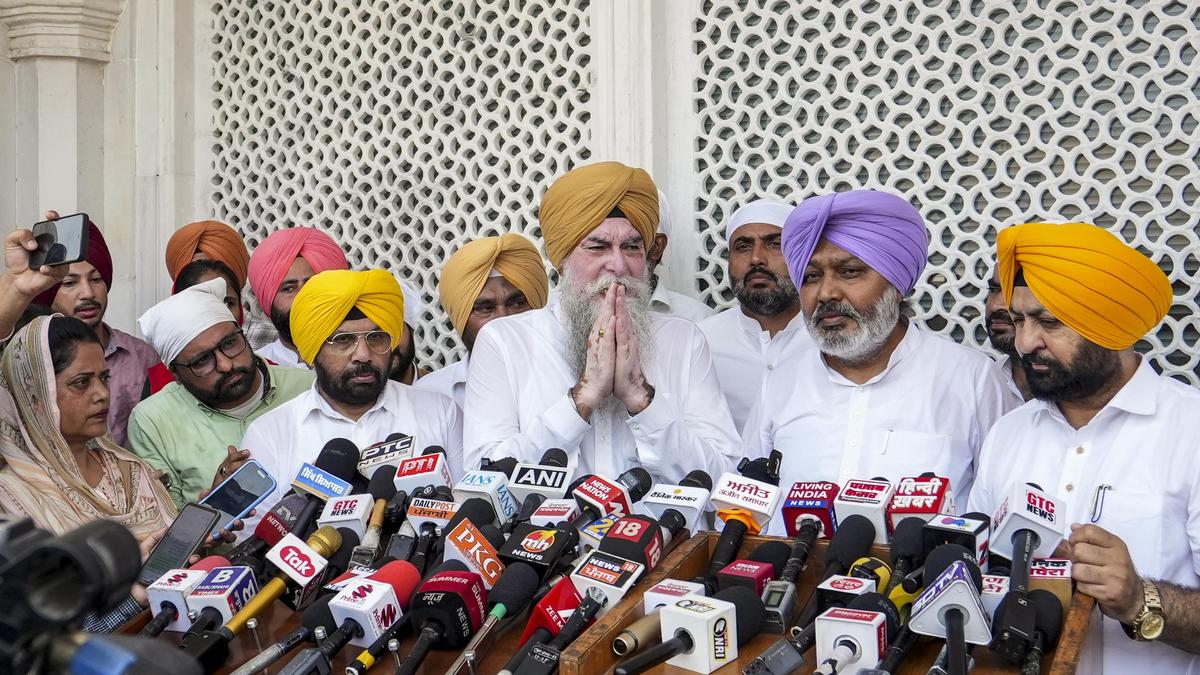
Last month, a law criminalising acts of sacrilege against the holy scripture of the Sikhs, the Guru Granth Sahib, came into effect in Punjab.The Aam Aadmi Party-led Bhagwant Mann government called the law “a historic correction” of the failure of past regimes.Over the years, sacrilege has become an emotive and polarising religious and political issue in Punjab and popular support has grown for such a law.Two other governments had tried to bring a similar law ensuring harsher punishment for such crimes but failed. Mann embarked on a four-day yatra to mark the passage of the law, hoping to use it to the party’s advantage in the upcoming Assembly elections.But legal experts and political observers in Punjab have warned that the law is draconian and can be misused to settle personal scores.A strong critique of the law has emerged, strikingly, from the Sikh religious establishment, which has accused the government of trying to interfere in matters of faith.On May 8, the Akal Takht, the highest temporal body of the Sikhs, summoned the Speaker of the Punjab Assembly, Kultar Singh Sandhwan, to have a “clause-by-clause” discussion on the law.After the exchange, acting Akal Takht leader Giani Kuldeep Singh Gargaj gave the Punjab government 15 days to “remove provisions from the act that are against the Guru Granth Sahib, Khalsa Panth and sentiments of Sikh community.”The lawIn July last year, the Aam Aadmi Party government brought in an anti-sacrilege law that proposed life imprisonment to those guilty of acts of sacrilege against holy texts of all religious communities – Sikhs, Hindus, Muslims and Christians.The proposed legislation was sent to a select committee for review and consultation.But in April, the Punjab government dug up an older law to regulate the printing, publication, storage, distribution or supply of the Guru Granth Sahib and amended it to create an anti-sacrilege law.On April 13, the Punjab Assembly unanimously passed the ‘Jaagat Jot Sri Guru Granth Sahib Satkar (Amendment) Bill, 2026’ – which enabled harsher punishment, including life imprisonment, for sacrilege of the Guru Granth Sahib.The law defines sacrilege as “any wilful and deliberate act, committed with the intent of desecration by way of physical damaging, defacing, burning, tearing or theft of the Saroop(s) of Jaagat Jot Sri Guru Granth Sahib or part thereof…”‘Saroop’ refers to a physical copy of the Guru Granth Sahib, considered to be a living Guru in Sikhism.Sacrilege, according to the law, can also refer to “words, either spoken or written, or by signs or by visible representations or through electronic means or otherwise” that “hurt the religious feelings of persons professing the Sikh faith.”The offence of sacrilege is now punishable by a minimum imprisonment of seven years extendable up to 20 years, along with a fine ranging from Rs 2 lakh to Rs 10 lakh. The law prescribes life imprisonment and fines up to Rs 25 lakh if the act of sacrilege has been committed as part of a conspiracy to “disrupt peace or communal harmony”.Policing faithThe Sikh religious establishment has alleged that the law amounts to government interference in matters of faith.The Akal Takht, the highest body of the religion, objected to the fact that the Punjab government had completely “bypassed” the Sikh religious institutions while framing the anti-sacrilege law.In a letter written to Speaker Sandhwan on May 11, the Akal Takht objected to calling a copy of the Guru Granth Sahib a ‘Saroop’ rather than the more commonly used term, ‘Bir’.More importantly, it took issue with the new concept of “custodian” of the Guru Granth Sahib introduced in the law.The law defines custodian as “any individual, institution, or gurdwara committee” to whom a copy of the Sikh holy book “has been formally supplied”. The law holds the custodian responsible for the protection of the Guru Granth Sahib and for following the tenets of the religion.The Akal Takht pointed out that the definition of “custodian” has created fear among the community as it makes possessors of the holy book responsible for any violations.The law also makes it mandatory for the Shiromani Gurdwara Parbandhak Committee, which is the only body authorised to print and publish the Guru Granth Sahib, to maintain a central register containing details of printing, storage, distribution, and supply of the texts. This register, as per the law, should assign a unique identification number to each copy of the holy book, its date of printing and publication, place of storage and name and address of custodian.This codification of the holy book, the Akal Takht said, is a violation of the sanctity of the holy scripture. Who gets a copy of the sacred text and whether that individual is following the religious code of conduct is something only Akal Takht should have jurisdiction on and not the state, it said in the letter. “The government has no authority to make such decisions.”Moreover, those who possess a copy of the Guru Granth Sahib can be punished for five years if they fail to adhere to the Sikh religious code of conduct vis-a-vis the holy book.This provision, the Akal Takht says, targets Sikh sewadar groups, gurdwara committees, granthis who read the scripture and officiates at ceremonies, pathis who recite hymns or Gurbani, preachers, and others in the Sikh community. “Except for sacrilege offences, all other matters concerning violations of rehat maryada, which is a code of Sikh conduct, and internal administrative systems of gurdwaras are under Akal Takht’s jurisdiction," the letter added.Kiranjot Kaur, senior member of the Shiromani Gurdwara Parbandhak Committee, told Scroll that the government was making a mistake by intruding in religious matters.“The state has no business in interpreting religious terminology and religious maryada [the code of Sikh conduct and conventions],” Kaur said. “Where does religious autonomy go if they start interfering?”The Shiromani Gurdwara Parbandhak Committee, the topmost statutory body responsible for managing historical Sikh places of worship, initially welcomed the new law. But, weeks later, it called the law a “political conspiracy challenging Guru Granth and Guru Panth”.Kaur pointed out that the definition of sacrilege could be misused against ordinary believers.“Even the routine wear and tear of our prayer book can be criminalised,” she said. “Over a period of time, when you read a book daily, it’s likely that its cover or pages will come apart. Under this law, if somebody sees that a prayer book is in bad or torn shape at somebody’s home, even that can be called sacrilege.”Kaur warned that the law “has the potential to be misused exactly like the laws that were put in place by the government in the 1980s”. She was referring to several stringent laws extended to Punjab to deal with the insurgency during Khalistan movement, which, she said, “gave unprecedented powers to the police which were eventually used for the harassment of the common people”.Mann has dismissed the allegations of the Shiromani Gurdwara Parbandhak Committee, which is believed to be close to the Akali Dal. “It’s been 14 years since an SGPC election was held. It is no longer a constitutional body,” Mann told reporters in Amritsar on May 7. “The Sikh community across the entire world accepts this law. The SGPC had raised the demand for the enactment of such a law. Now they are saying that it is not acceptable to them. In fact, it is not acceptable to their bosses, who are involved in sacrilege cases.”Zero safeguardsThe amended law significantly increases the punishment for acts of sacrilege, which critics say is uncalled for.Before the new law was passed, sacrilege incidents in Punjab were investigated under the provisions of Section 299 of the Bharatiya Nyaya Sanhita, a more or less equivalent version of the Section 295A of the Indian Penal Code, which is often referred to as India’s blasphemy law.Unlike the new law, which deals only with holy scriptures of the Sikh faith, Section 299 dealt with “deliberate and malicious acts,” against all faiths. Acts of outraging “religious feelings” were punishable with a maximum imprisonment of three years or with fine or both.Arjun Sheoran, a lawyer at Punjab and Haryana High Court, objected to the new law’s penal provisions. The punishment for the offence of sacrilege carries a minimum imprisonment of seven years, extendable up to 20 years or even life imprisonment. “Such punishment is meant for crimes like terrorism, rape, murder or dacoity. Equating sacrilege with these acts is totally disproportionate,” said Sheoran, who has also served as the Deputy Advocate General of the Punjab government.Moreover, the entire architecture of the law puts an accused at a disadvantage with zero safeguards, Sheoran warned. “This law has no safeguards and is more draconian than UAPA and the NDPS,” he said.The UAPA or the Unlawful Activities (Prevention) Act is a stringent anti-terror law and NDPS or the Narcotic Drugs and Psychotropic Substances Act is invoked in cases of drug trafficking.Under the new law, the police can arrest a person accused of sacrilege without any warrant or approval of the magistrate. Besides, the offence is both non-bailable and non-compoundable. In other words, even if the parties involved in the case wish to withdraw the case, they cannot. The case will end only once the trial is complete.Sheoran, too, flagged the sweeping definition of “sacrilege”. “How difficult is it to say that someone has committed sacrilege?” said Sheoran. “All you need to accuse someone of sacrilege under this law is a torn page [from the scripture]. The issue of proof will come during trial. Until then, an accused has to be in jail.”In contrast, the Section 299 of Bharatiya Nyaya Sanhita has more safeguards, including prior sanction of the government. “There is no mechanism of prior sanction which usually allows the government to take a call on a case after the investigations are complete,” Sheoran said.‘Dangerous gimmick’Jagrup Singh Sekhon, former professor of political science at Gurunanak Dev University, Amritsar, said the legislation glosses over the real issue. “The fundamental question is why are acts of sacrilege happening in the first place? It’s something which has not happened even during the Partition of the country,” he said. “The law doesn’t answer that question at all.”According to Sekhon, the state should maintain a distance when it comes to religious affairs. “The state has no role to make such [sacrilege] laws or intervene in the religious structure or religious system in the society. Whenever the state intervenes in these matters, it has backfired.”Instead of enacting a harsher law, the government should have focused on the quality of investigations in sacrilege cases in order to ensure the punishment of culprits, critics say.Punjab police’s record of taking sacrilege cases to their logical end has not been encouraging. Between 2015 and April 2026, a total of 597 sacrilege cases were registered in Punjab out of which only 44 ended in conviction — a conviction rate of merely 7%. The number of cases that ended in acquittal was 99.Instead of ensuring convictions, Sheoran said the government has come up with a very “dangerous political gimmick”. “We have seen this experiment happen in Pakistan and how blasphemy laws have been misused against the minorities and those from marginalised backgrounds.”
Why Sikh religious leaders are alarmed by AAP’s anti-sacrilege law
The Akal Takht claims that the government is trying to interfere in matters of faith and putting believers at risk of harassment.
1,850 words~8 min read