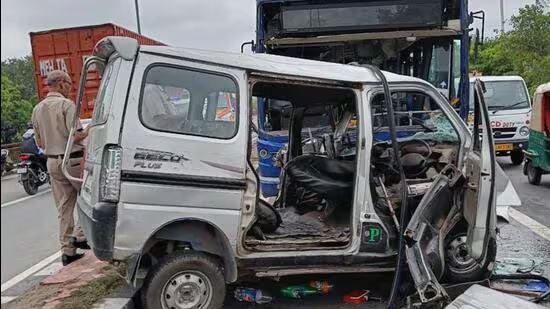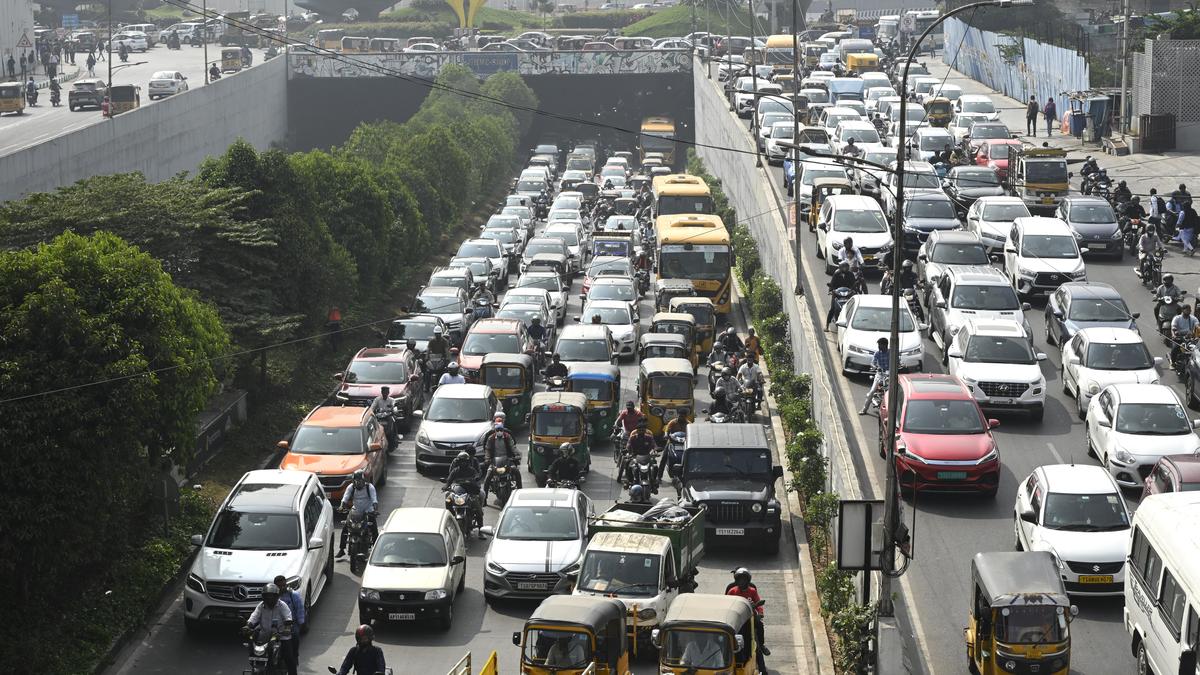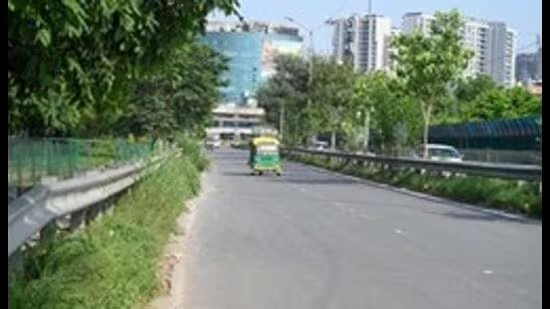
A traffic and road safety audit is underway on at least 14 of the 30 black spots identified this year across the Gurugram district, where a high number of accidents were recorded over a three-year period, district traffic police officials said on Saturday.(Representative image) The black spots, identified in May through the Ministry of Road Transport and Highways’ app “Sanjaya”, are spread across 18 locations, including 16 on high-speed corridors and expressways since 2023. (HT Archive)The black spots, identified in May through the Ministry of Road Transport and Highways’ app “Sanjaya”, are spread across 18 locations, including 16 on high-speed corridors and expressways since 2023. The app tracks the yearly Integrated Road Accident Database (iRAD) to identify accident-prone stretches. Under the norms, a 500-metre stretch is declared a black spot if it records either five accidents, including one fatality, or 10 fatalities over three years.The district’s earlier “zero fatalities” action plan had identified 23 accident-prone stretches that recorded 53 deaths in 49 fatal crashes between 2023 and 2024, while under MoRTH’s Sanjaya initiative, around 50 people lost their lives last year across 32 identified blackspots.The ongoing audit includes mapping road geometry, recommending design improvements, installing signage and strengthening pedestrian safety infrastructure through marked crossings, metal grills and additional foot-over-bridges (FOBs). Officials said the location-specific audits will be conducted in phases, followed by on-ground road safety upgrades and traffic streamlining measures over the coming months.According to traffic police data, around five black spots are located near Manesar bus stand, three between Ambience Mall and Sirhol border, and two each on Golf Course Road, Binola flyover and Narsingpur. One black spot each has also been identified at Rathiawas, Bilaspur, Khandsa, near Ghamroj toll plaza, near Old Rao Hotel in Sidhrawali, near Raman Munjal University, Panchgaon, Vatika, Rajiv Chowk, and Shankar Chowk, among others.Black spots near Rampura Chowk were rectified last year, while the stretch between the Gurugram-Delhi border and Ambience Mall recorded zero fatal accidents in the past eight months. “Since road safety and decongestion measures were introduced at Shankar Chowk in October, the contributing factors to accidents have reduced due to clear lane demarkations for traffic heading to Delhi, Jaipur, Cyber City and nearby areas. Narrowing the NH-48 carriageway width outside the Ambience Mall has also improved lane discipline and two-wheeler safety,” said a senior traffic police official, requesting anonymity.Black spots near the Manesar bus stand are expected to improve after the completion of an under-construction flyover. The National Highways Authority of India (NHAI) has set an August deadline for two six-lane flyovers, measuring 800-900 metres, at Rathiawas and Bilaspur. Authorities also plan to install four FOBs at Rathiawas, Binola, Shankar Chowk and NH-8 to curb jaywalking.In 2025, at least 50 people died in accidents at these black spots out of the 1,112 road accidents and 478 fatalities recorded across Gurugram last year. Six spots recorded no fatal accidents; however, clearance requires consistent enforcement and accident prevention measures sustained over three years.Prateek Gehlot, Deputy Commissioner of Police (Traffic), said scientific infrastructure improvements were critical for reducing accidents. “Pedestrian safety infrastructure, including imposing grilles and footpaths, will be carried out on many of these stretches where workers usually cross roads carelessly. Already, a running underpass near Shankar Chowk has opened a safer alternative for the crowd from Udyog Vihar, which used to rely on NH 48 as a dangerous crossing,” Gehlot said.Instant traffic streamlining trials are also underway at Gwal Pahari T-point crossing, Bristol and AIT chowks to reduce congestion and collision risks.
Gurugram begins safety audit of 14 of 30 flagged crash-prone black spots
Officials are mapping road geometry, adding signage, FOBs and pedestrian barriers to reduce crashes and improve traffic flow on key stretches.
581 words~3 min read