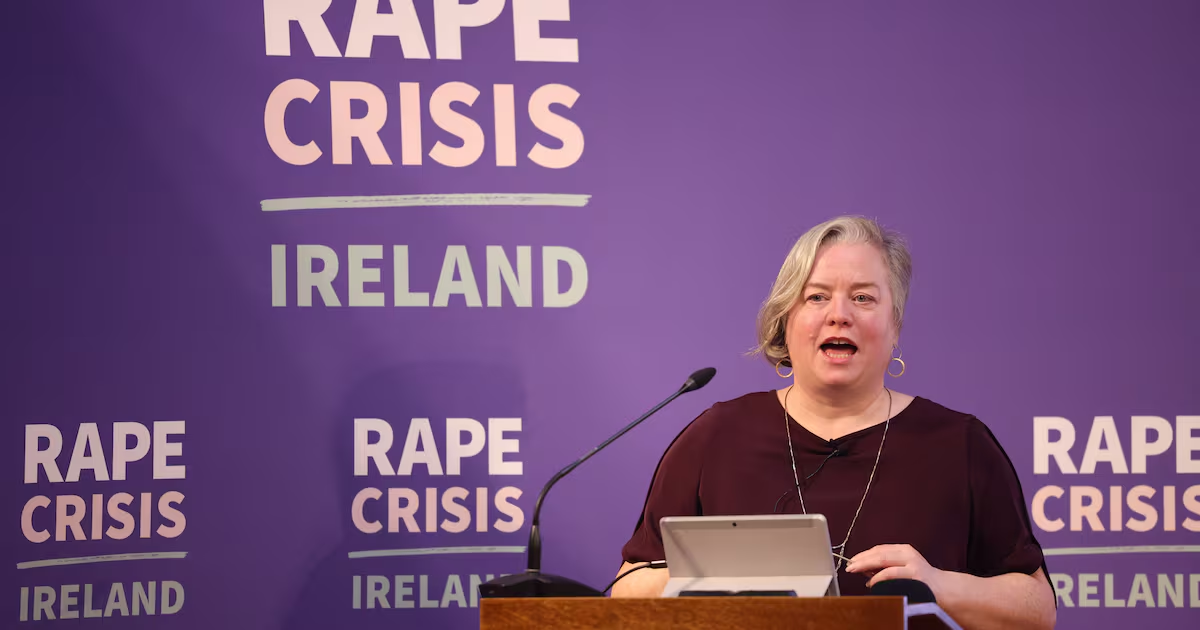
Rape Crisis Ireland (RCI) has urged the Minister for Justice to strengthen a proposed new law aimed at restricting disclosure of counselling notes in sexual offence cases. It wants amendments including a stand-alone provision “stating clearly that there shall be a presumption of non-disclosure in respect of all applicable records”, said RCI executive director Clíona Saidléar.A spokesperson for the Department of Justice, noting advice from the Attorney General that a “blanket ban” on disclosure would be unconstitutional, said disclosure is being restricted “to the maximum extent possible”.The reforms “will ensure that any disclosure of sensitive material only occurs where strictly necessary, and always subject to rigorous judicial scrutiny”.The exchanges on Sunday came in advance of the Oireachtas Justice committee’s consideration of the Criminal Law and Civil Law (Miscellaneous Provisions) Bill on Tuesday.Saidléar said the Minister, Jim O’Callaghan, had indicated in January he would “introduce a statutory presumption of non-disclosure of counselling notes and other sensitive personal records in sexual offence proceedings” and that the “sole” test for any disclosure would be a real risk of an unfair trial. “Neither commitment appears in the published Bill,” she said. “It is deeply unsatisfactory that the Minister has not yet honoured the clear public commitments he made to survivors earlier this year.” The word “presumption” does not appear in the draft Bill and it is “the difference between a law that protects survivors and one that only appears to”, she said.“Survivors have waited long enough, have been disappointed enough and they deserve a law that does what was promised.” [ Disclosure of rape complainant’s counselling notes during trial will be ‘an exception’ under law changeOpens in new window ]The Minister, she said, had also “committed publicly” that the only basis for disclosure would be “a real risk of an unfair trial”. While that standard was included in the legislation, the RCI feared another “open-ended” ground would “undermine” it. That other ground allows disclosure where “it is otherwise in the interests of justice to so order” and it should be removed, she said.Saidléar said the RCI welcomes “meaningful changes” effected in the Bill, including the removal of the prosecutorial duty to notify an accused of the existence of personal records. That duty had contributed to “a culture of routine record-gathering before any question of relevance was determined by a court”, she said.RCI is supportive of the Bill and is not seeking for it to be delayed but wants it to include the changes it had identified, she said.In a statement, a department spokesperson said the Attorney General has advised a blanket ban on disclosure would be unconstitutional because, in a small number of cases, counselling records may contain material relevant to the defence. “It is in this context that legislation is being brought forward to restrict disclosure to the maximum extent possible, while ensuring independent judicial oversight in all cases.”The Bill amends the current statutory framework to ensure judicial oversight governs the disclosure of any counselling records, in order to ensure adequate judicial oversight so the rights of victims to privacy are always taken into account, the spokesman said. [ Unconstitutional to have complete ban on use of counselling notes in criminal trials, Minister tells DáilOpens in new window ]The Bill was debated at Second Stage in the Dáil last January and the Minister secured Government approval to bring forward further amendments to the legislation “to restrict the disclosure of counselling records as far as possible”. This includes amendments to introduce a presumption of non-disclosure, and it is the intention the same protection regime is applied to other victims’ records containing sensitive personal data, such as medical records, child protection records and other such documents. “These reforms will ensure that any disclosure of sensitive material only occurs where strictly necessary, and always subject to rigorous judicial scrutiny.”
Minister urged to strengthen new law restricting disclosure of counselling notes
Attorney General has advised a ‘blanket ban’ on disclosure would be unconstitutional
633 words~3 min read