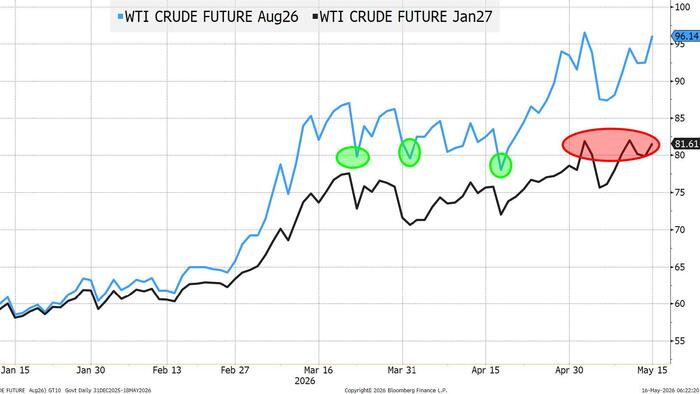
By Peter Tchir of Academy SecuritiesLast week, we contemplated, for the first time, that we might need to Understand Universal Basic Income. The timing was very good as on Monday, South Korea floated the idea of transferring some AI-driven tax revenue to its citizens. As uncertainty around jobs, income, and costs continue to weigh on overall confidence, expect this subject to get more airtime in the political arena. The concept of UBI does go hand in hand with two competing themes: AI and Affordability.China, Iran, and a Whole Lotta NothingIran took a backseat to the Summit in China. We had relatively low expectations for the Summit. The cards were stacked somewhat in China’s favor as examined in China and Trade. It turns out that even our low expectations seemed to have set the bar too high. Friday’s title pretty much sums it up: My President Went to Beijing and all I got was this Crummy T-Shirt. There may yet be some deals announced, either with Iran or with China, but it looks like we are starting the week roughly where we started the prior week, but with even lower expectations.The Oil CurveWhile Brent crude is most impacted by the ongoing problems in the Middle East, we will stick with WTI because that is what affects Americans the most.One of the talking points for the admin had been that the oil market was predicting a “quick” resolution. Some officials pointed to the August contracts as demonstrating that $100 oil was a blip and things would “normalize” quickly. While $80 was still higher than pre-war, the argument had some legs. But now, the August contract is up to $95, and we are seeing $80 priced in all the way into 2027. This is certainly “higher for longer.” What is increasingly concerning is that it is difficult to tell if this is pricing in a re-opening or not. It was entirely plausible, a month or more ago, to believe that with the Strait of Hormuz getting back to normal levels of transit, global energy prices would “normalize” quickly. It is increasingly unclear what the “new” normal is. How much damage has been done to the “organism” that is energy? How quickly can things be fixed? Is the “new” normal the same as the “old” normal (see "Why One Bank Thinks It's "Magical Thinking" That Hormuz Reopens In June")?Increasingly there are more and more questions about how long the damage will last, and if that damage will continue to elevate not just the price of oil, but also gasoline, diesel, jet fuel, etc.The U.S. can continue to release its Strategic Petroleum Reserves (SPR). It is unclear how low the reserves can go (I’m told that some amount needs to be left in place for structural integrity). We have released about ½ of what was added back to the SPR. Keep an eye on this, as it does limit our options over time. No one is expecting the problems to last that long, yet here we are, 3 months into the conflict, and transit through the Strait remains limited. Higher for longer in the oil market is the single biggest issue for Global Affordability.AI versus AffordabilityWe received some consumer spending data this week which wasn’t too bad. It did seem to highlight, yet again, the problems facing people in the lower income brackets. I’m not convinced it doesn’t obfuscate that we are spending more to get less, but that is for another day. But here is a “simplified” version of a chart I’ve seen in various formats.Companies servicing the consumer are not seeing much appreciation in their stock price.Companies making chips are growing like gangbusters!Is this sustainable? That question is being asked with increased urgency. The “parabolic” rise is raising some concerns. Without a doubt, this is the sector experiencing growth. It does seem to justify not only today’s prices, but also possibly even higher multiples. The earnings engine (and growth) is there, but this market has had a habit of hitting “high-conviction” trades.I find this chart extremely weird, but also interesting.SOXL is a 3x leveraged SOX ETF. The assets in this ETF are about $20 billion, but the shares outstanding have been declining. While it may be inappropriate to label SOXL as a “degen” trade, I’m going to go there. “Degen” is an “affectionate” way of describing a group of very aggressive investors. Whether it is day trading leveraged ETFs, making bets in crypto altcoins, or playing in 0DTE options, there is a crowd of very aggressive traders that I will call “degen” for now (Warren Buffett would probably just call them gamblers).I do think this crowd represents the “tip of the spear” on retail sentiment. If that assessment is correct, then it might indicate that retail is done (or almost done) fueling this trade.The SOXX ETF weighs in at $33 billion (I had to do a double take, that it is “only” $33 billion while SOXL is $20 billion). The share count here tends to be more correlated with price. If anything, the last decline in SOXX was possibly telegraphed by a declining share count.My view is that retail is slowing down on the semi-trade, just as institutions, including hedge funds, are treating it as a “must-have” position.Retail, unlike funds, don’t have stop losses. Is this setting up for a pullback? Based more on positioning, and who is positioned, rather than the fundamentals?Without the AI and semi story, market averages would be much lower. That is a fact. Is there anything to indicate that this trade cannot continue? No. But, I am curious what retail is up to here, and whether we are seeing enough of a pullback to create a reasonable pullback?Which Brings Us To RatesYes, I “cherry picked” April 2024 as a starting point, because the 10-year U.S. Treasury yield is unchanged, while rates across the globe have risen. Most noticeably for Japan. In 2 years, the 10-year JGB went from yielding less than 1% to almost 3%. This is incredibly important. Japan as a “nation of savers” has been funding much of the world’s debt. I remain convinced that “at or near-zero” bond buyers of all levels of sophistication will take steps to get positive yield. So, when Japan hovered near 0% on rates, many investors would find alternatives to their domestic market to get yield. That has changed.Globally, U.S. Treasuries, are fairly “generic.”If you do not need dollar exposure, you have local FX bonds that can serve your needs.All countries face a variety of risks to their economy. All central banks are trying to navigate the data, their expectations, and their mandate. It is less certain today how the U.S. central bank will respond to data than it was a few months ago – so that uncertainty should have a cost?
AI vs Affordability And Rates
Retail is slowing down on the semi-trade, just as institutions, including hedge funds, are treating it as a “must-have” position.
1,639 words~7 min read