FLUX.1 is a family of text-to-image models released by Black Forest Labs this summer. The FLUX.1 models set a new standard for open-source image models: they can generate realistic hands, legible text, and even the strangely hard task of funny memes.You can now fine-tune FLUX.1 [dev] with Ostris’s AI Toolkit on Replicate. Teach the model to recognize and generate new concepts by showing it a small set of example images, allowing you to customize the model’s output for specific styles, characters, or objects. Ostris’s toolkit uses the LoRA technique for fast, lightweight trainings.People have already made some amazing fine-tunes:How to fine-tune FLUX.1You can fine-tune FLUX.1 on Replicate by just uploading some images, either on the web or via an API.If you’re not familiar with Replicate, we make it easy to run AI as an API. You don’t have to go looking for a beefy GPU, you don’t have to deal with environments and containers, you don’t have to worry about scaling. You write normal code, with normal APIs, and pay only for what you use.Prepare your training dataTo start fine-tuning, you’ll need a collection of images that represent the concept you want to teach the model. These images should be diverse enough to cover different aspects of the concept. For example, if you’re fine-tuning on a specific character, include images in various settings, poses, and lighting.Here are some guidelines:
Fine-tune FLUX.1 with your own images – Replicate blog
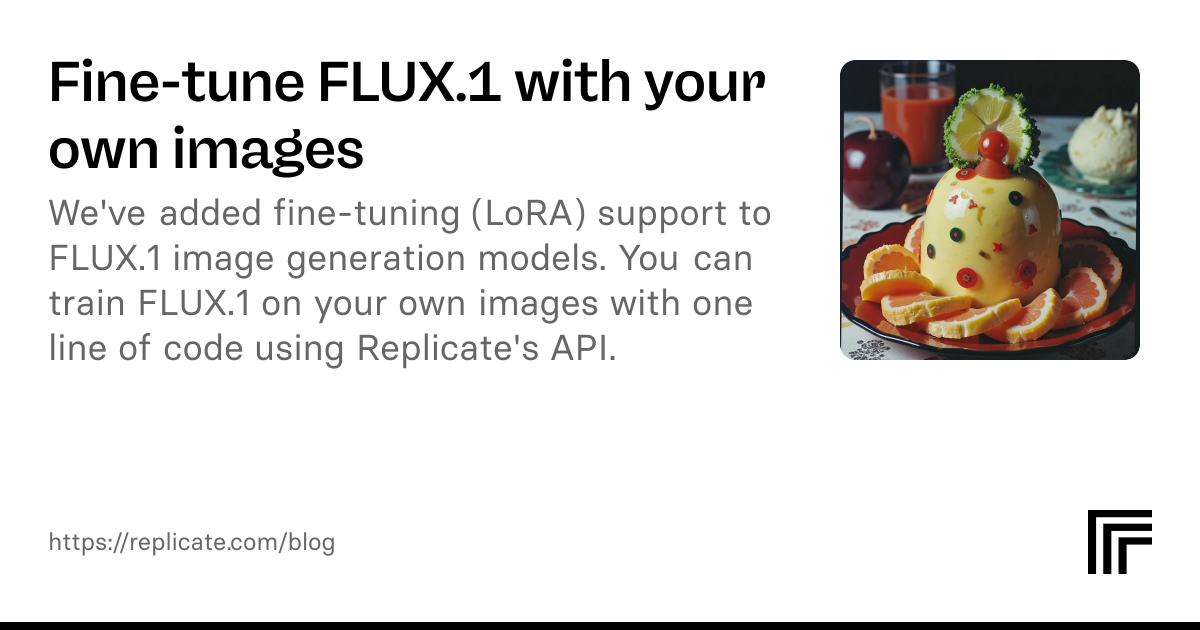
We've added fine-tuning (LoRA) support to FLUX.1 image generation models. You can train FLUX.1 on your own images with one line of code using Replicate's API.
1,034 words~5 min read