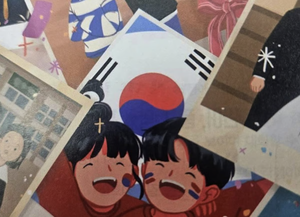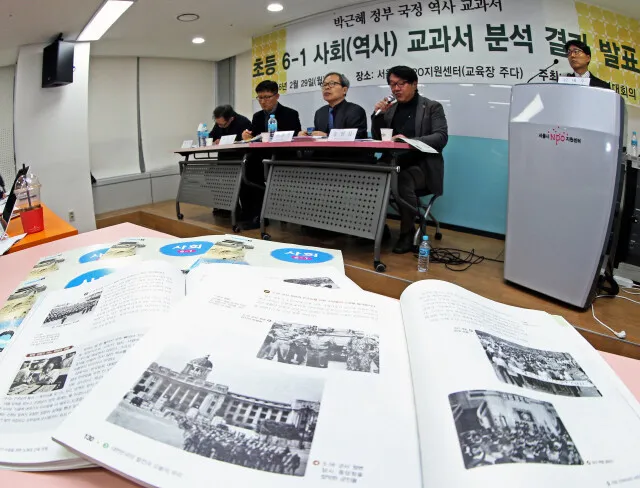
The Korean history and social studies textbook for the first semester of the sixth grade of elementary school
The Korean history and social studies textbook for the first semester of the sixth grade of elementary school, which is the first history textbook to be issued under the administration of President Park Geun-hye, contains numerous errors, and is more favorable to former president Park Chung-hee (1961-79), Park Geun-hye’s father, than previous textbooks.It’s no wonder that various historical groups are contending that the textbook has been altered for political purposes. Since this provides a glimpse of what state-issued history textbooks for middle and high school will look like, we cannot help but feel concerned about the results of the textbook authorship process, into which the government has entered so rashly.According to the Historical Education Solidarity Council, which reviewed the final version of the social studies textbook that will be used in the next semester, there are 93 errors, simply looking at basic historical facts.For example, the book presents blue and white porcelain and lacquerware with mother-of-pearl as being part of peasant culture, though these were actually luxury products used by Korea’s yangban, or aristocrats. In addition, the Donghak philosophy is described as having being difficult for society of the time to accept, even though it was in fact widely embraced by the Korean people.While these mistakes no doubt were a side effect of attempting to change so many things all at once, there are some points that make us wonder if errors were introduced deliberately.The bigger problem is political bias. The new textbook replaces the phrase “establishing the government of the Republic of Korea [in 1919]” with “establishing the Republic of Korea,” reflecting the argument of the so-called “New Right” that the country was established in 1948.The section about former president Park Chung-hee briefly dispenses with his dictatorship and trampling of civil rights and focuses on economic growth. In the discussion of social problems that arose at this time, the gap between rich and poor is omitted. In the section about former president Chun Doo-hwan, the expression “military dictator” does not appear.Former presidents Syngman Rhee (1948-1960) and Park Chung-hee and their administrations are mentioned 14 times and 12 times, respectively, while former presidents Kim Young-sam (1993-1998), Kim Dae-jung (1998-2003), Roh Moo-hyun (2003-2008) and Lee Myung-bak (2008-2013) and their administrations are not mentioned at all.Elementary school textbooks are still controlled by the state. This makes it easy for the government to insert its views into textbook narratives if it wishes to do so.For this reason, the revised version of the sixth grade social studies textbook that is now being released has been seen as a bellwether of what will appear in upcoming state-issued middle school and high school history textbooks.The results are atrocious. The philosophy of history education has vanished, and at various points there are clear signs that historical narratives have been revised to please the whims of those in power.The South Korean government has decided to produce Korean history textbooks to be used in the nation’s middle and high schools starting next year. The people who are writing these textbooks have been kept secret, and they do not have much time to write them, either. These books are likely to maintain the basic narrative structure of the sixth grade social studies textbook.It’s obvious that this will be a debacle for history education, which is supposed to teach students to understand, criticize and judge historical facts and, in so doing, to develop their creativity and imagination. The government is committing a crime against history.Please direct questions or comments to [english@hani.co.kr]