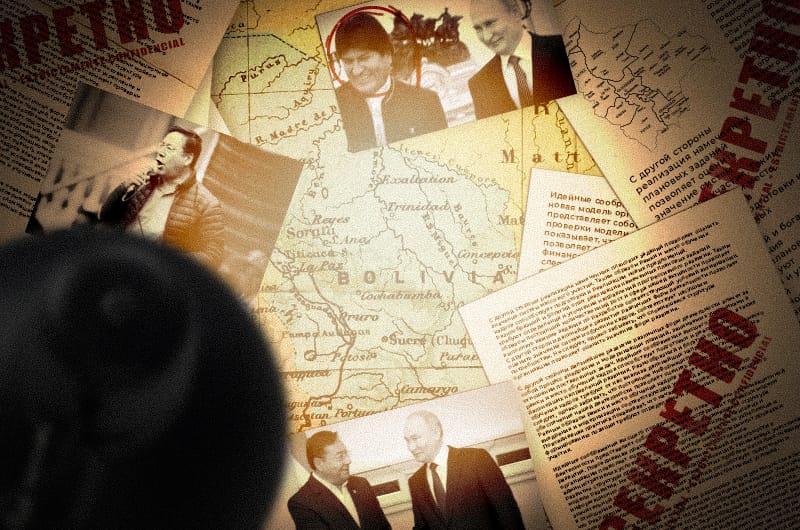
On an unusually warm day in July 2024, a team of seven Russian “specialists” landed in La Paz, Bolivia, with the aim of “stabilising” the government of President Luis Arce, an ally of Russia, ahead of a national election scheduled for the following year.The stakes were high: 2024 had been a hard year for Bolivians, marked by economic difficulties, a severe fuel shortage, extensive wildfires, and more than 500 protests and anti-governmental demonstrations. Inflation was at its highest since 2008, and Arce’s Movement for Socialism party (MAS) was riven by an internecine battle for control between the president and his ally-turned-rival and predecessor, former President Evo Morales. The MAS regime, in the meantime, was one of the few remaining Kremlin allies in the region, and resource-rich Bolivia has 21% of the world’s deposits of lithium, a vital mineral for next-generation technologies.Three weeks before the arrival of the Russians, on 26 June that year, a small band of soldiers led by the chief of the army, general José Luis Zúñiga, had tried to take control of the presidential palace, only to surrender soon after. When arrested, Zúñiga said the uprising had been staged by President Arce himself to boost his flagging public support; a narrative seized on by media, opposition politicians, and also Morales and his supporters, but vehemently denied by Arce.The Russian Foreign Ministry publicly condemned the coup and called for calm to prevail. “There was no interference by third countries in what happened in Bolivia,” the Kremlin spokesperson Dmitry Peskov told the press.But a trove of 1,431-page Russian-language documents obtained by The Continent, an African news outlet, and shared with openDemocracy reveal the Kremlin had picked a side.The Russians who arrived in La Paz that July were operatives working for a reincarnation of the Wagner Group, a paramilitary corporation that had been disbanded in 2023.Over the next four months, as the documents reveal, these agents sought to shore up Arce’s government and discredit Morales, his rival, who had also been a popular leader both in Bolivia and the region.Their proposed tactics included drafting Arce’s speeches, setting up a rapid-response communications unit within the government, false flag operations aimed at Morales, who was openly challenging the Presidency, and influencing Bolivia’s national elections and judicial elections.It is unclear how influential the Russians were: Arce stayed on till his term ended the following year, but did not run in 2025. The MAS lost the election, which was won by the centre-right opposition led by Rodrigo Paz. One of Paz’s first moves as president-elect was to announce the resumption of economic and diplomatic ties with the United States after a 17-year hiatus.The previously undisclosed story of the operation in La Paz offers a glimpse of Russian efforts to maintain the Kremlin’s influence in South America, and for the first time, evidence of political and propaganda operations by former Wagner contractors in South America. Previous reports have documented the presence of paramilitary soldiers linked to Wagner in Venezuela.openDemocracy reached out to a lawyer acting on behalf of former president Luis Acre, as well as former ministers in his cabinet, former president Evo Morales, the office of current president Rodrigo Paz, the Bolivian Foreign Ministry, the Russian Foreign Ministry and the foreign intelligence service, and all individuals mentioned in this report for comment several days before publication.This report shall be updated when they reply.From Wagner to the SVRRussia has three main agencies: the domestic counterintelligence security service known as FSB, the military intelligence directorate GU, and the foreign intelligence service SVR, explained Lou Osborn, member of the INPACT/All Eyes On Wagner collective, which tracks Russia’s hybrid warfare operations.The SVR, Osborn told openDemocracy, “is focused on collecting intelligence in foreign countries with a perimeter related to political affairs, economic affairs and security”.Then, there are “several Russian private military companies which have had ex-members of these services”, Osborn added. Wagner was one such company.Wagner first made its presence known as a violent paramilitary operating under Russian oversight in Kremlin-occupied Donbas, before expanding its operations into Africa, and then Syria. Wagner played a significant role in Russia’s full-scale invasion of Ukraine in 2022, only for its self-proclaimed founder, Yevgeny Prigozhin, to fall out spectacularly with President Putin in 2023. Progizhin died in a plane crash soon after, and most of the group’s structure was subsequently taken over by Russian military intelligence.“The big shift came after Prigozhin’s death, with a deeper involvement from security services in what the Wagner Group had created,” Osborn said.What is left of the Wagner Group, she added, “especially in the Central African Republic and information operations, was rumoured to have been taken over by the SVR for years, and now these leaked documents are proving it”.The documents contain strategies, workplans, budgets, accounting reports, staff biographies, profiles of targeted public figures, and briefings of media operations relating to Russian influence campaigns executed between January and November 2024 in at least 30 countries in Africa and Latin America, including in Bolivia and Argentina.Worldwide presence of the Company agents, 2024–2025. In dark red, countries with confirmed on-the-ground units; in light red, countries targeted by influence campaigns, where current presence is unconfirmed | Sofía Álvarez Jurado/Forbidden StoriesopenDemocracy and a consortium including The Continent, Dossier Center and iStories (Russia), All Eyes on Wagner and Forbidden Stories (France) and two independent Russian-speaking journalists, have examined and fact-checked the documents and are publishing a series of stories on many of these activities.A key document in this trove is a 54-page report titled “Strategy for increasing Russia's influence in Africa”, and likely dated in August 2023, which makes clear that these documents were prepared by operators linked to the Wagner group for internal use. In several places, the document calls for joint strategies of cooperation with the SVR. At least 17 of the more than 60 operatives deployed by 2024 and mentioned in these documents have previous links to Wagner.Finally, openDemocracy was able to confirm that an interaction described in the documents – between the Russian operatives and a senior advisor to the Arce administration – did indeed take place.“Defenders of the Peace”The Bolivian operation was led from Russia by a man named Sergei Sergeyevich Klyukin, described in the documents as the “curator” of the mission. An internal biographical document analysed by openDemocracy states that Klyukin had joined ‘the Company’, as the group called itself in the documents, in 2018 after working as a political consultant in Russia.Klyukin, the documents say, worked as the head of the Company’s “sociological department” in Sudan from 2018 to 2020, where Wagner once had significant interests. In January 2024, Klyukin was in charge of monitoring and analysis of the situation in 15 countries and of managing 34 “sociologists” or “political specialists”. He was also, the documents claim, the recipient of a company-level award for the “Defence of Peace in Africa”.He “organized the operational collection of information, and compiled analytical reports on the situation in the country, which allowed for the assessment of the situation before sending a group of specialists to La Paz,” a document says.Also overseeing the mission was Sergei Vasilievich Mashkevich, another veteran political operative with experience in regions as diverse as Sudan, Abkhazia and South Ossetia, according to the documents. Mashkevich, the documents said, was responsible for the “expansion of the Company's presence on the African and Latin American continents,” and coordinated the team in Bolivia between July and September 2024.Dmitry Viktorovich Volkov was assigned to lead the Bolivia mission on the ground in July 2024. Before that, he led the information direction in Mali and was promoted to head of the Mali mission in 2024. He joined the Wagner Group in 2023.Biographies of other members listed in the documents suggest a team of political operatives with experience in propaganda campaigns in several African countries, and a Spanish-language translator.None of the individuals mentioned above, nor the SVR, responded to repeated requests for comment.Agents from everywhereBolivian security analyst Jorge Santistevan said Bolivia is a stomping ground for undercover agents from a number of nations due to its natural resources, such as lithium and rare earths, and narco-trade.“Not just undercover Russian agents arrive in Bolivia, they come from everywhere,” Santistevan said, adding that Israel's Mossad and the United States intelligence agencies, particularly the US Drug Enforcement Agency, which despite being expelled during Morales' government, “never really left, it has always been in Bolivia”.Santistevan, who is also a constitutional lawyer and reserve member of the armed forces, said the alliance between Russia and Bolivia was not ideological, but “just geopolitical interests”, like access to lithium.For instance, in September 2024, a subsidiary of the Russian nuclear energy state giant company Rosatom, Uranium One Group, signed a $1bn contract with the Arce government to produce 14,000 annual tonnes of lithium carbonate in Salar de Uyuni, one of the world's largest lithium salt flats.Around the time the Russians landed in La Paz, their country also began shipping diesel to Bolivia. For the Kremlin, Bolivia offered an outlet at a time when Western sanctions meant there were few takers for Russian oil. For President Arce’s embattled government in Bolivia, the shipments were a lifeline for a country crippled by fuel-shortages, frequent protests, and plummeting foreign reserves.In short, both sides had an interest in stabilising the Arce regime.In a 14-page document dated 17 August 2024, titled “Strategic vision of the political process in the Plurinational Republic of Bolivia, the Russian operatives laid out the dire results of a recent phone survey they had: “67.2% of respondents do not trust Luis Arce” the memo noted, warning of the possibility “that Luis Arce will not retain his post until the expiration of his term.”In the document, likely intended for their handlers, the Russian operatives claimed to have convinced the Arce government to set up an “anti-crisis information centre” with rapid response functions within the Ministry of Communications, an “anti-crisis headquarters” to “identify tension points regarding food supplies” and to purge members of Acre’s government.Contemporary events indicate Arce had, in fact, removed the ministers of Oil, Labour and Development around that time, but a cabinet reshuffle had been expected anyway.The proposed new communication structure included a media officer who would report daily to the President, be “responsible for work with mass media” and lead an “analytics department”, as well as a “secretariat” who would subordinate “press secretaries of institutions and heads of state media to him”. The structure and work flow was described in detail, even with a chart. “In view of the critical situation in the country, the implementation of these measures had begun on 29.07.2024”, the document claimed.Diagram of the communication structure suggested by the Russians | James BattershillopenDemocracy was unable to independently verify if this “anti-crisis information centre” was indeed set up by Arce’s government under Russian advice, or if the foreign agents were simply taking credit for actions and events occurring independently of their actions.openDemocracy reached out to several sources linked to Arce’s government, including his lawyer, Jaime Tapia, who declined to respond to allegations regarding Arce’s time in office and said he has only represented Arce since December 2025.A major headache for Arce’s government, the Russians claimed, was the widespread belief that Arce had organised the coup against himself to discredit his opponents. These allegations were insistently amplified by the supporters of his rival, Morales. The memo noted: “The long-standing split in the ruling MAS party between supporters of Luis Arce and former President Evo Morales [has] created a real threat of a further constitutional crisis.”Accordingly, in a subsequent report titled “Project on influence”, the Russian operatives said they had published more than 300 materials “claiming the failed coup was part of a US plan”, and dozens more pieces of content to discredit a protest march, organised by Bolivian trade unions by claiming the march was “sponsored by the US to destabilize the country”.Financial records included in the trove listed 52 published articles, of which 10 appeared in Bolivian media, with the rest published by Argentinian digital outlets. They also claimed to have “injected” a fake video of Morales supporters threatening President Acre onto social media channels, but openDemocracy could not locate this particular video.As a result of these actions, the documents claimed, “the president’s special envoy confirmed the self-coup topic is no longer acute” and the march “failed to achieve mobilization goals.”“Sociologists” and “Political Scientists”As part of the wide remit they had given themselves, the Russian agents also set up plans to engage with high-ranking members of the government, opposition figures and with leaders of anti-government protests.The documents record a 5 November meeting with a person they identified as “special representative” of president Arce, Hugo Moldiz, who apparently sought their support to “neutralise the political influence of Morales”.In an interview with openDemocracy, Moldiz confirmed that he met with Russians who introduced themselves as “sociologists” or “political scientists” and that he had assumed that’s what they were. Moldiz denied any involvement in their operations.“My relationship with Arce became similar to my relationship with Evo Morales. Except for my brief stint at the Ministry of Government and as an advisor to the presidency during Evo Morales' administration, my contribution to the process of change was in my capacity as a left-wing activist without any official position. In that capacity, I meet with academics and analysts, both national and international. It could be said that I have been a kind of source of consultation, without the capacity nor intention to structure teams and make decisions”, Moldiz said in a written answer to openDemocracy.He added: “Within those limits, I spoke with Russian sociologists and political scientists who had come to Bolivia because of the interest generated by the situation after the attempted coup against President Arce and his political and electoral prospects. It was obvious that they were unfamiliar with the country's political history, and some of their opinions or suggestions were of a general nature. To think otherwise would be biased or inaccurate”.Arce vs. MoralesWith Arce’s popularity showing no signs of improvement, the Russians considered working towards nominating a third candidate acceptable to both Arce and Morales. “The negative side of this strategy is the risk of a complete loss of influence over this successor and the continuation of disagreements after the elections,” concluded an internal memo, dated 23 October 2024, offering a glimpse of why Russian intelligence was so invested in the outcome of this election.Then, they rolled out a more aggressive campaign against Morales.The former president had faced allegations of sexual misconduct for years. Morales stood accused of aggravated sexual trafficking of a minor in 2015, when he was president, and an arrest warrant was requested by the prosecutor’s office in December 2024 and issued by a judge in January 2025.At present, Morales, who has consistently denied the allegations, remains free, with the arrest warrant yet to be served. Critics allege he is being protected by his followers, the combative coca growers in the central province of Chapare.In memos, the Russians considered ways to amplify the narrative that Morales was a rapist and that his supporters were accomplices; they considered crafting fake videos of Morales’s supporters demanding the decriminalisation of rape to discredit his movement, and measures to block the broadcasting of Radio Kawsachun Coca, known as Morales’s media mouthpiece.The news articles cited in their internal reports described Morales as “blackmailing” the government, aligning with right-wing narratives, and even working with the US to regain power.
How the Kremlin tried to pick a winner in Bolivia’s fractured left
Exclusive: New dossier exposes how Russian operatives sought to ensure their ally won Bolivia's presidential election
3,313 words~15 min read