Under national anti-sexual violence organization RAINN's new Safe Access Program, Visby Medical said patients in care deserts with positive chlamydia, gonorrhea and trichomoniasis infections can access the medication they need without in-person appointments.WHY IT MATTERSApproximately 443,000 Americans experience sexual violence each year, and many face care access barriers or long wait times, according to RAINN. While its new partnership with Visby aims to improve detection and treatment of sexually transmitted infections (STIs) in regions of 17 states with known healthcare gaps, it could also help address post-assault mental health trauma that prevents some from seeking care in a clinical setting. It's "a more accessible, private option, without requiring survivors to re-enter spaces that may feel overwhelming," said Megan Cutter, RAINN's chief of victim services, in the announcement this week.A lack of STI treatment can have long-term health consequences. More than 50% of women with chlamydia or gonorrhea show no symptoms, and an estimated 100,000 untreated women suffer infertility each year as a result, according to the U.S. Centers for Disease Control and Prevention's web archive page."Testing is often the only way to detect infection early," said Adam de la Zerda, Visby's founder and CEO, by email. "Many face delays in treatment because of cost, privacy concerns and discomfort with clinical settings." Visby, which offers an infectious disease diagnosis platform, said its at-home STI test kit has a 98% accuracy rate, which is comparable to clinical settings. Test results are available in 30 minutes via mobile app, the company said."If positive, patients are connected to a licensed telehealth provider through a third-party partner, for a complimentary virtual visit, with prescriptions issued when appropriate – without an in-person appointment," la Zerda explained on Thursday.Visby said it funded RAINN's initial program to distribute 1,000 test kits across rural and underserved communities across 17 states, "where healthcare access is most limited," and is working to scale the program nationwide, he said.THE LARGER TRENDSome healthcare technology leaders regard the rural United States as a forgotten frontier because health systems care for 20% of the U.S. population, but they employ one-tenth the number of U.S. providers. The federal Government Accountability Office projected a shortage of over 20,000 primary care physicians in rural areas by 2025. Projected rural physician shortage estimates have since skyrocketed.In December, GAO estimated a shortage of 187,000 physicians by 2037 in a review on Medicare-Funded Physician Residency Positions prepared for Congress."Rural areas are projected to face a physician shortage of nearly 60% compared to a 10% shortage in urban areas," the GAO said in the report.Meanwhile, remote care technologies are helping to make remote STI testing more accessible in Europe and the United States.Sheffield, England-based Preventx, which offers a remote sexual health testing platform, opened its STI-specific lab in Cincinnati, Ohio, two years ago to aid cash-strapped public health officials in their efforts to improve access to underserved groups."Public health budgets are being cut while pressures on Disease Intervention Specialists and other public health staff increase, so remote testing can give some relief to U.S. public health officials," said Nick Malhomme, the company's former international development director and now CEO at home lab testing services startup Diagnostics Your Way, in that announcement.ON THE RECORD"The end-to-end process removes follow-up visits and repeat intake, shortens the care timeline and lets patients move from testing to treatment entirely through remote care while maintaining privacy and reducing logistical and emotional barriers," la Zerda told Healthcare IT News.Andrea Fox is senior editor of Healthcare IT News.Email: [email protected]Healthcare IT News is a HIMSS Media publication.
Changing assault-based STI outcomes with remote care delivery
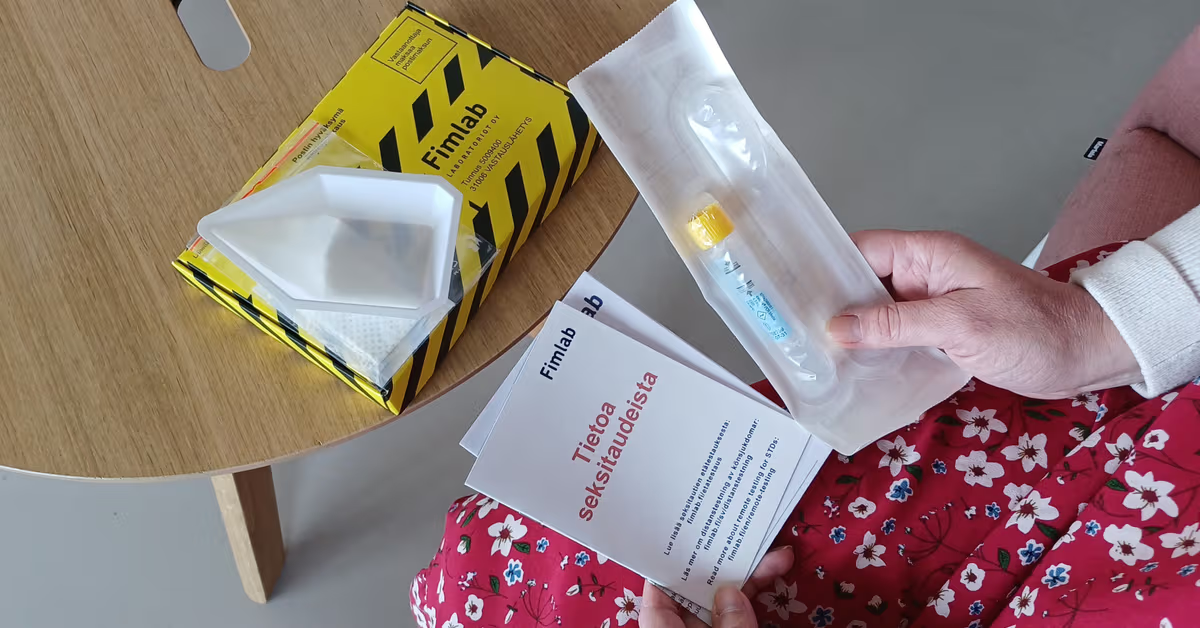
A new program targeting improved care access for sexual assault victims in rural and underserved communities uses at-home PCR tests to detect the three most common curable STIs and connect patients to treatment via telehealth.
587 words~3 min read