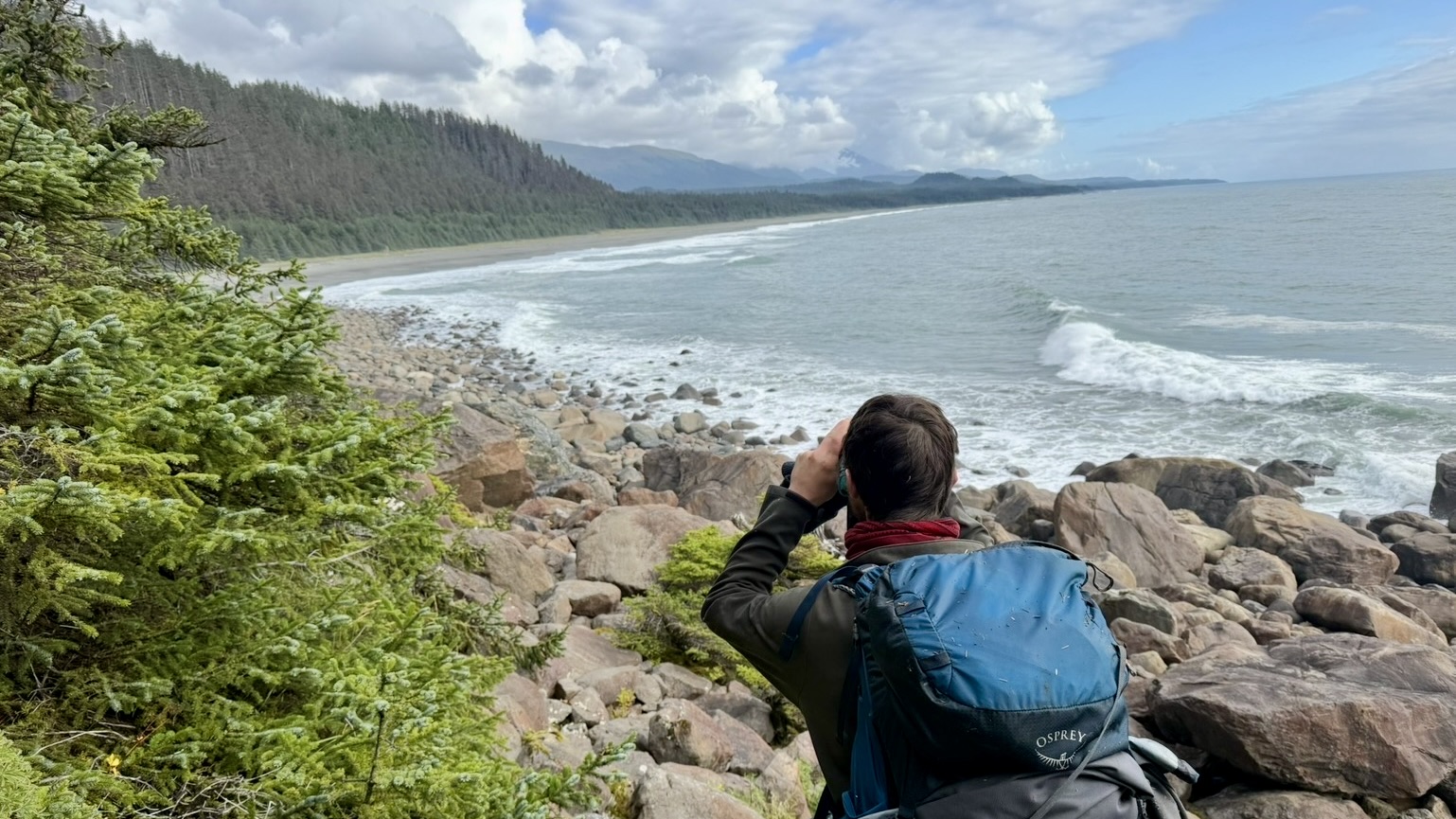
When the earliest humans began to migrate out of Africa, it didn’t take long before they ran into an ocean. Or a sea. Or a lake. Or a river — most of our planet’s surface is water, after all.For ancient humans, large bodies of water were both a hefty challenge to overcome, and a gift to the ones who learned to thrive near them.National Geographic Explorer Paul Salopek has been tracing the path of human migration out of Africa for the past 13 years, and he’s documenting his travels in the Out of Eden Walk project. Salopek joined The World’s Host Marco Werman from Alaska’s southern coast to talk about the role coastlines have played in migration.Marco Werman: Paul, you have been playing the part of coastal nomad for the past couple of weeks. What have your days been like? Have you been entirely on foot, or do you need some water transport to help you negotiate the fjords?Paul Salopek: Yeah, Marco, it’s been amphibious. It’s been walking very empty, wild beaches in Southeast Alaska, and then having to blow up a small boat called a pack raft that I carry in my backpack that has little lightweight paddles. It’s actually kind of mimics, possibly, early migrations. Using inflatable pack rafts to navigate glacial rivers in Alaska with walking partner Rowan Sharman.Paul Salopek/National Geographic, Out of Eden WalkYou’re carrying a boat in a backpack. That’s probably not too similar to what people used to do to navigate the water.Yeah, you know, they probably were using skin boats way up here in the far north, and then probably transitioned to wooden boats much further south. But yeah, modern technology allows these modern substances, plastics and whatnot.Coastlines, I mean, they are so obvious. There’s land, then land stops, then you face water. In your 13 years of doing this project, this is obviously not the first time you’ve encountered an ocean. What have you learned, though, about the importance of coastal ecology to early humans and humans today?This whole walking project is an interesting experiment in recreating the vast ancient dispersal that [occurred] in the Stone Age. And basically, my experience [mirrors], more or less, what scientists have been telling us in the latest research: that human beings often populated the planet along the interface between land and sea. Basically, we kind of beachcombed our way across an unmapped world. And this has two advantages. One is … you sort of have a direction to go in, right? You have a beach, or you have a coastline that gives you directionality. And the beauty of it is that you have two ecosystems to harvest food from. So, sometimes things wash up by the sea, or if you’ve developed hooks using the seashells, you can fish, and when the sea doesn’t give, you can pivot and turn inland. It’s actually a very clever way to move through the world.Tlingit salmon fishers Dylan Petersen and Paul Pavlik in Yakutat, Alaska. Paul Salopek/National Geographic, Out of Eden WalkYeah, and that coastal diet varies so much depending on which coast you are on. In Alaska, what stood out to you in the nourishment that comes from the water?Well, you know, I’ve got to admit I’m mainly eating freeze-dried packaged foods. For me, I’m having to make kilometers every day and pausing to fish or to subsistence hunt, while it would be fascinating, is something I frankly don’t have time for. But what I do see is a lot of the resources that ancient people used. There are tremendous shellfish beds along the rocky shores. And what’s really fascinating is that archeologists find what they call shell middens — basically feast sites where temporary camps or villages would gorge on shellfish. And you just find these big lenses, these big mounds of what they cooked, the shells that are left. And they’re all over the world along coastlines.Wow, that’s incredible. So, I know you had the chance to speak with some local archeologists in Alaska. Who did you meet, and what have you learned about the first humans to come from Asia over that land bridge to these waters you’re paddling and moving through?That’s a really hot topic for research. It seems that the public is really excited, or at least interested or fascinated, about the “first Americans,” quote unquote, right? The picture is quite complicated. There is no, at least at this stage in history, no very clear single pulse. You know, back when you and I were in school, the prevailing theory was that people walked over the Bering Land Bridge, right, and Siberia and Alaska were joined, sea levels were down. Now, they’re finding sites way down in Chile that are 12,000 to 14,000 years old. It’s just simply too far south and to have moved so quickly on foot. And now there are also maritime sites popping up right along coastlines. So, evidence points to both: Some people traveled on foot when the glaciers melted, [creating] a corridor. Others traveled probably by skin boat. And what’s fascinating, Marco, is they’re finding technological similarities between ancient people who lived in what is today northern Japan … Hokkaido … and the ancient people who left artifacts in what is today Alaska and northwest Canada.Frozen sea at sunset with a boat: the northeast coast of China.Paul Salopek/National Geographic, Out of Eden WalkYeah, so that would seem to scan with maybe other stories you’ve heard about humans living this coastal lifestyle on other continents. I mean, did you sense a thread?Yeah, absolutely. Absolutely. And again, it just makes sense. Think about it this way, through this long period of time, tens of thousands of years, the sea levels rose and sank like a heartbeat due to glaciation. And we’re talking very significant drops, more than a hundred meters. If you have a continental shelf, as there is one up here in Alaska, the shoreline of today’s shoreline would have been kilometers into the ocean. And so, a lot of these sites are probably underwater. And these kinds of continental shells provided basically a highway, a superhighway for migration. And this happened not just here in North America, but also way back in Africa, where I started. There’s a strait between the Red Sea and the Gulf of Aden called the Bab al-Mandeb that was probably a land bridge or at least a series of islands. So, people also island-hopped across shorelines.With a cargo camel at the edge of the Red Sea in Saudi Arabia.Paul Salopek/National Geographic, Out of Eden WalkYou wrote for National Geographic that, very early on in your walk, you and your guide in Djibouti encountered the Indian Ocean after 43 days of this global trek, and you stared at it for hours. Two questions that occurred to me. First of all, what was it about getting to the edge of land that felt so hypnotic?You know, it’s this sense that I think everybody who goes to the beach, even for a holiday, for a weekend, to read a book under a beach umbrella, or to go surfing, or just to take a stroll at sunset … it’s the sense of immense possibility, right? This immense horizon that just, you see the curvature of the earth, literally. And I spoke to a geneticist who decoded the DNA of Neanderthals, and he was joking with me, and said, “You know, when Neanderthals also walked the Earth and when they reached a shoreline, they either went left or right.” But something about Homo sapiens is different. There’s evidence that some Homo sapiens reached the shoreline and, instead of turning left or right, pushed a floating object into the surf. And they did it, you can imagine for centuries over many, many generations. And imagine how many never came back, but somebody reached an island. Or somebody might have reached another continent across a narrow strait. And he said, “That’s what makes Homo sapiens happy and special is we’re kind of crazy when we get, when we hit the beach.”Well, adjacent to that, part two of my question, what was the coastline that most tempted you to jump in and go swimming?Well, that one particularly. The one in Djibouti, because we had just, my Ethiopian and Djibouti walking partners, who were camel pastoralists, by the way, we had been walking through one of the hottest deserts in the world, the Afar triangle, where the temperatures are just astronomical. So, reaching a shoreline and the water was nice and warm. We both took a long dip, and I must say that our two cargo camels did not. They stood praising us skeptically from the shoreline.Parts of this interview have been lightly edited for length and clarity.Writer and National Geographic Explorer Paul Salopek has embarked on a 24,000-mile storytelling trek across the world called the “Out of Eden Walk.” The National Geographic Society, committed to illuminating and protecting the wonders of our world, has funded Salopek’s project since 2013. Explore the project here. Follow the journey on X at @PaulSalopek, @outofedenwalk.The story you just read is not locked behind a paywall because listeners and readers like you generously support our nonprofit newsroom. Now more than ever, we need your help to support our global reporting work and power the future of The World. Can we count on you?
How coastlines propelled ancient humans across the planet - The World from PRX
National Geographic Explorer Paul Salopek is a man on a mission: Travel across the world in the way the earliest humans out of Africa did. Lately, he's been hiking and paddling along Alaska's southern coast. He joins Host Marco Werman to share what he's learned about how coastal ecosystems helped our ancestors thrive as they populated the planet.
1,558 words~7 min read