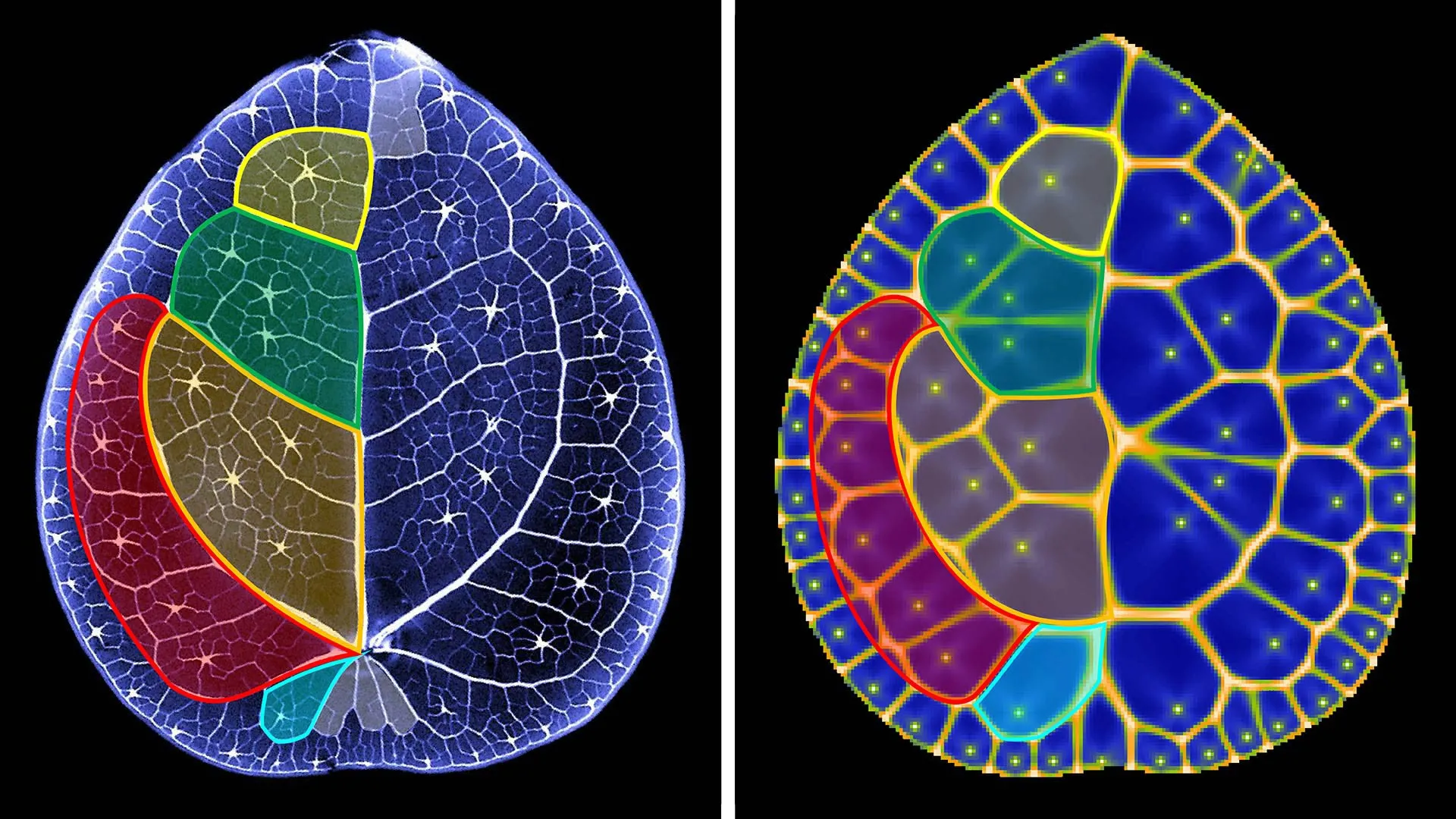
People often spot familiar shapes in random places. Maybe you have looked at the clouds and imagined a sailboat, a seahorse, or even your great-aunt Rosemary staring back at you. Scientists call this tendency to find meaningful patterns in randomness "apophenia." But in some cases, those patterns are very real. Cold Spring Harbor Laboratory Associate Professor Saket Navlakha studies the hidden structures that appear throughout nature.
One of the best known examples of organized patterning is the Voronoi diagram, a geometric system that divides space into separate regions around central points. A simple example would be school districts. Each district (region) is arranged so students are always closest to the school (central point) assigned to them.
"Voronoi diagrams have been used for centuries in a variety of applications ranging from city planning to network design," Navlakha says.
Patterns resembling Voronoi diagrams can often be seen in nature, including the markings on giraffes. However, these natural versions usually do not contain the obvious central points found in textbook examples. Navlakha and former graduate student Cici Zheng recently identified a rare exception in Pilea peperomioides, better known as the Chinese money plant.